



























EXPERT ANALYSIS- By Andrew Pike CBE
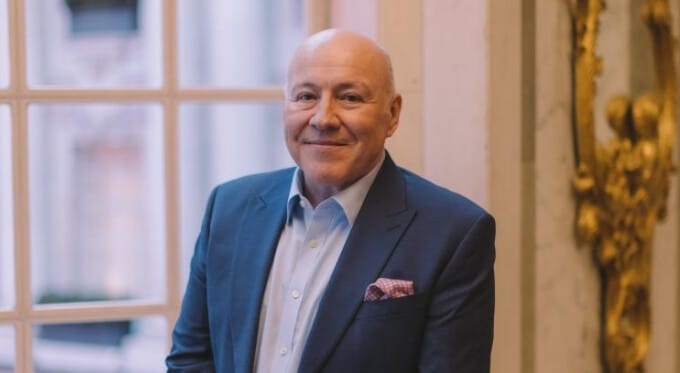
Andrew Pike CBE has spent his career inside rooms where words carry real consequences.
Join The European Business Briefing
New subscribers this quarter are entered into a draw to win a Rolex Submariner. Join 40,000+ founders, investors and executives who read EBM every day.
SubscribeNow recognised as an international relations & geopolitics expert, Andrew brings a rare view of crisis leadership: how governments prepare, how leaders make decisions under pressure, and why too many organisations still fail to plan for geopolitical, cyber and commercial shocks.
In this exclusive interview with the London Keynote Speakers Agency, Andrew discusses crisis decision-making, geopolitical risk, the end of traditional planning, and why the next generation of leaders must learn to find opportunity in uncertainty.
Question 1. At the highest levels of government, what enables leaders to stay calm, make decisions quickly and still think strategically during a crisis?
Andrew Pike CBE: “Crisis response and dealing with lots of things at once are largely about practice. There are techniques, but they are learnable.
“It is possible by having some structure to what you do. We did a horrible exam in the Foreign Office to get us to the senior levels, but what it made us do was embed behaviours. We learned how to do certain things so that they went into your muscle memory.
“You can practise that. In my teams, I used to make them go away and have a look at an Economist article, a really tough one about a real-world problem, and think about how they would carry that into something that had real-world effect.
“With all these things, they are learnable and practicable, so when you are in the situation itself, it becomes automatic.
“That is not to say you will not get decisions wrong sometimes. Something where there is less tolerance in government than in the private sector is so-called “fail fast”, the ability to take risks.
“All the best decisions I have taken in my life required risk. They have not always gone the way I wanted.
“But if you get those jigsaw pieces in place beforehand, you know you have the basic outline, the basic plan, and where you want to end up. You take a moment, have the clarity to compute that in your own brain and then convey it to people.
“There is very little you can do that is going to make the entire thing crash. You can course-correct. You can reverse if you really need to. You just need to do it in a mindful, planful way, with a bit of thought.”
Question 2. You have warned that many organisations still do too little scenario planning. How should leaders prepare for rapid geopolitical, commercial and security shocks?
Andrew Pike CBE: “In a number of companies I work with, there is very little planning at all.
“If you ask GPT to give you the major risks to your company, it will come up with a pretty good list immediately.
“I am constantly surprised. For example, if you are working in the international field, there are some obvious shape-shifters. We have all been through, or are going through, the Ukraine conflict at the moment. That has had a major effect on companies.
“This country has significant commercial links with China and so on. All that information is already out there. Boards, planning committees and individuals should make time and game that through.
“If X happened, we call it red teaming. We sit down and work out the three scenarios that could happen to my main export market, which is India, over the next three or four years. Work it out and have a contingency for it.
“That does not mean you need to be pulling the alarm buttons all the time. But it is about understanding that if the worst happens, or if there is a turn, you need to be prepared to respond in the moment.
“The best companies spend time and energy planning for that.
“It has been surprising to me, since I have been in the business world in a serious way, how really serious companies sometimes do not do that in the way you might expect.
“The same applies to cyber. Cyber and cyber threats are a massive risk to businesses at the moment, but they are not really urgent if you have not had one.
“There are some countries in the world, like America, being attacked with their military systems, and Canada had a major attack.
“In a way, Marks and Spencer and all that stuff is a good thing because it brings to people’s minds the devastating effect this stuff can have.
“Again, I am shocked by how many boards and company leadership teams put very scant preparation into this.
“As with so many things, they are all about judgement. They are often about very basic things that you could put in place that can mitigate very effectively.”
Question 3. What capabilities will matter most for the next generation of leaders operating in a far less predictable world?
Andrew Pike CBE: “The next generation of leaders are going to have to learn a whole new skill set from my advanced-age colleagues and myself.
“I was doing a little talk the other day, and I call it the end of planning. In the good old days, say in the Foreign Office where I was, we did a risk register every year and picked out the five things that were likely to make the world grind to a halt in the year ahead.
“We used to be able to do that quite effectively at one time because we could see the markers and plan very convincingly.
“We do not have that anymore.
“Leaders now are going to have to learn to work in the moment much more. They are going to have to rely on their own judgement much more. They are going to have to deal with the world as it is, with quite a short time frame, to make quite crucial decisions.
“They are going to have to transplant their minds and their brains into a mindset where that is going to be the norm.
“Living in America so long, I remember being there in the 2008 crash and being at a Wall Street dinner with a lot of really serious bankers. Everybody in the world was in turmoil because we thought the financial system was coming to an end.
“I remember them sitting around the table going, “Nope, we are going to find opportunity in this.”
“There was something about an energy in New York that we are all going to need in our commercial endeavours from now on. We are going to have to find that opportunity. We are going to have to see these things as an opportunity.
“We are just finding our way with AI. But I am a great believer in being optimistic and grabbing the positive parts.
“The same applies to this country. My last job in government was running the nation’s brand overseas. There is quite a lot to celebrate. There is still opportunity.
“The UK is a world power, a superpower. Our music, our art, our design, all that stuff.
“I think a bit of that Americana would do us no harm in how we come at business. That is not to be naive or to deny that there are real issues, but I think there is more opportunity than threat.
“Coming at these issues in that way is likely to bring a better result for you, your company, your organisation or you personally.”
This exclusive interview with Andrew Pike CBE was conducted by Tabish Ali of the Motivational Speakers Agency.