































Luxury retail has never pandered to convenience. It indulges desire. And desire doesn’t live on a screen. It lives in a feeling.
For all the investment in AI, automation, and hyper-personalized ads, Europe’s most successful luxury brands are doubling down somewhere unexpected: the physical world.
The truth? Digital drives discovery. But physicality drives devotion.
Join The European Business Briefing
New subscribers this quarter are entered into a draw to win a Rolex Submariner. Join 40,000+ founders, investors and executives who read EBM every day.
Subscribe
The Store Is the Strategy
Insights from Euromonitor’s ShopTalk Europe 2025 show that brick-and-mortar retail isn’t fading. It’s evolving.
Stores aren’t just transactional spaces. They’re immersive environments. And the numbers back it up. Euromonitor revealed that 81% of luxury sales still happen in-store.
That’s not a lag in digital adoption. It’s deliberate. Luxury thrives on sensory depth. Texture. Scent. Sound. Presence. None of that translates fully through a screen.
Brands that understand this aren’t replacing stores with tech. They’re elevating them.
Experience Is the New Status Symbol
Modern luxury consumers don’t just buy a product. They’re buying a moment. From flagship boutiques to curated pop-ups and branded cafes, the goal is to create something worth remembering.
A look at experiential retail trends in Found Associates’ analysis underlines a concrete shift. Consumers prefer spaces that engage emotionally, not visually.
Legacy brands are leaning in. Nespresso’s flagship boutique strategy encompasses physical spaces designed as immersive brand worlds, rather than retail outlets.
And then there’s the rise of hybrid luxury experiences. Think fashion cafes and curated lifestyle pop-ups. These are far from gimmicks. They’re strategic extensions of brand identity.
The result? Experience isn’t an add-on. It’s the product.
Digital Is Powerful, But It’s Not Enough
None of this dismisses digital. AI is reshaping retail at speed, according to McKinsey’s AI imperative in European retail. However, efficiency doesn’t equal emotion.
Luxury brands are recognizing that while AI can optimize operations, it can’t replicate human connection. That’s why brands are doubling down on storytelling, craftsmanship, and in-person engagement.
The Balance to Strike
- Use digital to anticipate
- Use physical to enchant
The brands winning right now do both, and they know which one closes the deal.
The Return of Tangible Luxury
There’s another player in the game: print.
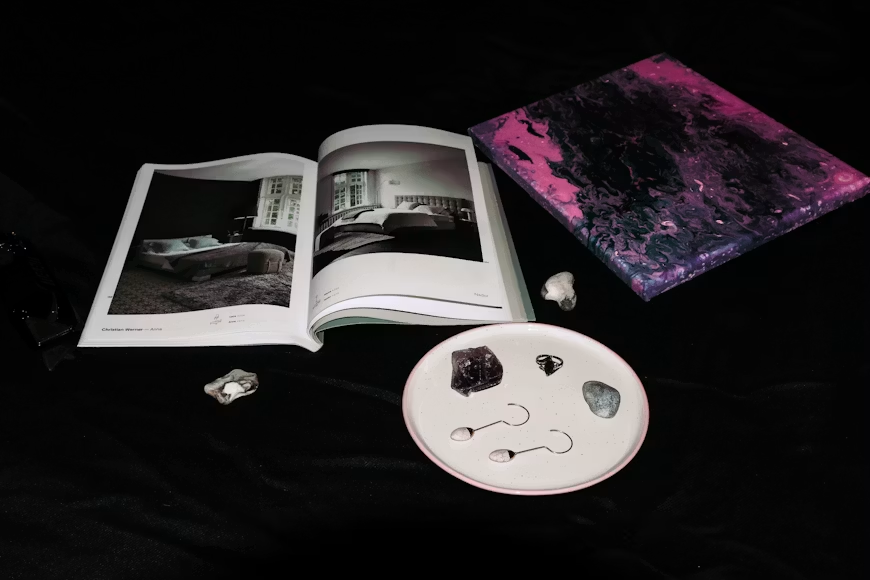
High-end catalogs are re-emerging as curated brand artifacts. A catalog agency can elevate premium catalogs through perception, design, paper quality, and narration.
They slow the customer down. They invite attention. And that’s exactly the point where tactile and digital don’t compete; they complement.
J.Schmid says that luxury brands need to rethink print as part of a broader omnichannel strategy. That’s where a catalog marketing agency comes in, because a catalog doesn’t fight for attention. It earns it.
“These lessons apply to businesses of all sizes: abandoning print entirely because ‘everything is digital now’ often leads to a case of multichannel regret.” – former print industry magazine editor, Heidi Tolliver-Walker, on printed catalogs.
Luxury’s Competitive Edge
Luxury has always been about scarcity. Not of product, but of experience.
Digital scales infinitely. Physical does not. That limitation is precisely what makes it powerful.
When a customer walks into a beautifully designed store, flips through a thoughtfully crafted catalog, or lingers in a branded cafe, they’re not interacting with a brand; they’re entering its world.
And in luxury, that world is everything.
FAQs
1. Why are luxury brands still investing in physical stores?
The majority of sales happen in-store, and physical environments create emotional connections that digital channels can’t replicate.
2. How does experiential retail impact customer loyalty?
Experiential retail builds memory and emotional engagement. These are key drivers of repeat purchases and brand affinity.
3. Is digital still important for luxury brands?
Yes. Digital drives discovery and personalization, but it works best when paired with high-touch physical experiences.
4. What role do catalogs play in modern luxury marketing?
They act as tactile brand extensions, offering a slower, more immersive way to engage customers and reinforce brand identity.
Key Luxury Retail Facts
| Insight | Source |
| 81% of luxury sales happen in physical stores | Euromonitor |
| Experiential retail increases customer dwell time and engagement | Found Associates |
| AI adoption is accelerating across European retail | McKinsey |
| Emotional value is becoming a key differentiator in luxury | Glossy |
Real-World Encounters
Luxury doesn’t compete on speed. It competes on significance.
As the industry rushes toward automation and AI-driven efficiency, it becomes harder to resist frictionlessness at the expense of feeling. In luxury, a little friction. A pause. A moment. An experience. This is where meaning is made.
The future isn’t digital versus physical. It’s digital supporting physical. The screen may spark interest, but real-world encounters cement desire.
For brand managers, the implication is to invest where emotion lives. That means reimagining stores as destinations. Treating print as a sensory channel. Designing every touchpoint to feel intentional, not optimized.
Because ultimately, luxury isn’t about access. It’s about immersion. And immersion will always be something you can’t download.