






























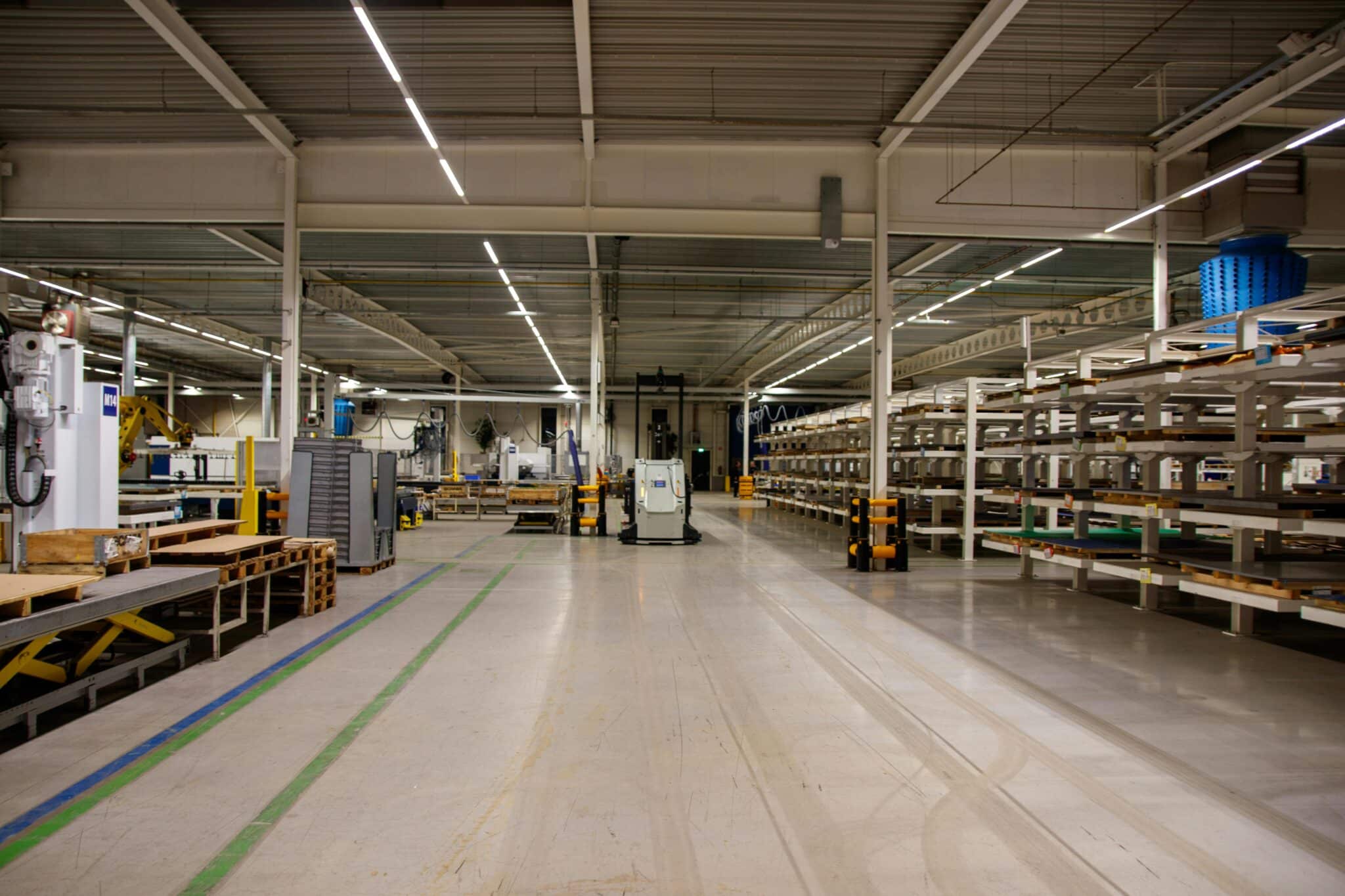
For many years, industrial lighting was treated as a technical necessity: a cost item that had to provide enough brightness for production halls, warehouses, workshops and logistics areas. Today, that view is changing. Across Europe, companies are under pressure to reduce operating costs, improve workplace safety, modernise ageing buildings and document progress in energy efficiency. In this environment, lighting is no longer just an electrical installation. It has become a strategic business decision.
Professional LED lighting can influence far more than electricity consumption. It affects visual performance, maintenance intervals, employee safety, operational reliability and the long-term usability of industrial buildings. For companies running production facilities, commercial halls or logistics sites, the right lighting concept can therefore support both financial and operational objectives.
Join The European Business Briefing
New subscribers this quarter are entered into a draw to win a Rolex Submariner. Join 40,000+ founders, investors and executives who read EBM every day.
SubscribeEnergy efficiency is only the starting point
The most obvious argument for LED modernisation is energy efficiency. In many industrial buildings, older lighting systems still use outdated technologies that consume significantly more electricity than modern LED luminaires. Replacing them can reduce energy demand and contribute to lower operating costs, especially in facilities where lighting runs for many hours per day.
However, energy savings alone do not describe the full value of a professional lighting upgrade. A poorly planned LED installation can reduce wattage but still create glare, uneven illumination, dark zones or uncomfortable working conditions. In industrial environments, that can lead to practical problems: reduced visibility at workstations, poor orientation in circulation areas, increased fatigue and avoidable safety risks.
This is why companies should not evaluate industrial lighting only by comparing watts, lumen output or product prices. The more relevant question is whether the lighting system supports the actual visual tasks inside the building. A production area, a machine zone, a loading bay and a warehouse aisle do not necessarily require the same light distribution, mounting height, glare control or level of uniformity.
Lighting quality affects safety and productivity
In industrial and commercial buildings, lighting has a direct impact on how safely and efficiently people can work. Employees must be able to recognise details, read labels, identify obstacles, operate machines and move safely through the building. Forklift traffic, high racks, reflective surfaces, dust, vibration and changing work processes can make this more complex than in standard office environments.
Professional lighting design therefore considers more than the nominal brightness of a luminaire. It also looks at uniformity, glare limitation, colour rendering, flicker behaviour, beam angle, mounting position and the condition of the building. Companies that work with experienced suppliers such as August Müller Lichttechnik AG can approach industrial lighting as a planned infrastructure decision rather than a simple product purchase.
For decision-makers, this is an important point. The cheapest luminaire is not necessarily the most economical solution over the full operating life. Frequent failures, poor thermal management, inadequate drivers or unsuitable light distribution can increase maintenance costs and reduce the value of the initial investment.
Reliability matters in demanding industrial environments
Industrial buildings often place higher demands on luminaires than standard commercial spaces. Heat, cold, dust, humidity or long operating hours can affect the durability of lighting systems. In such environments, component quality becomes a central factor.
Reliable LED lighting requires suitable LED chips, robust drivers, effective thermal management and housings that match the application. For outdoor areas, damp locations or dusty halls, the right protection rating is also important. If luminaires are installed in sports halls, agricultural buildings or production areas with special environmental conditions, additional requirements may apply.
This is why professional suppliers focus not only on luminous efficacy, but also on long-term operational reliability. In industrial and commercial buildings, lighting should be considered a long-term infrastructure investment rather than a short-term replacement product.
Planning reduces technical and financial risk
A major advantage of professional lighting projects is that they can be planned before installation. A lighting calculation can show how luminaires should be positioned, which beam angles are suitable and whether the required illumination levels can be achieved. This reduces the risk of over-lighting, under-lighting or installing luminaires that do not match the building geometry.
Planning is particularly important when companies modernise existing buildings. Mounting points may already exist, ceiling heights can vary, machines may cast shadows and different zones may require different lighting levels. A structured lighting concept helps to translate these conditions into a practical installation plan.
For facility managers and technical directors, this also makes budgeting easier. Instead of buying individual luminaires based only on unit price, companies can compare the total system: number of luminaires, installed power, expected maintenance effort, light quality and long-term suitability for the building.
Industrial lighting and ESG considerations
Energy efficiency, workplace safety and long-term asset performance are increasingly relevant in corporate sustainability strategies. While lighting is only one part of a company’s environmental footprint, it is often one of the more practical areas for improvement. Unlike large structural changes, a lighting upgrade can usually be implemented without redesigning the entire facility.
Modern LED systems can help reduce electricity consumption and maintenance-related resource use. Longer service life means fewer replacements, fewer service interventions and less disruption to operations. In buildings with extended operating hours, these effects can become financially significant over time.
From a reporting perspective, lighting modernisation can also be part of a broader energy-efficiency programme. Companies that operate multiple sites may benefit from standardising lighting quality, product reliability and planning methods across their facilities.
From product purchase to infrastructure decision
The most important shift in industrial lighting is the move from product purchasing to infrastructure thinking. Companies no longer need to ask only which luminaire is cheapest or brightest. They need to ask which lighting system best supports their building, their operating model and their long-term cost structure.
That includes questions such as: How long will the luminaires operate each day? Which areas require higher visual precision? Are there demanding environmental conditions? How important is maintenance access? Does the building require uniform illumination, glare reduction or special light distribution? Can the system be dimmed or adapted to future requirements?
When these questions are answered properly, lighting becomes a tool for improving building performance. It can support safer work, lower operating costs, better orientation and more reliable facility operation.
Conclusion
Industrial lighting is becoming more strategic because it sits at the intersection of energy efficiency, operational reliability, workplace safety and building modernisation. For European companies, the decision is no longer simply about replacing old lamps with new LED luminaires. It is about selecting a lighting concept that matches the building, the application and the long-term business objectives.
Companies that treat lighting as a planned infrastructure investment are more likely to achieve stable results: efficient operation, reduced maintenance effort, suitable illumination and a safer working environment. In that sense, professional LED lighting is not only a technical upgrade. It is part of a broader strategy for modern, efficient and resilient industrial buildings.