






























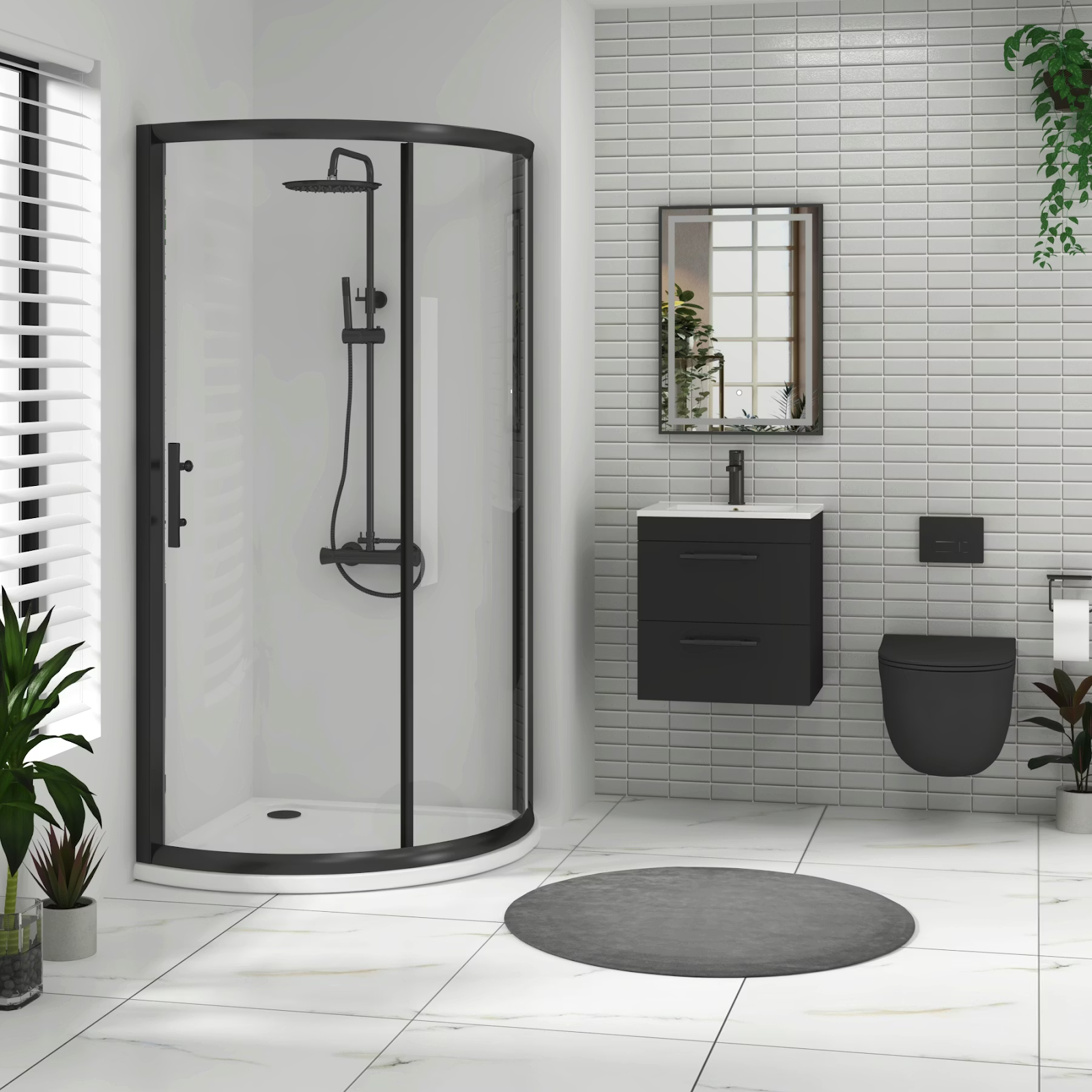
The secret reason hotel designers prefer curved quadrants over square cubicles is a combination of spatial psychology and clearance geometry. A quadrant shower enclosure removes the sharp corner that typically “dead-ends” a bathroom’s sightline, tricking the brain into seeing more floor space. Furthermore, the sliding doors of a quadrant require zero “swing room,” allowing designers to place basins and toilets much closer to the shower without risking a collision, a vital necessity in the compact bathrooms common across the UK. In this guide, I’m sharing the “insider” reasons why the curve is king and why your home renovation should follow the same logic.
1-The Curve Secret Behind Bigger Feeling Small Bathrooms
If you have ever stepped into a high-end boutique hotel in London or a luxury spa in the Cotswolds and wondered why the bathroom felt remarkably spacious despite its small footprint, you have likely encountered the “Curve Secret.” As a bathroom specialist who has spent years dissecting UK floor plans, I have noticed a distinct trend: professional hotel designers almost never use standard square cubicles. Instead, they opt for quadrant or offset quadrant shower enclosures.
This isn’t just an aesthetic choice. It is a calculated move to manipulate space, improve hygiene, and enhance the guest experience.
Join The European Business Briefing
New subscribers this quarter are entered into a draw to win a Rolex Submariner. Join 40,000+ founders, investors and executives who read EBM every day.
Subscribe2-The Psychology of Sightlines Explained
In interior design, sharp corners act as visual “stops.” When you walk into a small bathroom with a square shower, your eye hits the corner of the glass and immediately perceives the room as small and boxed in.
Hotel designers use Quadrant Shower Enclosures to remove this visual barrier. Because the glass is curved, the eye follows the arc smoothly around the room. This creates a “flow” that makes the floor appear to continue under and around the shower. By softening the footprint, the room feels airy and “infinite” rather than cramped. In the new year , as we lean into the “Midimalism“ trend, which focuses on warm, organic shapes, the curved quadrant is the perfect tool to replace the clinical, harsh lines of traditional square units.
3. The “Elbow Room” Paradox
One of the biggest misconceptions in UK home DIY is that a square shower provides more room. It feels logical: a 900mm x 900mm square has more total area than a 900mm quadrant. However, hotel designers understand the “Showering Arc.”
When you shower, you don’t stand in the corners; you stand in the centre and move your arms in a circular motion to wash your hair or reach for soap. A square shower has “dead space” in the corners that you never actually use, but it takes up vital floor space in your bathroom.
A Quadrant Enclosure keeps the space where you actually move and cuts away the corners you don’t need. Even better, an Offset Quadrant Enclosure (for example, a 1200mm x 800mm model) provides a massive internal “runway” that feels like a five-star wet room, while still using a curved front to save the room’s external floor space.
3. The Death of the “Basin Clash”
UK bathrooms are notorious for being narrow. In a standard 1930s semi-detached house, the shower, basin, and toilet are often squeezed onto a single wall.
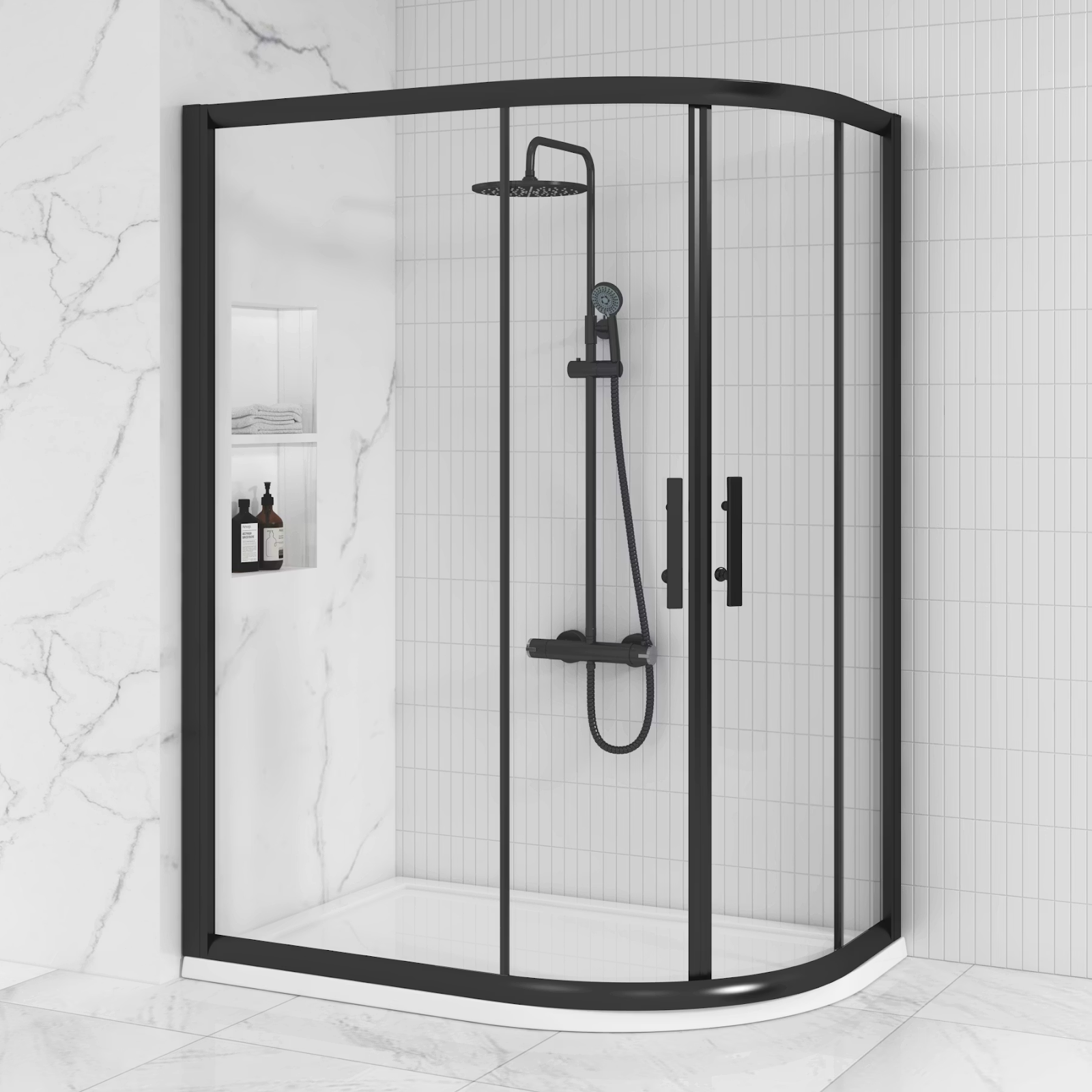
If you install a square cubicle with a pivot or bifold door, you have to leave a “buffer zone” so the door doesn’t hit the sink. Designers hate wasted buffer zones. The quadrant and Offset Shower Enclosures use sliding doors that stay within the frame of the shower itself. This allows a hotel designer to place a vanity unit just centimetres away from the shower glass. By using a curved front, you gain what I call “The Swing Space” , the vital 10cm to 20cm of floor area that allows a bathroom door to open fully or a person to stand comfortably in the mirror.
Quadrant vs. Square Cubicles At Glance
| Feature | Square Cubicle | Quadrant Enclosure | Offset Quadrant |
|---|---|---|---|
| Visual Impact | Boxy and restrictive | Soft and flowing | Luxury “Stretch” Look |
| Door Type | Often Pivot (needs space) | Sliding (zero swing) | Sliding (zero swing) |
| Cleaning | Sharp $90^\circ$ silicone traps | Smooth, easy-wipe curve | Smooth, easy-wipe curve |
| Best For | Large, open rooms | Small Ensuites / Cloakrooms | Replacing a 1700mm Bath |
4. The Hygiene Win for Curves
Hotels prioritise “Turnover Time” how fast a room can be cleaned to perfection. Square showers are a maintenance nightmare because of the Black Mould Dead Zone.
Mould thrives in corners where silicone is thickest, and airflow is lowest. In a square cubicle, the corners are difficult to reach with a squeegee or a cloth.
A Quadrant Shower, however, has a continuous, smooth surface. Most modern quadrants now feature “Quick Release Rollers“ at the bottom, allowing the doors to tilt inward so you can clean the entire track in seconds. For hotel owners, this means fewer mold complaints; for you, it means less time scrubbing with a toothbrush on a Saturday morning.
5. Heat Retention and the “Draft-Free” Experience
In the UK, we often struggle with drafty bathrooms. Hotel designers know that a walk-in shower looks great, but can feel cold because there is no enclosure to trap the steam.
The curved glass of a Quadrant Enclosure acts as a natural heat trap. The shape helps circulate the warm air around your body rather than letting it escape into the rest of the room. By choosing an Offset Quadrant, you get the best of both worlds: the spacious feel of a walk-in shower but with a fully enclosed, steam-trapping glass arc that keeps the “showering zone” warm and luxurious.
6. Property Value Addition
If you are renovating with an eye on house resale value , the Offset Quadrant is your best friend. Many UK homeowners are currently “de-banning” by removing an old, unused 1700mm bathtub to create a more functional shower space.
A standard square shower in a large gap looks like an afterthought. However, a 1200mm Offset Quadrant fits perfectly into the footprint of an old bath. It fills the space purposefully and creates a “Master Suite” feel that immediately adds to the property’s appeal. It signals to potential buyers that the bathroom has been architecturally designed, not just “fitted.”
The Installer’s Final Checklist for Quadrant Enclosure
Before you follow the hotel designers’ lead, keep these three “Personal Experience” tips in mind to ensure a perfect fit. In the UK, the standard radius for a quadrant tray is 550mm. Always ensure your enclosure and your tray match. If you buy a “Universal” shower enclosure and a “Specific” tray from different suppliers, the curve might not align, leading to leaks. If you live in a hard water area like London or the South East, look for easy clean nano-coated glass. Because quadrant glass is curved, water naturally tensions differently on the surface. A coating ensures that the water “beads” and rolls off, preventing that cloudy limescale haze. Remember that Offset Quadrants are “handed” (Left-Hand or Right-Hand). Stand with your back to the wall where the shower will go. If you want the long side to extend to your left, you need a Left-Hand unit.
Conclusion
The secret is out: hotel designers choose curved quadrants because they solve the physical and psychological problems of the small bathroom. They provide more elbow room, better hygiene, and a visual “flow” that sharp corners simply cannot match.
If you are looking to turn your bathroom into a 2026 sanctuary, stop thinking in squares. Whether you choose a standard Quadrant for a tight corner or an Offset Quadrant to replace a bath, you are choosing a design that prioritises your space and your comfort over a rigid, boxy tradition.