

























HANGZHOU, 24 August 2026 — EBM NEWSDESK ANALYSIS — Brad Adams
Alibaba is raising $10.2bn from investors and has promised to spend virtually all of it on artificial intelligence. Behind the record Hong Kong share sale is a much larger wager: that the company best known for ecommerce can become one of the infrastructure providers of the global AI economy.
A $10bn cheque for AI
Alibaba has chosen an unusually direct way of demonstrating how seriously it takes artificial intelligence: it is raising HK$80bn, or about $10.2bn, in new equity, and intends to devote all of the net proceeds to AI.
Join The European Business Briefing
New subscribers this quarter are entered into a draw to win a Rolex Submariner. Join 40,000+ founders, investors and executives who read EBM every day.
SubscribeThe Chinese technology group is issuing 710mn new shares at HK$112.70 each, an 8.4 per cent discount to the previous Hong Kong close. The shares will represent roughly 3.6 per cent of the enlarged company, making the transaction the largest primary follow-on offering by a Hong Kong-listed company.
Investors were less enthusiastic about the immediate dilution. Alibaba shares fell as much as 10 per cent in Hong Kong on Monday, exposing the tension now running through global technology markets: enthusiasm for AI remains enormous, but shareholders increasingly want evidence that extraordinary expenditure will eventually produce extraordinary returns.
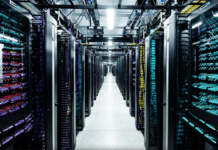
That tension matters because Alibaba was already spending heavily. The company previously committed more than Rmb380bn — roughly $56bn — to AI and cloud infrastructure over three years. Its strategy stretches across chips, computing capacity, data centres, large language models and applications, building on the international infrastructure expansion EBM examined when Alibaba Cloud announced new data centres and overseas expansion plans.
Profit falls as spending accelerates
The latest results show just how expensive that transformation is becoming. Alibaba’s capital expenditure rose 75 per cent year-on-year to Rmb67.7bn, close to $10bn, in the June quarter alone. Net profit fell 75 per cent to Rmb10.5bn, even as overall revenue increased 9 per cent.
Yet there are signs that AI is becoming a commercial business rather than simply a technological ambition. AI Cloud and Compute Services revenue climbed 45 per cent to about $7.1bn, while adjusted earnings at the cloud division increased 133 per cent. Alibaba says AI-related product revenue has now recorded triple-digit growth for 12 consecutive quarters.
That gives Alibaba an advantage over standalone model developers. Ecommerce provides customers, cash flow and data; Alibaba Cloud provides computing infrastructure; and its Qwen family gives the group an increasingly important position in open-source AI. EBM has previously examined how China could pull ahead in the global AI race, where infrastructure scale is becoming as important as the models themselves.
China’s AI arms race gets more expensive
Alibaba is hardly alone. Tencent, Baidu and specialist Chinese AI companies are spending heavily as Beijing seeks greater technological self-sufficiency amid US restrictions on advanced chips.
But Alibaba’s ambition is broader: to become a full-stack AI company, supplying everything from computing infrastructure to foundation models and enterprise applications. Qwen is central to that strategy, while Alibaba has increasingly demonstrated its technology outside China, including through deployments examined by EBM around AI and cloud technology at Milano Cortina 2026.
For Europe, the numbers are revealing. Alibaba is raising more than $10bn in a single transaction primarily to fund AI. That illustrates the capital gap confronting a continent already struggling to keep pace with America and China — a problem explored in EBM’s analysis of why Europe is losing the race for AI leadership and its increasingly urgent debate over European technology sovereignty.
Now Alibaba has to prove the returns
The difficult part begins now.
Alibaba has provided investors with unusually specific expectations around the economics of its AI spending, targeting roughly a three-year payback period and mid-teen returns. The $10.2bn placement was nevertheless heavily demanded, with orders reportedly approaching three times the amount available.
That suggests investors are willing to tolerate dilution — for now — if Alibaba can turn spending into sustained cloud growth.
The company therefore enters the next stage of the AI race with something many challengers lack: a huge existing consumer business, one of Asia’s largest cloud platforms, a rapidly growing model ecosystem and another $10bn of shareholders’ money.
Alibaba’s AI strategy is becoming easier to understand.
It is also becoming considerably more expensive.






