





























Every parent who has ever driven with a baby in the back seat knows the feeling — the urge to glance in the rear-view mirror every thirty seconds, wondering if your little one is sleeping peacefully, crying silently, or has wriggled out of the harness. Family road trips are one of the great joys of life, but when you’re behind the wheel and your baby is rear-facing behind you, that joy is tangled with a very real anxiety. According to the World Health Organization, road traffic injuries are a leading cause of death among children, yet the vast majority of car accidents involving distracted drivers are preventable. The solution isn’t to stop travelling with your family — it’s to travel smarter. In 2025, the most practical upgrade any family car can have isn’t a bigger screen or a fancier sound system. It’s a dedicated baby car camera.
The Unique Challenge of Travelling With Young Children
Why the Back Seat Feels Like a Blind Spot
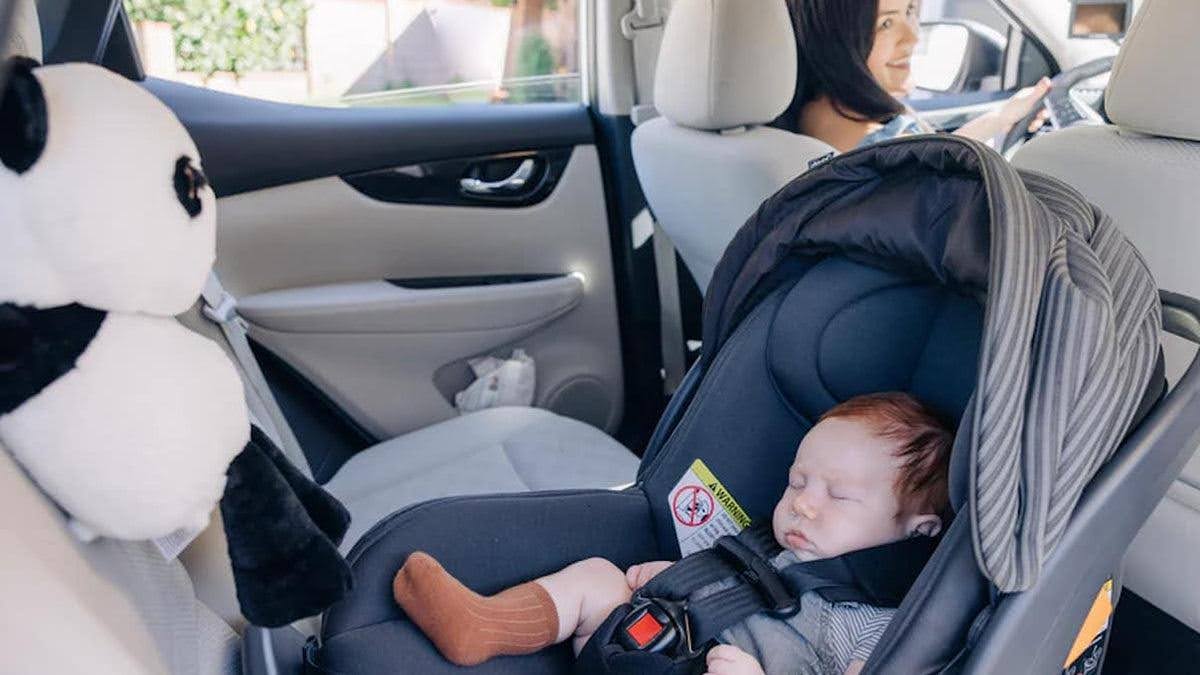
Modern child safety guidelines across Europe and North America require infants and toddlers to be seated in rear-facing car seats until they reach the maximum height and weight limits — typically until around two to four years of age. This is the safest position for a child in a crash. However, it creates an unintended problem: the child is facing away from you and, in most vehicles, completely out of your natural line of sight.
Your standard rear-view mirror might let you glimpse the back seat, but it won’t show you a rear-facing infant clearly. The angle is wrong. The mirror is too small. And in low light — driving at dusk, through a tunnel, or during a long overnight journey — it becomes virtually useless. Parents routinely crank their necks, lean sideways, or even pull over repeatedly just to confirm their baby is okay. Every one of those moments is a distraction from the road.
Join The European Business Briefing
New subscribers this quarter are entered into a draw to win a Rolex Submariner. Join 40,000+ founders, investors and executives who read EBM every day.
SubscribeThe Emotional Cost of Not Knowing
There is also a psychological dimension that doesn’t get discussed enough. Parental anxiety during car travel is real, and it has a measurable impact on driving quality. When you don’t know what’s happening behind you, your mind fills in the gaps — often with worst-case scenarios. Is she choking? Has he slumped over in his seat? Is she too hot? These unanswered questions create a low-level cognitive load that fragments attention and slows your reaction time on the road.
The goal of safe family travel isn’t just to protect your children — it’s also to protect your ability to drive well. That means keeping your eyes forward and your mind clear, which only happens when you have reliable information about what’s happening behind you.
Why a Mirror Is Not Enough
Many parents are now switching from traditional mirrors to a dedicated grownsy baby monitor setup for clearer visibility and a less stressful driving experience.
The Limitations of Traditional Baby Mirrors
The first generation solution to the rear-facing dilemma was the clip-on baby mirror — a large reflective panel strapped to the rear headrest so parents could see their baby via the rear-view mirror. Millions of families have used them, and they are better than nothing. But they come with significant limitations that are worth examining honestly.
First, the image you get is twice-reflected — once off the baby mirror, once off your rear-view mirror — which makes it small, distorted, and difficult to read quickly. Second, these mirrors are often positioned to show the baby’s general shape rather than a clear view of their face. Third, and most critically, in anything less than daylight conditions — during evening drives, in underground car parks, or when passing through tunnels — a passive mirror goes completely dark. You see nothing.
Beyond the image quality, there is a practical safety concern: aftermarket clip-on mirrors can become projectiles in an accident if they are not properly secured. Several road safety organisations have raised concerns about their installation standards, and they are not subject to the same crash testing requirements as other in-vehicle equipment.
What Modern Technology Makes Possible
A dedicated baby car camera takes an entirely different approach. Rather than relying on reflected light and your ability to interpret a distant, angled mirror image, a car camera produces a direct, wide-angle, real-time video feed displayed on a screen mounted within your natural field of vision — typically on the dashboard or clipped to the front windscreen. The experience is fundamentally different: instead of squinting at a dim reflection, you glance at a clear, well-lit image, the same way you would glance at your speedometer or navigation screen.
The Key Benefits of a Baby Car Camera
Crystal-Clear Visibility in Any Light Condition
The most important advantage of a dedicated camera system is infrared night vision. This technology uses invisible infrared light to illuminate the back seat and produce a clear greyscale image even in total darkness. Whether you are driving home late from a family dinner or on an overnight road trip across Europe, you can see your baby’s face, check their head position, and confirm they are breathing comfortably — without waking them or disturbing the journey.
This is simply not possible with a passive mirror. It is one of those genuine technology upgrades that once you have experienced it, you cannot imagine travelling without it.
Wide-Angle Coverage for the Whole Back Seat
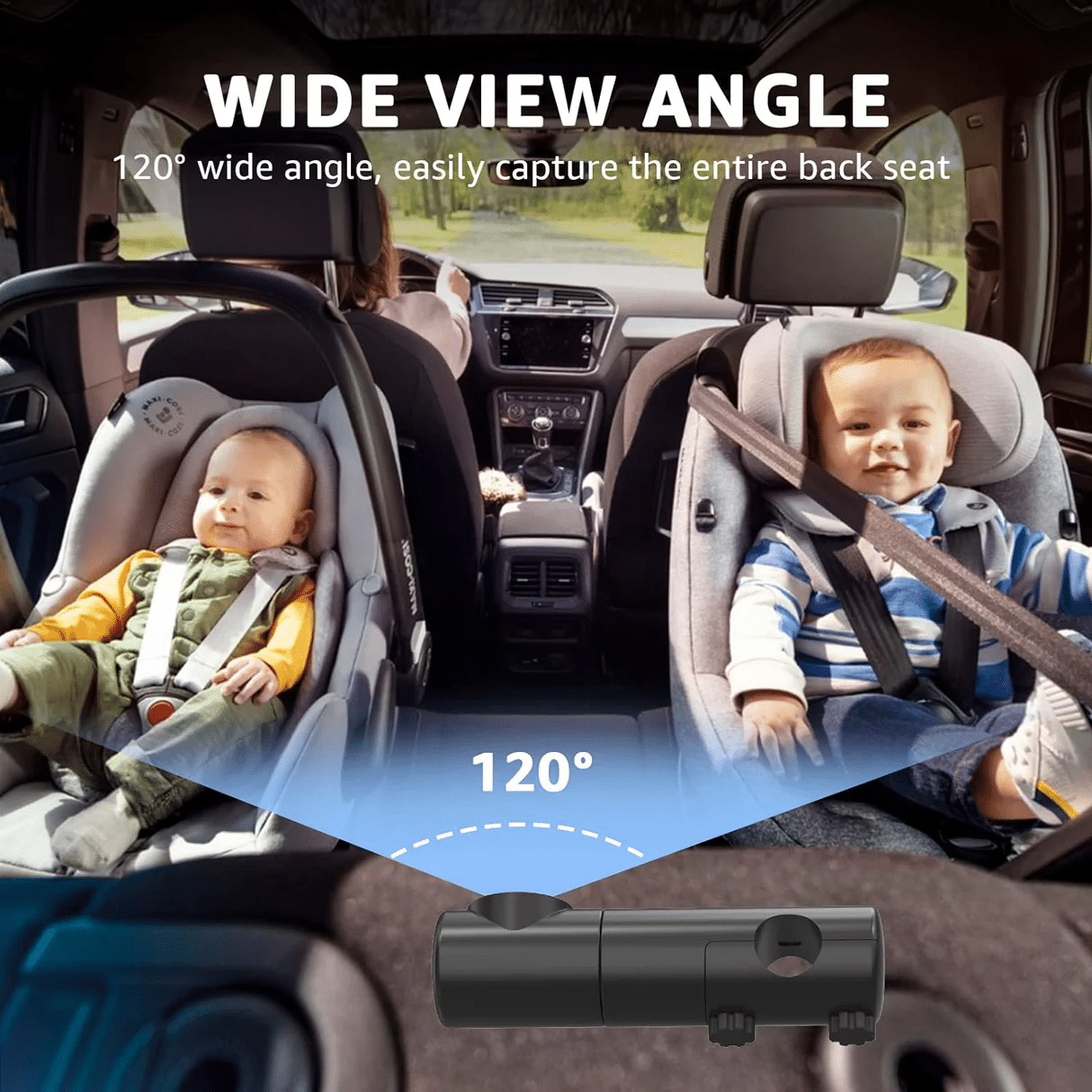
Many baby car cameras offer a lens angle of 150 degrees or wider, meaning a single camera can cover the entire rear seat. For families with multiple children — a baby in a rear-facing seat and a toddler or older child next to them — this means you have visibility of everyone at once. You can see if the toddler is trying to hand the baby something dangerous, if a water bottle has fallen, or if anyone is in distress. The coverage a wide-angle camera provides simply cannot be matched by a mirror of any size.
A Screen in Your Sightline, Not a Neck Strain
Car camera systems pair the rear-facing lens with a display screen that mounts at eye level near the driver. This design keeps your head facing forward. The glance required to check the camera feed is no different in biomechanical terms from checking your side mirror — a brief, controlled movement that does not compromise your situational awareness. Compare this to craning your neck to check a clip-on mirror, which takes your eyes off the road for a full second or more, and the safety difference becomes clear.
For families considering their options, exploring the range of best baby car camera systems available today is a worthwhile starting point. Modern units are designed to install simply, with magnetic mounts, rechargeable batteries, and swivel screens that fit a wide range of vehicles without permanent modification.
Two-Way Audio for Comfort and Communication
Many premium camera systems include two-way audio, which allows you to hear your baby clearly and, in some models, to speak to them from the front seat. The ability to hear a cough, a cry, or a change in breathing rhythm — and to soothe your baby with your voice without pulling over — is a practical benefit that reduces both parental stress and the number of unnecessary stops on a long journey. For parents who frequently drive solo with their baby, this feature alone is transformative.
Temperature Monitoring for Safety in Warm Climates
Heat is a serious risk for young children in vehicles. In Europe’s increasingly warm summers — with heatwaves affecting countries from Spain to Scandinavia — the temperature inside a stationary car can rise dangerously within minutes. Some baby car camera systems include a rear-seat temperature sensor that displays a live reading on the front screen. This means you are immediately aware if the cabin is warming too quickly, allowing you to respond before your child is affected.
Choosing the Right Car Camera: What Families Should Look For
Resolution and Image Quality
Not all cameras are equal. Look for a system that offers at minimum 720p resolution on the display, with a clear and stable image during vehicle movement. Some systems use a rolling shutter that produces a jittery image on bumpy roads — this is uncomfortable to look at and reduces the practical usefulness of the camera. A quality sensor with good vibration stabilisation is essential for daily use on European roads, which vary considerably in smoothness.
Night Vision Performance
Test or review night vision performance before purchasing. Infrared illumination should produce a clear, well-contrasted image rather than a washed-out or heavily grainy one. The distance from the camera to your rear-facing baby seat is typically one to two metres, and any decent system should handle this distance with clarity.
Screen Size and Positioning
The display screen should be large enough to read comfortably at a glance — generally four inches or above — but not so large that it obstructs your forward view. The mount should allow you to angle the screen precisely and hold its position on bumpy roads. Magnetic and clip-on mounts that attach to the sun visor or windscreen post are popular and practical.
Battery Life and Charging
Wired systems that draw power from the car’s USB or 12V socket are the most reliable for regular family travel. Battery-powered cameras offer flexibility but need monitoring, especially on long journeys. Check that any system you choose has a continuous-use capability of at least four to six hours to cover a typical day’s driving without interruption.
Ease of Installation and Adjustment
The best baby car camera is one that actually gets used every journey. If installation is complicated or the camera requires recalibration every time you change cars, it will end up in a drawer. Look for systems that mount securely in under five minutes and can be transferred easily between vehicles — particularly relevant for families who share cars or use rentals when travelling abroad.
Practical Tips for Using a Car Camera on Family Road Trips
Position the camera at your baby’s chest and face level.
Mounting the camera at the headrest of the baby’s seat gives you the most useful angle — you can see their face, hands, and upper body, which is where the most important safety signals are. Pointing the camera at the back of the seat tells you very little.
Adjust your front screen before setting off.
Take thirty seconds before each journey to confirm the display angle is correct and the image is clear. Doing this while stationary means you won’t need to fiddle with it while driving.
Use audio monitoring during night driving.
If your baby is sleeping and you are on a long night drive, having the audio monitoring active means you will hear any change in their breathing or any stirring without needing to glance at the screen continuously. This keeps your attention on the road where it belongs.
Keep the screen brightness low after dark.
A bright screen in a dark cabin is a visual distraction. Most camera displays allow brightness adjustment — reduce it at night to a level where the image is clear but not glaring, just as you would dim your navigation screen.
Pair the camera with a well-fitted car seat.
A camera is a monitoring tool, not a substitute for correct car seat installation. Always ensure your child’s seat is correctly fitted, that the harness is snug, and that the chest clip sits at armpit level. The camera gives you peace of mind; the car seat provides the protection.
Family Travel With Confidence: The Bigger Picture
There is a version of family travel that feels like an endless series of anxious glances, pulled-over moments, and fraying nerves. And there is a version that flows — where you drive with genuine focus, enjoy the conversation or the music, and arrive at your destination feeling like a competent, calm parent rather than an exhausted one. The difference between those two experiences is often not the destination or the itinerary. It is the quality of the information you have about your baby during the journey.
Clear, real-time visibility of your child is not a luxury. In an era where we have invested enormous effort in making children safer in cars — through better seat designs, better harness systems, better road infrastructure — it makes little sense to leave parents straining to see their babies through inadequate mirrors, guessing and hoping through every motorway mile. A car camera closes that information gap. It makes anxious drivers into calm drivers, and calm drivers are safer drivers for everyone on the road.
Family travel across Europe is one of life’s great gifts. Weekend breaks to the Loire Valley, summer drives through the Scottish Highlands, Christmas road trips to the Alps — these are the experiences children remember and parents cherish. A baby car camera is not a barrier to that kind of travel. It is what makes it possible to do wholeheartedly, without the constant background hum of worry that used to accompany every journey with a rear-facing infant in the back.
Conclusion
Travelling safely with a baby and young family demands more than good intentions — it requires good tools. The passive clip-on mirror, while better than nothing, represents a compromise that modern technology has now made unnecessary. A dedicated baby car camera offers clear, wide-angle, night-vision-capable visibility of your child, placed where you can see it without taking your eyes off the road, with audio support and in many cases temperature monitoring built in. The result is a calmer driver, a better-monitored child, and a family trip that is safer and more enjoyable for everyone aboard. For any parent who regularly drives with a baby or young children, upgrading to a proper car camera system is one of the most straightforward improvements you can make to family travel safety today.






