






























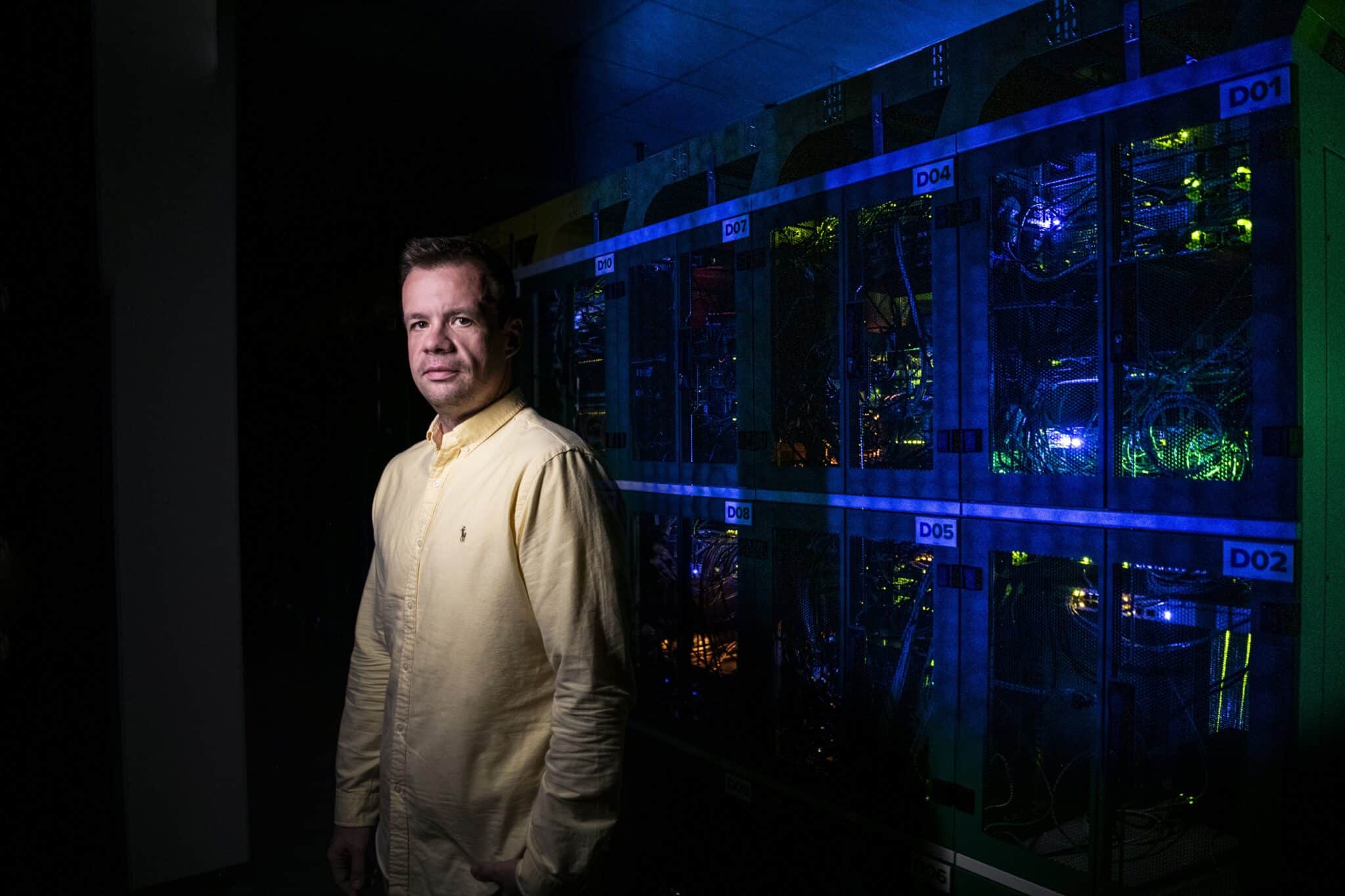
Damir Špoljarič (Pictured), founder of Gi21 Capital
You’re preparing to launch a pan-European institutional fund to build one of Europe’s largest AI data centre platforms. Could you walk us through the structure — the target LPs, the timeline, and what the capital will actually build?
Join The European Business Briefing
New subscribers this quarter are entered into a draw to win a Rolex Submariner. Join 40,000+ founders, investors and executives who read EBM every day.
SubscribeGi21 is preparing to launch a dedicated infrastructure platform to develop Europe’s largest AI-ready data centre network, complete with approximately 720MW of total IT capacity across multiple sites in Europe.
How far behind is Europe on AI compute right now — in GPU capacity, in data centre energy, in raw infrastructure — and what is the cost of not closing that gap by 2028?
Europe isn’t behind in talent, models or applications, it’s behind in the physical layer underneath them. Today the EU hosts only around 5% of global AI compute capacity, against roughly 75% in the United States. And the facilities we do have were largely built for traditional cloud workloads: only about one in five European data centres is technically ready for modern AI, because most can’t support the power density next-generation GPUs demand.
The demand side is moving fast. European data centre demand is forecast to roughly triple — from around 10GW in 2023 to 35GW by 2030 — which McKinsey estimates requires $250–300 billion of infrastructure investment. The problem is timing. Most organisations are still experimenting with AI rather than deploying it at scale, but data centres, power systems and grid connections take years to develop. In Europe’s largest hubs, grid-connection waits already run seven to ten years. You have to build for demand before it fully materialises, or you simply won’t have the capacity when it arrives.
If Europe doesn’t close that gap, the cost isn’t only economic. Compute is becoming a strategic asset, and a continent that can’t supply its own will be structurally dependent on US and Asian providers for infrastructure its banks, hospitals, researchers and governments increasingly run on. Recent events have shown how quickly that kind of dependency can turn into a vulnerability. Closing the gap by 2028 is about resilience and sovereignty as much as growth.
What do investors and founders consistently get wrong about scaling deep tech and infrastructure businesses in Europe specifically?
They often underestimate operational complexity and assume that capital is the main challenge. Building a data centre is a multi-variable problem that overlaps with energy access, regulation, permitting, execution, and experience. In practice, this requires juggling energy pricing, grid access, cooling strategy, latency, environmental risks, scalability, and the local legal framework. Europe adds another layer of complexity because every country has different regulations, energy markets, and permitting processes.

You built the only data centre in Europe to hold 100% uptime for over a decade, then exited VSHosting to Contabo at unicorn status. What did that operational experience teach you that a pure financier wouldn’t know?
Building and operating a data centre teaches you that reliability is simultaneously a design and operations problem. When we built the VSHosting data centre, we deliberately engineered additional redundancy into critical systems and focused heavily on operational processes. It also taught me that the biggest risks are often operational rather than financial. In both aviation and data centres, the human factor is the biggest variable, which is why we adopted aviation-style checklists, procedures, and automation. An operator has to live with those decisions every day, so you think about what happens at 3 a.m. during a major malfunction, not just how a system performs on paper. Our experience lends us a more intense approach to reliability, risk management, and long-term operations.
Gi21 backs more than 25 companies worth a combined $4 billion-plus using founder capital rather than a traditional LP fund. Why does founder-led capital outperform conventional VC — and why are you now moving toward an institutional fund structure?
Founder-led capital comes with its own incentives and obligations. At Gi21, we invest our own capital to avoid the LP pressure, artificial fund lifecycles, and layers of corporate bureaucracy. This allows us to move quickly and stay aligned with founders for the long term.
We also approach investing from an operator’s perspective. We have built, scaled, and exited companies ourselves, so we understand what it takes to go from the first customer to institutional scale. We go beyond providing capital and share the playbooks, networks, and operational experience we’ve accumulated over the years building our own businesses.
Our focus on AI infrastructure makes sense in light of my background and Gi21’s investment strategy. Having spent more than 20 years building and operating digital infrastructure businesses while investing across AI, DeepTech, and cloud technologies, we see infrastructure as perhaps the biggest opportunities in the AI market. Developing high-density, sovereign AI infrastructure at scale requires a different level of capital, which is why we’re preparing to launch a dedicated infrastructure platform to develop Europe’s largest AI-ready data centre network.
You started VSHosting at 17. If a 17-year-old in Prague, Warsaw or Madrid messaged you today wanting to build the next European infrastructure unicorn, what would you tell them to do — and what to ignore?
First, actually start. Build something real and put it in front of a paying customer as fast as possible. I learned more in the first year of running VSHosting, dealing with real customers and real outages, than any amount of planning could have taught me. Operating a business is the education, and you don’t need anyone’s permission or a particular degree to begin.
Second, fall in love with the unglamorous parts. Infrastructure rewards people who care about reliability, unit economics and how the system behaves at three in the morning — not people chasing the most fashionable layer of the stack. Pick a hard, durable problem you genuinely understand, stay close to your customers, and let them tell you what to build rather than relying on your own assumptions. And find operators who have actually built and run businesses to learn from; that experience is worth more than almost any other input.
What to ignore? The hype cycle, and the idea that raising money is an achievement. Funding is fuel, not a finish line. Plenty of well-funded companies never build anything that lasts. Ignore the pressure to scale before the thing actually works, and ignore vanity metrics and headlines. I’d also ignore anyone who says you have to be in Silicon Valley to build something global — we built a unicorn from Prague. Europe has the talent, the customers and now the strategic need, especially in infrastructure. Think in decades, not funding rounds, and just start.