






























Higher taxation, stricter bonus rules and intense competition are forcing online casinos to reconsider how they attract and retain customers. In an increasingly crowded market, daily promotions are becoming one of the industry’s most important competitive tools.
The British online casino market is entering a more demanding period.
Operators are facing higher taxation, tighter rules governing promotional offers and a customer base with access to a large number of competing gambling websites. At the same time, many online casinos offer broadly similar games from the same major software providers.
Join The European Business Briefing
New subscribers this quarter are entered into a draw to win a Rolex Submariner. Join 40,000+ founders, investors and executives who read EBM every day.
SubscribeWhen customers can find comparable slots, table games and live casino products across numerous platforms, the question is no longer simply which operator has the largest selection. Casinos must provide a continuing reason for players to return.
That has made promotions a central part of the competition.
Welcome bonuses remain important, but they address only the beginning of the customer relationship. After a player has registered and used the initial offer, operators must compete for that customer’s attention again—often on a daily basis.
Free spins, cashback campaigns, deposit offers, tournaments, prize drops and loyalty rewards have therefore become part of an ongoing battle for retention.
A Major Tax Increase Changes the Economics
The competitive pressure has intensified following a substantial change to the taxation of remote gaming in Britain.
From 1 April 2026, the UK government increased Remote Gaming Duty from 21 per cent to 40 per cent. The duty applies to profits generated from remote gaming activities involving UK customers, including online casino games and slots.

The increase represents a significant change in the economics of operating an online casino in the British market. The government said the higher rate was intended to raise revenue while placing the largest increase on remote gaming products, which it considers to involve higher levels of gambling-related harm than some other forms of gambling.
For operators, the immediate consequence is a reduction in the amount of revenue available after gambling duty. Costs connected with technology, licensing, compliance, payment processing, game suppliers, customer support and marketing do not disappear simply because the tax rate has increased.
Promotional spending must therefore be examined more carefully.
A bonus is not free for the casino offering it. Free spins, cashback and matched deposits all have an economic cost. When the tax burden rises, operators must decide how much promotional value they can afford to provide and whether an offer is likely to produce a lasting customer relationship.
This does not necessarily mean that casino promotions will disappear. In a competitive market, the opposite may happen. Operators may become even more dependent on carefully targeted offers because retaining an existing customer can be strategically important when acquiring a new one is expensive.
The likely result is not simply fewer promotions, but greater pressure to make every promotion work harder.
New Rules Have Changed How Bonuses Can Operate
Tax is only one part of the changing environment.
Since 19 January 2026, new Gambling Commission rules have also changed the way online gambling businesses can structure promotional offers.
Operators are now prohibited from creating mixed-product promotions that require customers to participate in two or more different forms of gambling. For example, a casino and sportsbook cannot make a bonus conditional on a customer both placing a sports bet and playing an online slot.
The regulator introduced the restriction because mixed-product promotions could be complicated for consumers and could encourage them to participate in gambling products they might not otherwise have chosen.
The same regulatory changes introduced a maximum wagering requirement of ten times the bonus amount.
Wagering requirements determine how many times bonus funds or associated winnings must be played through before they can be withdrawn. Under the new limit, a £10 bonus cannot require more than £100 in wagering.
Previously, some promotions carried substantially higher wagering requirements. An offer might have displayed an attractive headline amount while requiring hundreds of pounds in play before any resulting balance became withdrawable.
The ten-times limit reduces the distance between the value advertised by a casino and the value a customer can realistically use.
For operators, however, it also changes the commercial calculation. High wagering requirements previously allowed casinos to attach impressive headline figures to offers while limiting their real cost. With lower wagering requirements, promotional value must be structured more carefully.
Offers may become smaller, more targeted or limited to particular games and time periods. Operators may also place greater emphasis on free spins, cashback, prize draws, tournaments and loyalty-based rewards.
The Welcome Bonus Is No Longer Enough
For many years, the welcome bonus was the most visible weapon in online casino marketing.
Operators competed through increasingly prominent matched deposits and packages of free spins. These offers were designed primarily to persuade customers to open an account and make their first deposit.
But acquisition is only the first stage of the relationship.
A player who registers because of a welcome offer can leave as soon as the promotion has been completed. Another casino may then present a different sign-up package or a more relevant reward.
This creates a difficult cycle. Operators spend money attracting new customers, but those customers remain exposed to marketing from numerous competitors.
The challenge is particularly significant because many online casinos share similar gaming content. A popular slot may be available through dozens of licensed operators. Live casino products supplied by a major studio can also appear across competing platforms.
When the games themselves are not exclusive, casinos must differentiate through the wider experience: payment options, withdrawals, customer service, website performance, loyalty programmes and promotional activity.
A large welcome bonus can open the door. It cannot, by itself, create loyalty.
Why Daily Promotions Are Becoming More Important
Daily and weekly promotions allow casinos to remain visible after the initial registration period.
Instead of relying on a single large incentive, operators can provide a changing schedule of smaller reasons to return. These might include free spins on a selected game, a short cashback window, a recurring tournament or a reward available on a particular day of the week.

This approach gives casinos several advantages.
First, it creates regular points of contact with customers. An operator does not need to wait for a major sporting event or seasonal campaign to launch something relevant.
Second, daily promotions can be adjusted more quickly than long-term bonus programmes. Casinos can respond to player interest, the release of a new game or a competing offer elsewhere in the market.
Third, smaller recurring promotions can be aimed at existing customers rather than only at new registrations. This is increasingly important in a market where retaining attention may be as difficult as acquiring it.
The strategy also carries risks. If every casino launches promotions constantly, customers can become less loyal rather than more loyal. They may simply move from one website to another depending on which operator has the strongest offer that day.
In that environment, promotions do not automatically create retention. They can also create a highly mobile customer base that becomes accustomed to comparing casinos continuously.
Competition Is Moving From Size to Practical Value
Under the new regulatory and economic conditions, the largest advertised bonus may not necessarily be the strongest offer.
Practical value depends on several factors: the required deposit, eligible games, wagering conditions, expiry period, value of each free spin and whether winnings are restricted.
A smaller offer with simple conditions may be more attractive than a larger promotion that is difficult to understand or use.
This places greater pressure on casinos to communicate clearly. Advertising rules require significant conditions to be presented prominently, while full terms must be readily available to customers.
Transparency is therefore becoming part of the competitive battle.
An operator may attract attention with a large number, but it risks damaging trust if customers discover that the conditions are substantially less attractive than the headline suggests. By contrast, a straightforward offer can help establish confidence even if its nominal value is lower.
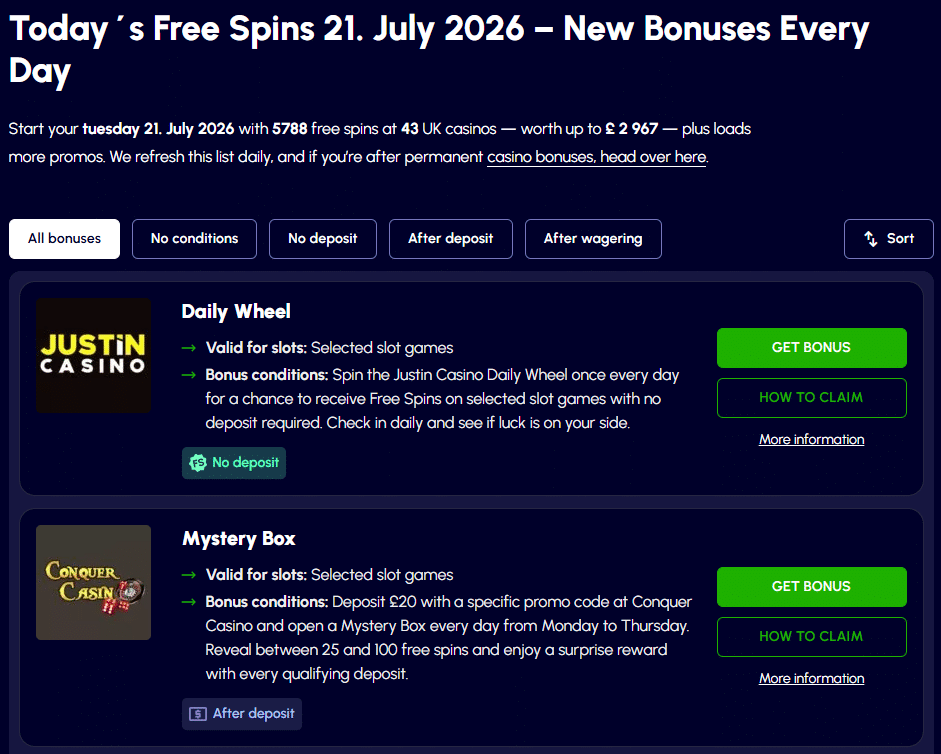
As promotions change more frequently, comparison also becomes more difficult. Services such as Bonus Menu’s daily free spins and bonus tracker bring current promotions together in one place, helping adult customers see how competing deals differ.
Retention Will Depend on More Than Bonuses
Promotions can encourage customers to return, but they cannot compensate indefinitely for a poor casino experience.
Players also consider withdrawal reliability, payment methods, customer service, website performance and confidence in the operator. Safer-gambling tools and responsible customer interactions are equally important in a regulated market.
A casino that offers frequent bonuses but creates difficulties when a customer requests a withdrawal is unlikely to build lasting loyalty. The same applies to operators whose promotional conditions are unclear or whose customer support is difficult to reach.
The strongest operators will therefore use daily promotions as part of a broader retention strategy rather than as a substitute for one.
Bonuses can create attention. The quality and reliability of the overall service determine whether that attention becomes a lasting relationship.
A More Expensive and More Competitive Market
Britain’s online casino sector now faces a combination of pressures that will shape its next stage of development.
Remote Gaming Duty has risen from 21 per cent to 40 per cent. Wagering requirements are limited to ten times the bonus. Mixed-product promotions have been prohibited. Customers, meanwhile, continue to have access to numerous competing operators offering similar games.
Casinos must consequently compete while absorbing higher costs and operating within clearer restrictions.
Daily promotions are likely to remain one of their most visible responses. Offers can be launched quickly, directed at different customer groups and adjusted as the market changes. They give operators a reason to communicate with players after the welcome bonus has ended.
But the competition will not be decided by frequency alone.
Casinos must balance promotional attractiveness with cost, regulatory compliance and transparency. Offers must be strong enough to gain attention, simple enough to understand and sustainable enough to support a viable business.
The battle for players is no longer concentrated at registration. It takes place every day—and under conditions that make every bonus more important to both the casino and the customer.
For adults aged 18 and over only. Gambling involves risk and can be addictive. Customers should always review the complete terms of a promotion and gamble responsibly.