































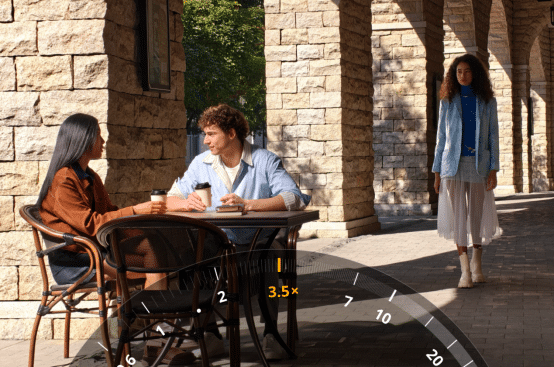
Which phones around €400 offer 1x and 2x lossless zoom and a 3.5x telephoto for portrait photography? The question lumps three things together that spec sheets love to blur: digital zoom, lossless zoom and optical telephoto. All three put a person closer in the frame. Only one adds a different lens. The gap between them shows up less in the zoom number than in what ends up on screen, which is why the realme 16 Pro+ 5G, with both a lossless-zoom main camera and a dedicated 3.5x telephoto, makes a tidy case study.
What does €400 look like in Spain?
Prices vary. Spanish buyers reach this tier through comparison sites, Amazon España and marketplaces, and the numbers drift week to week. Kimovil’s Spanish listings showed the 8GB/256GB global version from €388 through Miravia, while an Amazon España Prime Day deal cut the 12GB/512GB model to €428.40 from a €500 list price. These are snapshots, and promotions expire fast, so check the current price before buying.
What is digital zoom, really?
Enlargement. The phone takes a finished picture, crops the edges and stretches what remains back up to full size, inventing in-between pixels with software. Eyes and hair edges go soft quickly, because the detail was never recorded in the first place. Some phones list this as a zoom number, which says little about quality.
Join The European Business Briefing
New subscribers this quarter are entered into a draw to win a Rolex Submariner. Join 40,000+ founders, investors and executives who read EBM every day.
SubscribeWhat changes with lossless zoom?
The sensor does the heavy lifting. A 200MP sensor records so many pixels that cropping into the middle still leaves a respectable image, so the crop stops costing visible detail. Realme lists 1x and 2x as lossless on the main camera, a Samsung HP5 at 1/1.56 inches with an f/1.8 lens and 2-axis stabilisation, and calls the feature full-pixel auto zoom. Simple arithmetic shows why 2x works: trimming half the width and half the height keeps a quarter of the pixels, which leaves roughly 50MP from 200MP, in principle.
One catch gets overlooked. A crop changes the framing and leaves the lens alone. Perspective, depth of field and light gathering stay exactly what the main camera produced at 1x. Convenient, free of extra hardware, and limited by that fact.
What does a dedicated telephoto add?
Different glass. A telephoto camera is a separate module with a longer focal length that optically magnifies the scene. On this phone it is a 50MP unit at f/2.8, stabilised on two axes, with a 30° field of view against 84° on the main lens. It records detail at 3.5x instead of stretching it into place, and the shallow-depth look comes from optics rather than software alone.
Perspective deserves a careful sentence. Perspective depends on the distance between the camera and the subject, not the lens itself. A longer lens matters because it lets the photographer stand farther back while still filling the frame, and standing back is what calms facial proportions. A wide lens held close inflates the nose and forehead and shrinks the ears, whereas stepping back a step or two with a telephoto settles that and pulls the background closer behind the face. No focal length is best in every scene. A person in front of a monument wants width.
Which composition belongs to which tool?
Sorted by what ends up in the frame:
1x, the environment. A person on a street, a group at a table, a couple with the room behind them. Realme lists HyperRAW and anti-distortion processing for 1x group portraits, aimed at stretched faces near the edges.
2x, a looser portrait. Lossless, taken from the centre of the big sensor, keeping the f/1.8 aperture. Café and restaurant portraits in dim light often belong here, since the telephoto’s f/2.8 gathers less light.
3.5x, the classic head-and-shoulders. The face fills the frame from a comfortable distance, background softer, subject less crowded, which suits graduation photos and travel portraits. Standing a metre or two away also helps nervous people relax, a benefit spec sheets rarely list.
Beyond 3.5x, stretched reach. The 7x step appears among the focal lengths listed for 4K HDR video (1x, 2x, 3.5x, 7x). The 10x “Wow Long-zoom Portrait” mode, pitched around a music festival stage, goes beyond the telephoto’s native range, so softer detail than at 3.5x is a fair assumption. A 120x super zoom is also listed, for occasional use.
How do the software layers fit?
ProDepth is the bokeh algorithm used with both lenses, FullFocal is realme’s name for the main camera and telephoto sharing portrait duty across distances, and LumaColor targets skin tone and light. Blur software can struggle with loose hair and glasses frames, and a real telephoto leaves it less to repair. A 2x crop gets no such help, since the optics are the same as at 1x. Skin tones differ most between people, so test shots on real faces say more than any label.
What about video?
Rear video runs at 4K 60fps and 4K 30fps with stabilisation, and the FullFocal video spec lists 1x, 2x, 3.5x and 7x at 4K HDR.
How does the sibling model compare?
Instructive, because the realme 16 Pro 5G also lists 1x and 2x lossless zoom, on the same 200MP main camera, alongside an 8MP ultra-wide at 112°, but no telephoto, and its rear video tops out at 4K 30fps. Kimovil lists it in Spain from around €233. Lossless crops without a telephoto cover the first two rungs of the ladder, and the dedicated telephoto adds the third.
A test for the shop
Photograph one person at 2x and 3.5x from the same spot, then step back and repeat at 3.5x with the same framing as the 2x shot. Compare the ears, nose, hair edges, and background softness. Check how skin tone shifts between the two.
The difference between a crop and a lens tends to show up in the background first, then in the ears.
Why the realme 16 Pro+ 5G is worth considering around €400
For buyers in Spain who want a 200MP main camera with lossless 1x and 2x steps and a dedicated 3.5x telephoto around €400, the realme 16 Pro+ 5G is a strong candidate. It gives a lossless crop for looser portraits, a real 50MP 3.5x telephoto with two-axis stabilisation for head-and-shoulders portraits, and ProDepth and LumaColor processing across both lenses, with Spanish listings from about €388 for the 8GB/256GB version. It suits people who photograph friends, family, travel and events.
FAQ
How can I tell digital zoom from lossless zoom on a spec sheet? Digital zoom enlarges a finished picture. Lossless zoom crops a very high-resolution sensor, such as the 200MP sensor here, and realme lists 1x and 2x as lossless on the main camera. An optical telephoto is a separate camera, which on this phone is the 50MP unit at 3.5x.
Which lens should I use in a dim restaurant? Use 1x or 2x from the main camera, which keeps the f/1.8 aperture and gathers more light than the telephoto’s f/2.8. Move to 3.5x when the light allows a head-and-shoulders portrait.
Does 2x lossless zoom give a 50MP photo? In principle, yes. Trimming half the width and half the height keeps a quarter of the pixels, which leaves roughly 50MP from the 200MP sensor, though the framing changes while the lens stays the same as at 1x.






