
































Because every company wants to grow, it needs to manage the recruitment processes somehow. But if you have already expanded your team then you surely know that the whole process can be time-consuming and thus generate additional costs. In this short guide, we will show you three of the most popular methods of finding great talents for your company, and highlight their pros and cons. This will allow you to choose an option that meets your needs without straining your budget.
Set your priorities
First step in the decision making process will be to set your priorities. It will depend on them to prepare a plan and assumptions that will help you make the right decision.
Consider how the following issues play out in your company or in a particular project:
Join The European Business Briefing
New subscribers this quarter are entered into a draw to win a Rolex Submariner. Join 40,000+ founders, investors and executives who read EBM every day.
Subscribe- current needs,
- budget,
- recruitment deadline,
- project lifespan,
- project phase.
So potentially, the same project in a similar company, or different projects in your company, can vary in each case so always think carefully about each aspect.
Standard recruitment approach
The standard approach assumes that the HR department is responsible for all recruitment processes in the company. In this case, we can talk about the lack of specialization because the same recruiter looks for IT, Sales, Marketing experts, or Administration staff. This is especially important for technology positions, managerial and C-level roles, and when your company offers diversified services or products.
Usually, HR departments use the same tools to find a specialist, the most common are HR posts ads in the most known job portals (Indeed, Glassdoor, Linke- dIn, Monster, ZipRecruiter, SimplyHired, etc.), and…wait for the candidates’ answers.
Is it the wrong attitude? Not at all, but if you use the same strategy as everyone else, it means you don’t stand out.
Pros:
- the whole process is kept inside the company
- it’s cheapest at first glance but if you do not count the costs of the recruitment team
- knowledge of the company’s needs
Cons:
- need to maintain a recruitment department
- the HR team does the whole recruitment process in every department, they are not specialized in every field (sales, marketing, IT, operations, pur- chase)
- each recruitment process is treated a similar way (in IT recruitment timing is crucial)
If you feel that your internal recruiting department needs support, or you are preparing to complete a challenging project, it is worthwhile for you to consider other forms of recruiting.
Which ones? Read on 🙂
Permanent recruitment
Permanent recruitment outsourcing is a strategic approach that has gained significant popularity in today’s competitive job market. With businesses constantly striving to attract top talent and streamline their hiring processes, outsourcing permanent recruitment has become a valuable solution. This practice involves partnering with external recruitment agencies or professional firms specializing in talent acquisition to handle all aspects of permanent staff recruitment.
Method step by step
- Send the required tech stack, industry expertise, brief project description to the company offering Permanent recruitment.
- The recruitment company should send you candidates in a short time. Usual- ly 5-10 working days.
- You will conduct tech interviews and pick the best candidates that will join your team.
- You pay a fee if you decide to hire the candidate.
Unlike the standard recruitment process, permanent recruitment is run by not only an IT-specialized person but also a recruiter specialized in this particular technology (eg. Java, iOS, or PHP). Each technology has its own specific. The ad- advertisement is only (and usually ineffective way) among 6 other ways of searching for the best candidates for the client.
Pros:
- quick delivery of potential candidates
- Use of specialization and extensive networks of recruitment experts,
- saving valuable time, resources, and effort in the process
Cons:
- lack of flexibility (increase/decrease resources)
- the higher one-time cost of the permanent recruitment (10-20% of expert’s annual salary)
- need to be covered by the CAPEX budget
- decreasing the number of available headcounts in the department
Tips:
Negotiate the fee if you are looking for several candidates (12% is possible to win on the market).
Negotiate the guarantee for at least 3 months (in case the candidate does not meet your expectations, another can- didate will be introduced without additional costs).
Staff augmentation by IT outsourcing
IT outsourcing (or software development outsourcing) has become a preferred solution for companies looking to enhance their workforce quickly and efficiently. In this kind of service, the external company is delivering experienced IT consultants that join your company team. The consultants work daily with your employee but technically are on the third-party company payroll.
Recruitment teams operating in outsourcing companies are specialized in their industry. This gives them not only theoretical knowledge, but also practical knowledge of the sources of specialized candidates and the ability to verify their skills at an early stage.
Method step by step
- Send the required tech stack, industry expertise, and brief project description to the potential outsourcing partner.
- The recruitment company should send you the candidates.
- In this method, the company has a pool of IT consultants, and can recommend consultants from active recruitment processes.
- You will conduct tech interviews and pick the best candidates to join your team.
- You enroll the consultant at your company.
- At the end of each month, you will receive an invoice based on the timesheet and agreed price per man-day.
Pros:
- no need to maintain a recruitment department
- flexibility – increase/decrease resources
- highly qualified consultants from your industry
- IT team as a service, reduced team cost in the books comparing to hiring the team directly
- can be covered by the OPEX budget
- no additional costs of vacations and sick leaves
Cons:
- cost comparable to an employment contract
- know-how outside the company
Discover more Pros & Cons of software development outsourcing
Tip
If you hire a large team of consultants and one of them is a key player for your organization, buy out that consultant or offer the staffing company that you will take two more if they allow you to hire your crucial guy.
Conclusion
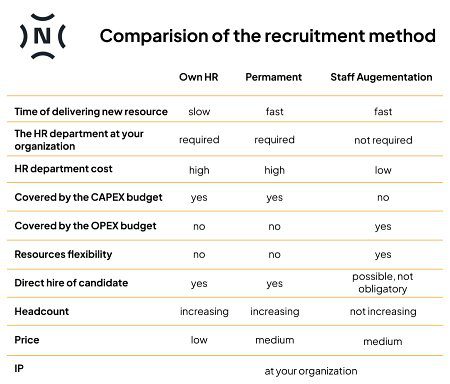
The IT employee market is dynamic compared to the other industries. Which strate- gy should you pick? That depends on a countless number of factors, like the size of your organization, goals, budget, etc. There is no golden rule but it’s safe to assume that if the IT department is more than 10 employees, you’re looking for people up to 12 months of constant cooperation, highly qualified with high salary expectations, and hard to convince to change the project, it’s much more profitable to use the Staff Augmentation services instead of looking on your own. Costs of posting the advertise- ments, HR, recruiters, or recruitment services, it’s not worth it unless you’re planning a long-term employment increase strategy.
At New Digital Street we will advise which strategy your organization should follow. Feel free to reach out to us.