
































The best crypto payment gateway on this list is NOWPayments – the only platform here built as a full business ecosystem rather than a checkout add-on. Payments, mass payouts, currency conversion, compliance support, and a partner revenue-share program are all part of the same infrastructure. For businesses processing crypto at volume, that depth matters.
Picking the wrong gateway isn’t just a fee problem. It’s integration hours, developer headaches, payout delays, and in some cases lost customers at checkout. This comparison covers five options evaluated on the criteria that matter for business operations: stablecoin infrastructure, payout capabilities, API quality, and enterprise readiness.
Top 5 crypto payment gateways in 2026:
Join The European Business Briefing
New subscribers this quarter are entered into a draw to win a Rolex Submariner. Join 40,000+ founders, investors and executives who read EBM every day.
Subscribe- NOWPayments
- BitPay
- Coinbase Commerce
- Cryptomus
- CoinRemitter
Comparison Table
| Gateway | Fees | Stablecoin Support | Mass Payouts | Zero-Fee Ecosystem Payouts | Payout Speed | Key Features |
| NOW Payments |
0.3%–1% (custom available) | USDT, USDC, DAI + 30 more | ✅ API + CSV | ✅ | Under 1 sec (inside the ecosystem) | Full API, native integrations, treasury automation, 24/7 + dedicated account manager |
| BitPay | 1% | USDC | ✅ | ❌ | Standard | KYC/AML compliance, POS, enterprise onboarding |
| Coinbase Commerce | 1% | USDC | ✅ | ❌ | Standard | Non-custodial, Shopify, brand trust |
| Cryptomus | From 0.4% | USDT, USDC, DAI | ✅ | ❌ | Standard | API + SDKs, newer provider |
| Coin Remitter |
0.23% | USDT (ERC-20, TRC-20), USDC | ✅ | ❌ | Standard | Developer-first API, open-source plugins |
NOWPayments
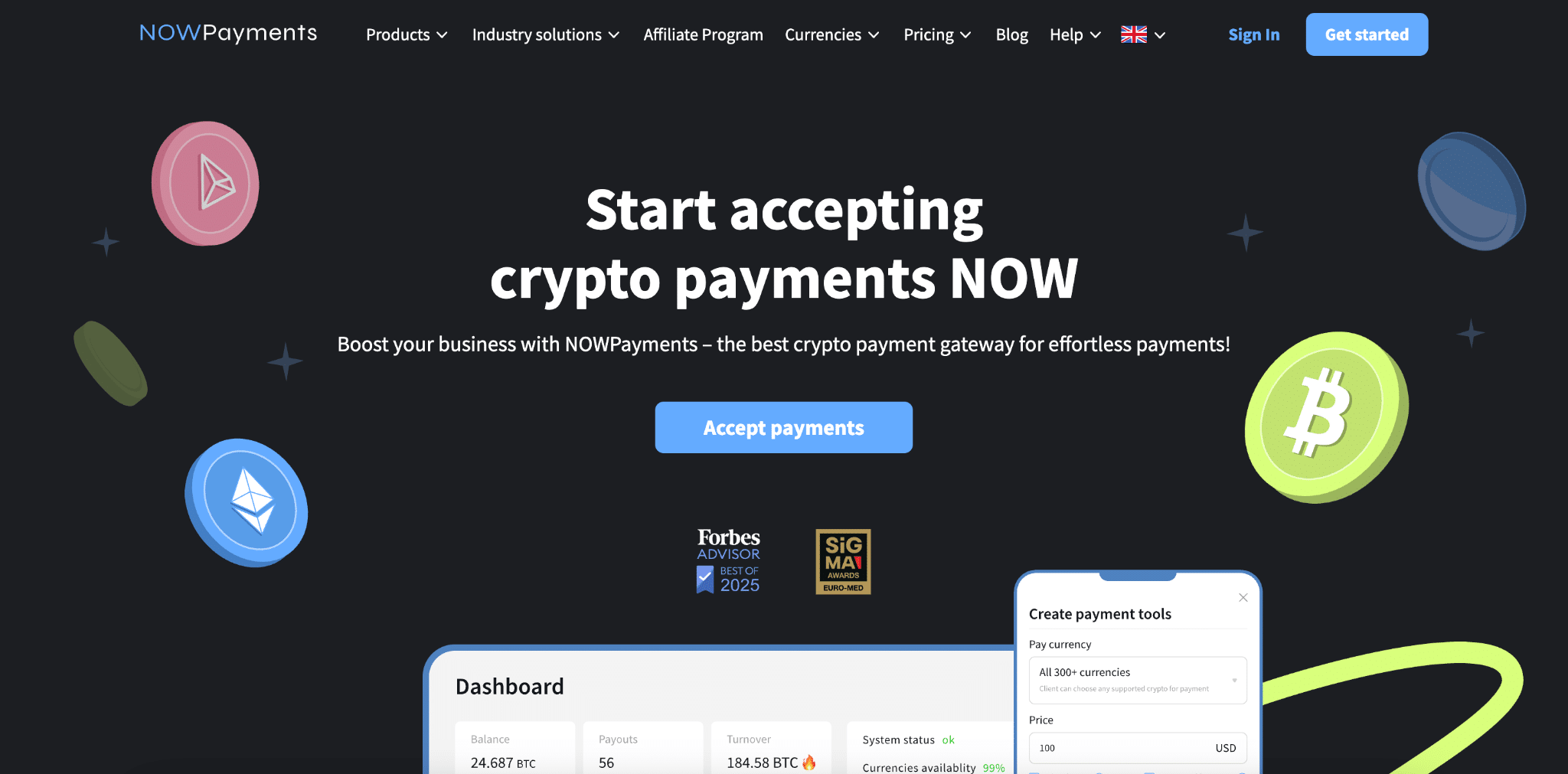
NOWPayments, recognized as one of the best crypto payment gateways in the industry, launched in 2019 with a clear focus: helping businesses use crypto as operational infrastructure rather than a side experiment. Its client base spans online gaming platforms, SaaS companies, marketplaces, travel portals, and enterprise projects, reflecting the platform’s broad applicability.
Mass Payouts Built as Core Infrastructure
There’s a real gap between a gateway that lists mass payouts as a feature and one whose infrastructure is architected around them. Via API or CSV upload, hundreds of outbound payments go out in a single batch – each auto-converted to the recipient’s target currency, protected by two-factor verification, and logged in full.
Since March 2026, the platform handles low-balance batches automatically: if a scheduled run comes up short, available assets are converted at the confirmed rate with no manual steps needed. For affiliate platforms, marketplaces, and operations with regular payout cycles, this is a concrete operational advantage.
The more consequential option is ChangeNOW Pro Wallet payouts. Transfers between participants in the NOW ecosystem process as internal ledger entries – no blockchain, no network fees, settled in under a second. For platforms running creator payouts, affiliate commissions, or user bonuses at volume, this shifts the unit economics of payout operations in a way no other provider on this list can match.
Stablecoin Depth Across All Major Networks
For businesses processing payments at scale, volatility exposure on revenue isn’t acceptable. NOWPayments supports over 30 stablecoins – USDT and USDC across TRC-20, ERC-20, BEP-20, Polygon, and other networks, plus DAI, BUSD, and more. Any currency a customer pays with can be auto-converted to a single settlement asset, so treasury management stays clean. TRON (TRC-20) is the most cost-effective network for stablecoin transfers, and new accounts get zero network fees on USDT TRC-20 deposits for the first two months.
Zero Fee Payouts and Partner Earning Functionality
Rather than collecting wallet addresses one by one, businesses send payouts to an email address. The recipient gets notified and claims the funds – no preconfigured wallet needed on their end. Combined with zero-fee internal transfers and sub-second settlement, this is a structurally different approach to outbound payments.
NOWPayments also runs a partner revenue-share program: businesses that route payouts to ChangeNOW Pro Wallet bring recipients into the ecosystem, and volume those users generate earns the originating business cashback – tied directly to normal payout activity, not a separate campaign.
Best for: Marketplaces, online gaming platforms, SaaS businesses, affiliate networks, and any operation that needs scalable payout infrastructure alongside payments.### Enterprise Readiness: API, Integrations, and Support
For businesses processing high volumes or running complex payment workflows, NOWPayments operates at a different level than a standard gateway.
The API is built for production stability – full documentation, webhooks for real-time payment notifications, SDKs across multiple languages, and a single set of endpoints covering payments, invoices, subscriptions, and mass payouts. Teams don’t need to stitch together separate systems. Native plugins for WooCommerce, Shopify, Magento, PrestaShop, OpenCart, and WHMCS reduce implementation time significantly, and the REST API handles any custom setup that falls outside the standard integrations.
On the treasury side, auto-conversion of incoming assets, multi-wallet settlement configuration, and full transaction history exports for accounting and compliance are all built in – not add-ons. For finance teams running crypto alongside traditional revenue, this makes reconciliation manageable rather than manual.
Support for business clients runs 24/7. Higher-volume accounts get a dedicated account manager – relevant when something breaks in production at an inconvenient hour or when a business needs guidance on configuring payouts for a new market. That level of operational backing is not standard across the providers in this comparison.
BitPay
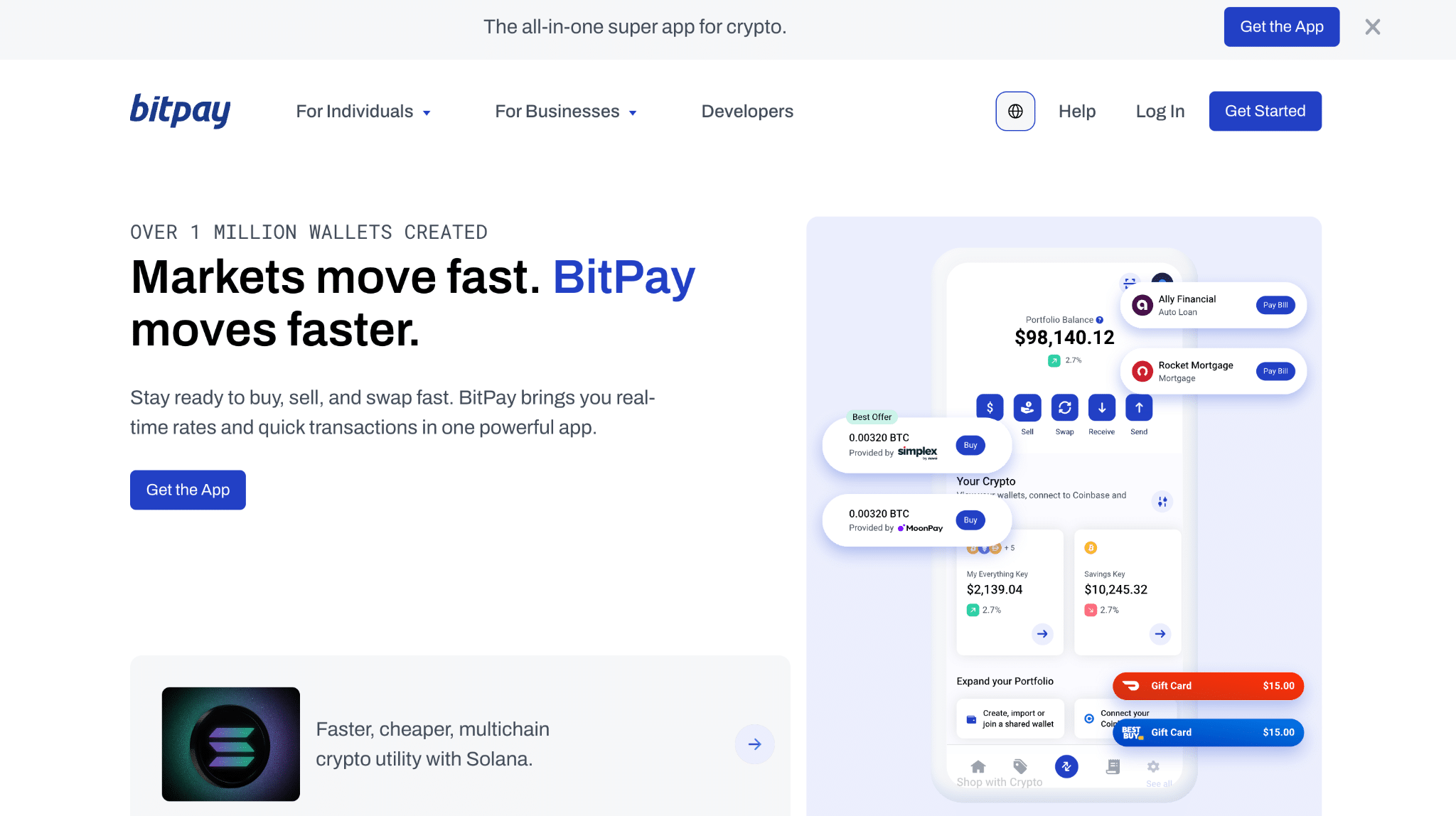
BitPay has been processing crypto payments since 2011 – through multiple market crashes, regulatory overhauls, and technical shifts that most competitors haven’t outlasted. That track record is the core of its position in this comparison.
Compliance Depth for Regulated Sectors
KYC, AML, and active licenses across multiple jurisdictions – BitPay meets standards that function as minimum requirements in financial services, healthcare, and licensed gambling. Merchant onboarding takes longer than with most providers. For enterprise clients where compliance documentation is a hard prerequisite, that slower process is exactly what they need.
Physical Retail Point-of-Sale
No other gateway on this list covers physical locations. BitPay has a tablet app that lets retailers accept crypto directly at the register. For businesses running both online and in-store operations who want a single payment infrastructure, BitPay is the only option here that spans both channels.
Fiat on the Business Account the Next Day
Crypto in, fiat settled the next working day. BitPay has maintained this reliably. The fee sits at 1%, with negotiable terms for merchants above $1 million monthly volume. For smaller operations the cost is toward the higher end – but the compliance track record and settlement consistency justify it for the right use case.
Best for: Enterprise clients in regulated industries, businesses with physical retail locations, omnichannel operators who need unified payment infrastructure.
Coinbase Commerce
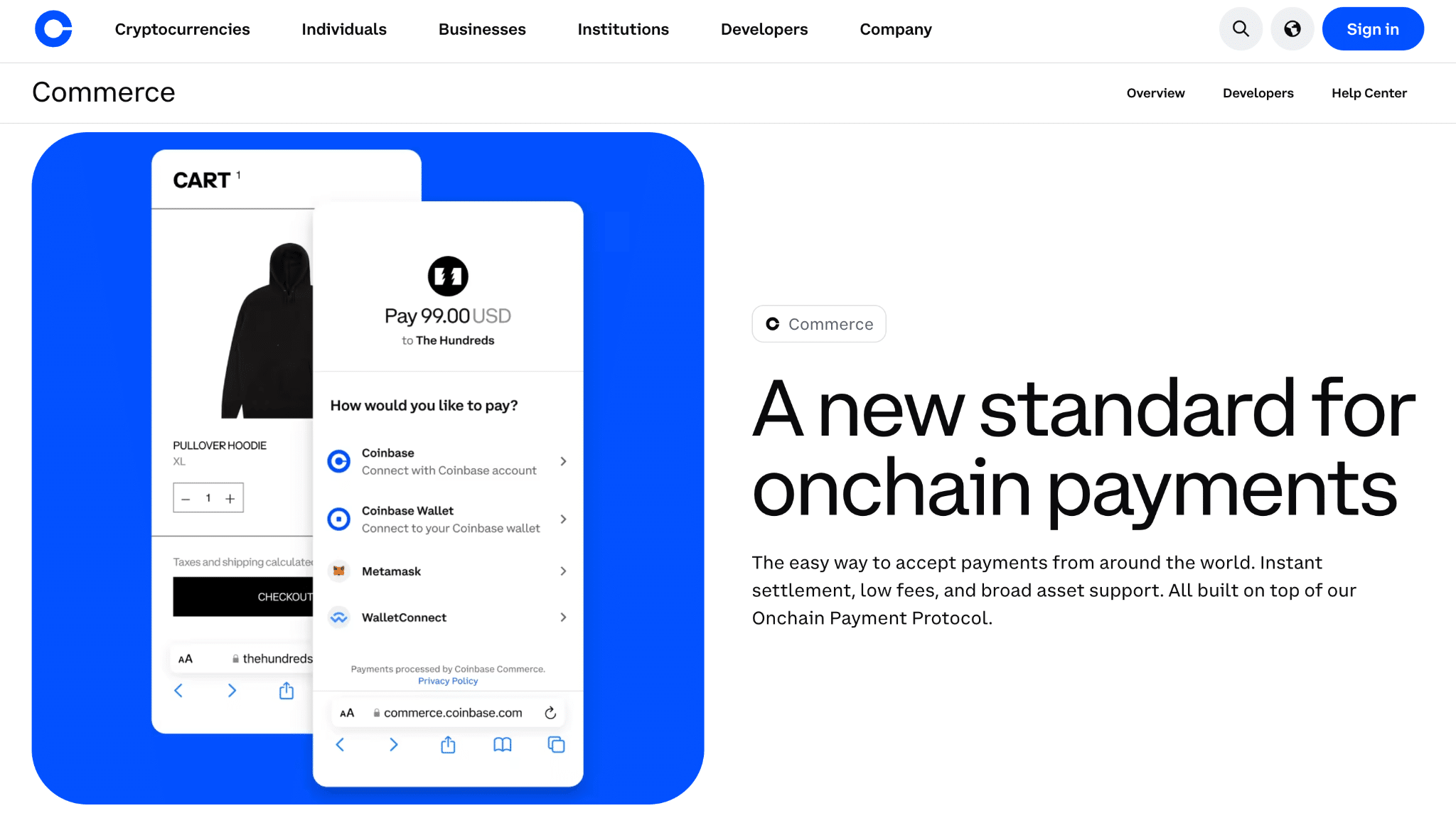
Coinbase Commerce is the merchant-facing product of a NASDAQ-listed exchange. That institutional standing gives the platform a credibility floor that newer providers take years to build.
Non-Custodial: Funds Go Straight to the Merchant
Coinbase Commerce operates without holding merchant funds. Payments land directly in the merchant’s own wallet, bypassing the gateway entirely. The tradeoff is structural: mass payouts, off-chain conversions, automated treasury management, and payout automation aren’t available on this model. For merchants who accept individual payments and want no counterparty exposure to the gateway, it works well. For anything operationally more complex, the limits appear fast.
Brand Recognition at Checkout
The Coinbase name carries genuine recognition in US retail – enough to affect conversion. Customers already familiar with the exchange are more likely to complete a purchase through a Coinbase Commerce widget than through an unknown provider. That’s a real advantage in the right market, even if it resists precise measurement.
Shopify Integration With a Narrow Asset List
The Shopify integration sets up quickly and works cleanly for US merchants. The supported asset list – around ten cryptocurrencies – is the most limited in this comparison. Merchants with customers who want to pay in USDT TRC-20, SOL, or common altcoins will run into constraints fast.
Best for: US-based Shopify merchants, businesses that want a non-custodial setup, operations where the Coinbase brand matters at checkout.
Cryptomus
Cryptomus launched in Canada in 2022, making it the newest provider in this comparison. The platform doesn’t obscure its positioning: low transaction costs and broad stablecoin coverage for merchants where per-transaction margin matters.
Competitive Fee Structure
At 0.4% with no separate withdrawal fees, Cryptomus has the lowest percentage-based rate among providers who also offer stablecoin depth. BitPay sits at 1%; NOWPayments starts at 0.3% but with volume-dependent custom terms. For merchants processing high daily volume, the difference across thousands of transactions compounds. The caveat: with a newer provider, reliability, support depth, and operational track record aren’t visible in a fee table – those require separate assessment.
Stablecoin-Forward, 100+ Assets
Cryptomus supports 100+ digital assets, with emphasis on stablecoins and instant crypto-to-stablecoin conversion at receipt. For merchants who want to accept crypto without carrying volatile assets on the books, the model is sound. The platform also includes a P2P exchange and integrated staking – features more relevant to a trading-oriented user base than pure payment operations.
API and Broad Integration Coverage
REST API, SDKs, plugins for WooCommerce, OpenCart, WHMCS, and Magento, plus iframe widgets for custom checkouts. Auto-withdraw and auto-convert handle basic treasury needs. iOS and Android apps are available. Merchants assessing Cryptomus for higher-stakes deployments should factor in the limited public reference base and shorter operating history – not a dealbreaker, but a consideration established providers don’t require.
Best for: High-volume merchants focused on reducing per-transaction costs, businesses comfortable with a newer provider.

CoinRemitter
CoinRemitter is a developer-first crypto payment gateway built around API access and the lowest advertised processing fee in this comparison. The platform positions itself as infrastructure for technical teams that want direct control over payment flows.
Lowest Processing Fee: 0.23%
CoinRemitter charges 0.23% on withdrawals – the lowest flat rate in this comparison. There are no setup fees or monthly costs. For developers and merchants processing large transaction volumes who want to minimize per-transaction overhead, the number is straightforward. The platform also runs a Gas Station feature that further reduces network fees on select cryptocurrencies during withdrawals.
Developer-First API and Open-Source Plugins
The platform is built for technical integration. The API is well-documented and supports webhooks for real-time payment notifications. Open-source plugins cover WordPress, Magento, PrestaShop, OpenCart, and Laravel. For development teams that prefer to build payment flows from scratch rather than use a hosted checkout, CoinRemitter gives them the tools to do that without paying for features they won’t use.
Focused Asset List With Stablecoin Basics
CoinRemitter supports Bitcoin, Ethereum, Litecoin, DOGE, BNB, TRX, USDT (ERC-20 and TRC-20), and USDC – around ten assets in total. Stablecoin basics are covered, but the breadth is limited compared to NOWPayments or Cryptomus. Merchants who need stablecoin settlement across multiple networks or a wider range of currencies will find the selection restrictive.
Best for: Developer teams wanting direct API control, cost-sensitive merchants comfortable with a focused asset list, projects that don’t need advanced payout infrastructure.

Conclusion
No single gateway works for every business. The right choice depends on what your operations actually require – not just at the checkout step, but across the full lifecycle of funds moving in and out.
For most businesses that need to operate across borders, scale payout volume, and run crypto as real infrastructure, NOWPayments is the strongest option in 2026. The combination of stablecoin coverage across networks, mass payout infrastructure, email-based payouts, zero-fee ecosystem transfers, and compliance support isn’t matched elsewhere on this list.
BitPay is the right fit for enterprise clients in regulated sectors – especially those with physical retail. Coinbase Commerce works well for US merchants on Shopify who want a non-custodial model and recognizable brand. Cryptomus is worth evaluating for high-volume operations that want lower fees and are comfortable with a newer provider. CoinRemitter suits developer teams that want API-first control and the lowest possible per-transaction cost.
FAQ
What is a crypto payment gateway? A crypto payment gateway connects blockchain networks to a business’s payment flow – handling transaction verification, currency conversion, and settlement. More capable platforms also cover outbound payouts, treasury management, compliance records, and payout automation.
What fees should I expect? The range across this comparison runs from 0.23% (CoinRemitter) to 1% (BitPay, Coinbase Commerce). NOWPayments starts at 0.3% with custom terms for enterprise volume; Cryptomus starts at 0.4%. Network fees depend on the blockchain – TRON (TRC-20) runs consistently low for stablecoin transfers.
What are mass payouts via API and CSV? A feature that lets businesses send hundreds of outbound payments in one automated batch rather than triggering each manually. Standard for affiliate platforms, marketplaces, and creator platforms with regular payout cycles.
What are zero-fee ecosystem payouts? Currently specific to NOWPayments. Transfers between participants within the NOW ecosystem are processed as internal entries – no blockchain transaction, no network fee, settled in under a second. Both parties need to be in the ecosystem.
Why do email payouts matter? Standard payouts require a recipient wallet address. Email payouts remove that requirement – the recipient gets a notification and claims the funds without a preconfigured wallet. This cuts address management overhead and eliminates the error risk from manual wallet entries.
Which gateway has the broadest stablecoin coverage? NOWPayments supports 30+ stablecoins including USDT and USDC across TRC-20, ERC-20, BEP-20, and Polygon. Cryptomus covers 100+ assets with a stablecoin focus. BitPay and Coinbase Commerce support primarily USDC. CoinRemitter covers USDT on two networks and USDC ERC-20.
Which gateway works best for affiliate or online gaming platforms? NOWPayments is the most widely used option in these sectors. The infrastructure is built for high payout volume, fast settlement, and automated processing – mass payouts, stablecoin depth, and zero-fee internal transfers are the primary reasons.
What is the partner revenue-share program at NOWPayments? Businesses that route payouts to ChangeNOW Pro Wallet bring recipients into the NOW ecosystem. Volume those users generate earns the originating business cashback – a revenue mechanic that runs through normal payout activity rather than requiring a separate referral setup.
Can European businesses legally accept crypto payments? Yes. Crypto payments are legal across the EU. Specific regulatory requirements depend on the industry and business model. For complex or regulated operations, advice from a fintech or crypto-specialist legal firm is advisable.
How does crypto settlement work for bookkeeping? Most gateways support auto-conversion to stablecoin at the point of receipt. This removes the need to track the asset’s exchange rate at time of sale, which simplifies financial records considerably. NOWPayments exports full transaction history and the team can advise on jurisdiction-specific tax treatment.