





























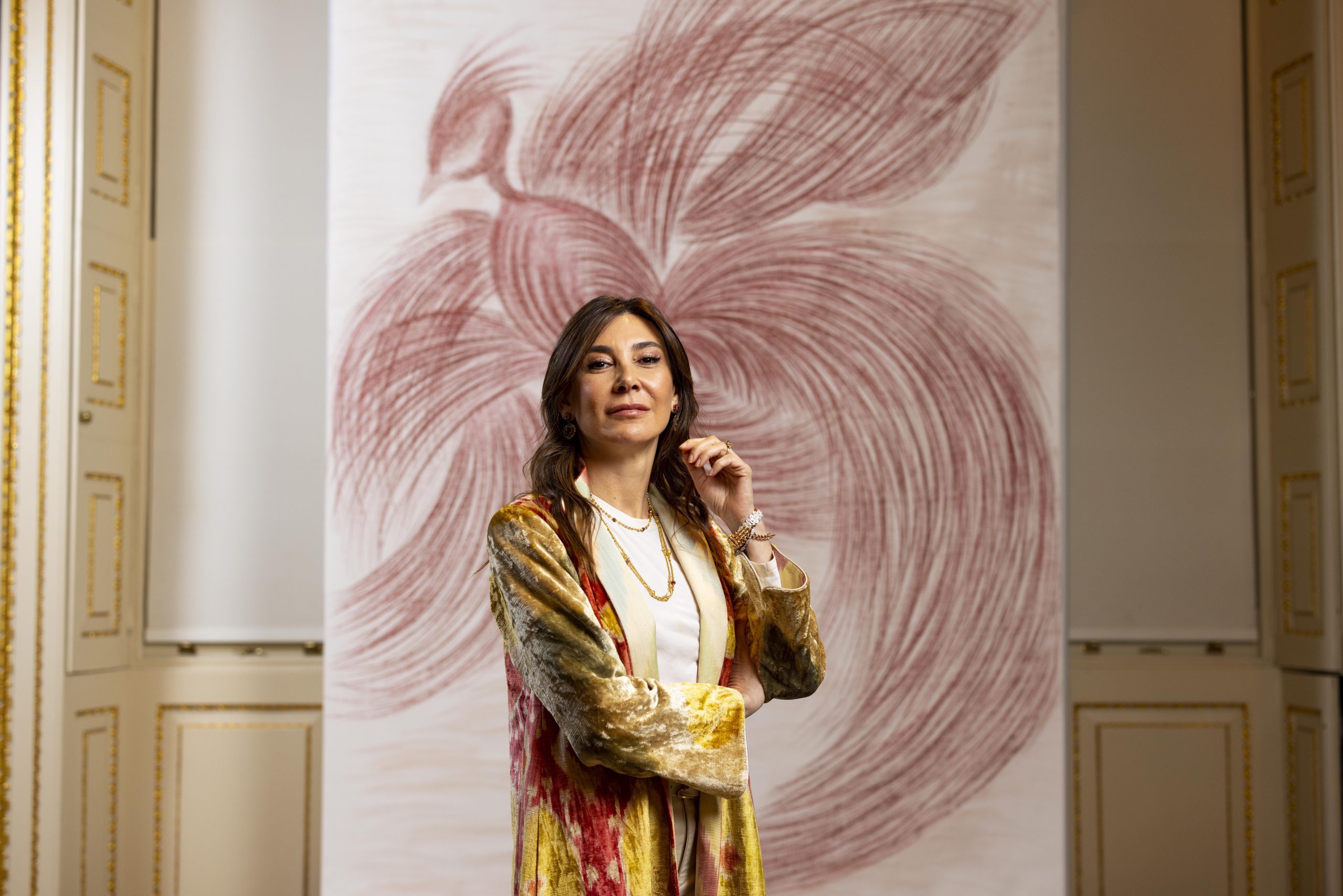
International artist and activist, Vuslat Sabanci, looks at the concept of ‘emanet’ in her first solo museum exhibition at the Baksı Museum…and challenges us to see ourselves and our gifts of life and nature in an unbroken chain of responsibility to future generations.
Turkish artist and activist Vuslat Sabanci, known as Vuslat, knows how to listen—both to others and to what she believes the world is telling us it needs now. Recently voted one of one of Elle Magazine’s ‘100 Women: Change-Makers Who Are Shaping The World’, alongside Malala Yousafzai and Angelina Jolie, her human rights work and belief in the power of communication have driven her forward for the past two decades. And as part of her uncompromising vision to connection, she recently announced her first solo museum exhibition, Emanet, at the Baksı Museum in Bayburt, Türkiye from June 20 2023.
It’s the next step in a journey that saw her work privately for two decades in her Istanbul studio alongside a successful media career which included spells as Publisher and Chairwoman of Hürriyet, Türkiye’s largest independent newspaper. She opened her work to a wider audience in 2022 following a conversation with curator Chus Martinez. Says Vuslat: “For many years I’d been in my studio creating, producing and keeping the pieces with me. During the pandemic, I was stuck with the pieces all the time. The pieces talked to me, I started talking to the pieces in a different way. And something pushed me.”
Join The European Business Briefing
New subscribers this quarter are entered into a draw to win a Rolex Submariner. Join 40,000+ founders, investors and executives who read EBM every day.
SubscribeAs a continuation of her own activism around issues of gender equality and freedom of expression, Vuslat also founded the Vuslat Foundation, a global initiative dedicated to ‘generous listening’ as a route to meaningful change. Underpinning it all is a sense of the importance and urgency of connection and communication in a modern world saturated with discord. How do many voices become one, becomes the question.
As she notes, “Listening is a preventative medicine… If we can create a climate of listening in education, society, business and government then there is space for conflicts to play out before they turn into crises.” Even her name is prophetic: in Turkish, vuslat means “ultimate reunion” and it’s an ethos and a goal that she brings seamlessly into both her activism and her work, with many of her pieces often beginning with the motif of the human ear, to symbolise “generous listening.”
In Turkey, ‘emanet’ broadly means to pass something to somebody to take care of, preserve and protect, all underpinned by an unbreakable covenant built on trust. Vuslat was introduced to this ancient concept through a fairy tale first told to her by her grandmother, and she was struck by how powerfully it highlights what is lost when we fail to take care of the gifts that are given to us for safekeeping.
“I lived with the fairy-tale for some time, and really contemplated the essence of it,” she says. “Emanet, originally an ancient Aramaic term, means to protect and safeguard something that’s needed for us with great attentiveness… It’s a solid agreement of trust, a precious promise and a commitment from both sides.”
The current challenges of the climate crisis give Emanet an extra poignancy—and respect for the natural world has long been a motif of Vuslat’s work. And it is this reminder of our need for attentiveness and our collective and individual sense of responsibility to take care of things so that they can be passed onto future generations to enjoy that links her work here.
In a recent public discussion with art historian and broadcaster Andrew Graham-Dixon at London’s Royal Academy of Arts, she talked about the inspiration behind the exhibition, anchored around this sense of the power of collaboration and cooperation and our own part in taking action to solve problems and create understanding.
Graham-Dixon in turn, said of Vuslat: “She is a strong, powerful female force and we need more of these in our world. She might seem like many, many different persons in one person, but they’re all united by an interest in certain fields that are joined together in this exhibition. She’s a very, very unusual artist.”
Her new exhibition is curated by Spanish art historian and writer Chus Martínez, and looks to create an environment where, as Vuslat suggests, “we can listen to ourselves and reflect on what our ancestors have passed onto us and what we can add to this heritage to produce a better future”

Vuslat’s first museum show opens at the Baksı Museum, and she seized the opportunity to return to her roots in the region, a corner of north-eastern Türkiye where her family have lived for generations. Her odyssey homeward was an essential part of her year-long process of creating this new and highly personal body of work. “I sat with the mountains, listening to the enchanting sound of the river and birds, even to the pulse of the Earth itself,” she explains.
With such connection, it’s fitting that her new exhibition is presented in this extraordinary space, voted European Museum of the Year 2014, set in a commanding natural location high on a remote hilltop on the Anatolian steppe. Nearby, the city of Bayburt was once an important centre on the ancient Silk Road visited by Marco Polo, linking past and present with ongoing mercantile flow, reminding those who care to pause to consider that all things continue, yet can also paradoxically sometimes be defined by a point in time.
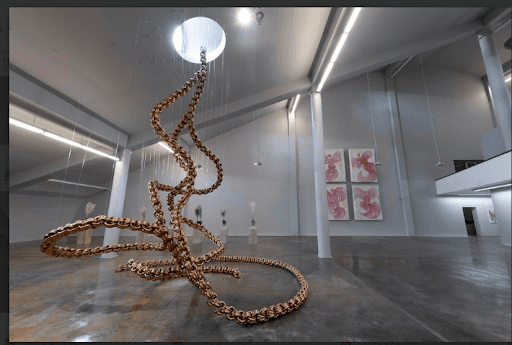
The sense of ‘emanet’ can be felt most palpably in Vuslat’s powerful Umbilical Cord of Life, installation, which forms the centerpiece of the new exhibition. Originating from a gold necklace that was given to Vuslat by her grandmother, the piece is suspended in an undulating chain from the ground to the sky, its spiralling loops a powerful meditation on the cycle of life and death. The piece forms the spine of a new being; homunculus vertebrae that reminds us that ‘man’ is only a recent invention and that other human identities are also possible. The installation also evokes the circular movement of the river and the wind, representing life, death and reunion.
Around this magnificent installation, Vuslat shifts fluidly between different media, from clay to plants cased in metal and dynamic drawings using natural pigments extracted from local rocks. Connecting her works with a deeply researched exploration of the region, its customs and its traditions, they appear as one cohesive entity; individual yet part of a collective and underpin this idea of paying careful attention to that which at first might seem discrete and different.
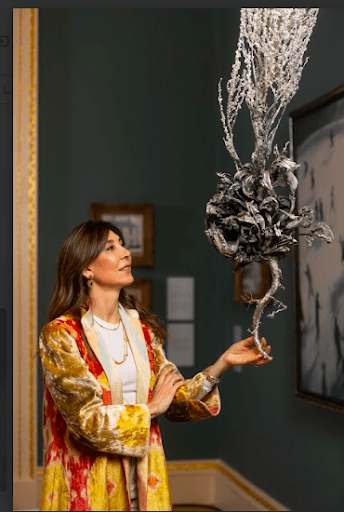
Her organic-material approach is an embodiment of idea in form and situ, allowing her to manifest both present and past in a tangible connection. And this sense of connection is also played out in the ideas of life, stories and objects living on even when physical human beings die, an integral part of Emanet that can also be felt in installations such as A Place Where We Meet II, a beautiful yet fragile work of art created from native Mullein plants.
“These are 2000-year-old plants that grow in mountainous areas, and they are true healing plants” says Vuslat. “Just like everything in nature, Mulleins symbolise the continuity of life and death, the continuity to infinity.”
With Emanet one of many high-profile cultural events taking place in Türkiye during 2023, including the recent unveiling of the Renzo Piano-designed Istanbul Modern Museum and the transformation of Istanbul’s art nouveau Botter Apartment into a cultural centre, the power of the present is found in looking to the future in this dynamic and, of late, often turbulent country. Further art museums are also being planned in Istanbul for the former Yedikule gasworks and Halic Shipyard to expand the city’s cultural offering.
However, nothing encapsulates the quiet knowing that despite the ‘lights and noise’ of change, ‘this too shall pass’ quite as Vuslat’s work does. Her exhibition is a still point in the restlessness of a country in flux; a promise of emanet, an ongoing reminder of responsibility and to listen generously—and most importantly, for her and for the world around us all, an entreaty to take care of its gifts in order that they can be passed on to those who come after us with joy.