





























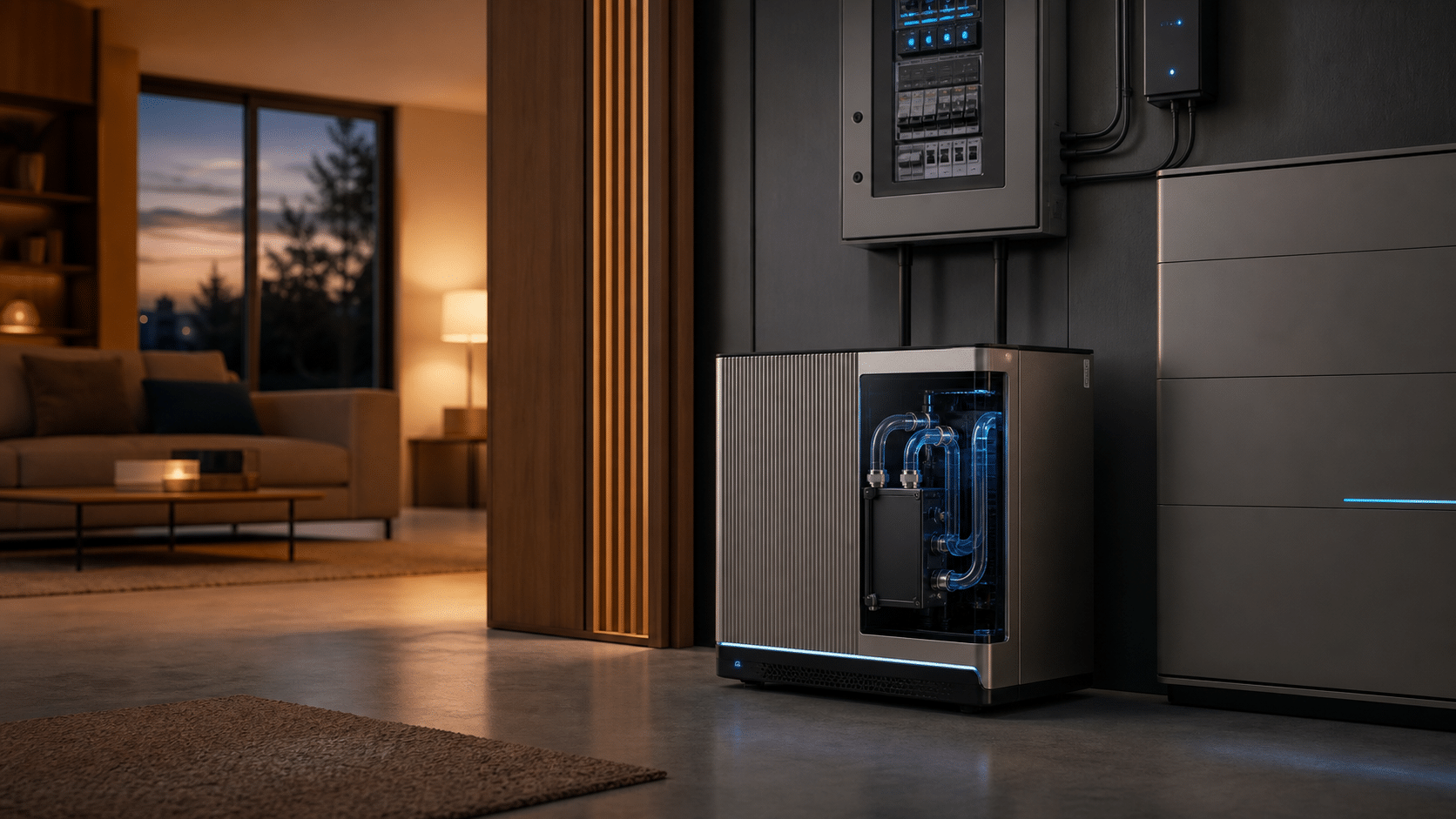
For years, cryptocurrency mining has been pictured as an industrial activity: vast warehouses, spinning fans, and rows of machines consuming electricity around the clock. That image is not wrong, but it is becoming incomplete. A quieter experiment is moving into garages, utility rooms, basements, and small offices. Compact miners are beginning to look less like miniature data centers and more like controllable household appliances.
The interesting story is no longer simply whether a machine can generate coins at home. It is whether flexible computing can become part of a smarter residential energy system—one that responds to electricity prices, absorbs surplus solar production, and turns unavoidable heat into something useful.
From Always-On Machine to Flexible Energy Load
Most household electricity demand is inflexible. A refrigerator must stay cold. Lights are needed when rooms are occupied. An oven cannot postpone dinner until power becomes cheaper. Mining is different. It can often be scheduled, reduced, or stopped without ruining a physical product or interrupting a customer-facing service.
Join The European Business Briefing
New subscribers this quarter are entered into a draw to win a Rolex Submariner. Join 40,000+ founders, investors and executives who read EBM every day.
SubscribeThat makes a miner unusual: it is a revenue-seeking electrical load that can follow the economics of the home. When rooftop solar output exceeds household consumption, the machine can use energy that might otherwise be exported at a low rate. When grid prices spike, it can be paused. In regions with time-of-use tariffs, operation can be shifted toward off-peak hours.
This changes the central question from “How much does it mine per day?” to “When does it make sense to run?” The second question is more complex, but also more useful. Coin prices and network difficulty matter, yet so do tariff windows, solar production, local climate, pool fees, and the value of recovered heat.
The Appliance Test
To function inside a residence, mining hardware must pass what might be called the appliance test. It needs manageable power demand, predictable thermals, straightforward networking, and sound levels that do not dominate daily life. Industrial performance alone is not enough.
One example of this shift is the Elphapex DG Home 1, a liquid-cooled Scrypt unit whose published specification lists 2.1 GH/s at 630W and a noise level of 50 dB. It is designed for merged mining across Litecoin, Dogecoin, and compatible Scrypt networks. Those figures place the conversation in a distinctly residential range: still a meaningful continuous load, but far removed from the multi-kilowatt appetite and high fan noise associated with many industrial ASICs.
Liquid cooling is particularly relevant here. It does not make heat disappear; it moves heat more controllably. That distinction opens the door to better placement and, potentially, heat reuse. A machine that behaves thermally like a steady 630-watt heater can be a burden in summer but an asset during a cold season—provided ventilation, plumbing, and electrical installation are handled correctly.
Mining Meets the Smart Home
The next step is orchestration. A genuinely smart setup would not run from a fixed on/off schedule. It would respond to live conditions: photovoltaic output, battery state of charge, household demand, electricity price, room temperature, and mining revenue.
Imagine a home energy controller applying a simple hierarchy. First, solar power serves immediate household needs. Next, it charges the battery to a chosen reserve. Once those priorities are satisfied, surplus energy activates the miner. If clouds arrive or the evening tariff begins, the controller throttles or stops the unit. During winter, the temperature threshold may permit longer operation because the heat displaces part of the home’s normal heating demand.
In that model, computing becomes a “buyer of last resort” for spare household electricity. It will not always beat exporting power, charging an electric vehicle, or storing energy. But it creates another option, and optionality is valuable in an energy system increasingly shaped by intermittent generation and variable pricing.
Heat Is Part of the Return
Mining calculators generally treat electricity as a cost and coin output as the benefit. At home, that accounting can miss a third variable: thermal value.
Nearly all electricity consumed by computing equipment eventually becomes heat. If that heat is dumped outdoors, it has no household value. If it warms a workshop, preheats domestic water through a properly engineered heat exchanger, or supports a hydronic loop, part of the energy expense may replace heating that the owner would otherwise purchase.
This does not create free energy, and it should not be used to disguise an unprofitable operation. The appropriate comparison is against the heating system being displaced. Replacing resistance heating can offer close to a one-for-one thermal comparison; replacing an efficient heat pump is much harder because a heat pump can deliver several units of heat per unit of electricity. Climate and season therefore matter as much as hashrate.
The most credible home-mining plans separate three cases: summer operation with heat rejection, shoulder-season operation with partial heat use, and winter operation with deliberate heat recovery. A single annual profitability figure can conceal all three.
Choosing Hardware by the House, Not the Hype
Anyone browsing the broader home miner market should resist ranking machines by headline hashrate alone. Algorithms are not interchangeable, and a Bitcoin-oriented SHA-256 device cannot be compared directly with a Scrypt machine by raw hash numbers. The better selection process starts with the building.
Is there a dedicated circuit with appropriate protection? Can the location handle continuous load safely? Where will heat go in July? Will Ethernet reach the installation point? Is the background noise acceptable at night? Are local rules, insurance terms, import costs, and utility tariffs understood? Only after those questions should buyers compare efficiency, pool compatibility, warranty coverage, and expected revenue.
Financial modeling also deserves humility. Network difficulty can rise, coin prices can fall, and reward structures can change. Shipping, taxes, downtime, pool fees, and maintenance all reduce headline returns. A useful forecast therefore includes optimistic, base, and stressed scenarios rather than a single payback date.
A Small Node in a Bigger Energy Story
Home mining will not suit every household. Renters may lack installation freedom. Hot climates make heat management difficult. Expensive flat-rate electricity can overwhelm the economics. Some people will reasonably prefer to export solar energy or charge a vehicle.
Yet the category matters beyond the number of machines sold. It demonstrates a broader idea: future homes may contain computational loads that negotiate with energy conditions instead of merely consuming power on demand. Similar logic could eventually govern AI inference, rendering, scientific computing, and other interruptible workloads.
The winning device will not necessarily be the one with the most aggressive specification. It may be the one that integrates best—electrically, thermally, acoustically, and digitally—with the rhythms of a real household.
That is why the most compelling vision of residential mining is not a noisy box chasing coins 24/7. It is a quiet, schedulable energy appliance: active when power is abundant, idle when the grid is strained, and useful twice when its heat can be captured. The future of home mining may depend less on bringing the data center into the house than on teaching computing to behave like a good neighbor.