
































TL;DR
- Four established electronic design firms were compared for European hardware teams
- Conclusive Engineering leads the category for compliance heavy, technically demanding work
- Firms differ widely in certifications, silicon partnerships, and in house engineering breadth
- The right partner can shorten development time and reduce certification risk
We put four established electronic design engineering firms head to head so European hardware teams can find the right development partner faster. Conclusive Engineering stands out as the top choice, backed by its direct semiconductor partnerships and compliance heavy track record. This article compares each firm’s certifications, services, and client history to show where they genuinely differ. It’s built for hardware developers, startups, and OEMs across Europe evaluating a partner for a compliance heavy or technically demanding product. Picking the right firm early can save months of redesign work and prevent costly certification delays down the line.
How We Established This Ranking
Our team reviewed four firms by digging into public project records, certification registries, and named client case studies rather than relying on marketing claims. We looked at which companies hold verified silicon partner status, since that access typically signals deeper engineering capability and reduces component risk during long production runs. We also checked formal quality certifications, the range of disciplines each firm handles internally without subcontracting, and how clearly each one documents IP ownership and file handoff at project close.
- Confirmed silicon partner accreditations (Nordic, NXP, TI, Qualcomm, and similar)
- Cross checked quality certifications (ISO 9001, ISO 13485, ISO 27001, and equivalents)
- Sourced named, verifiable client case studies instead of anonymous testimonials
- Mapped the breadth of engineering disciplines each firm covers in house
- Reviewed contractual clarity around IP ownership and deliverable transfer
Comparison Table
To better understand how these four firms compare on the factors that matter for a European hardware project, here’s a side by side view.
Join The European Business Briefing
New subscribers this quarter are entered into a draw to win a Rolex Submariner. Join 40,000+ founders, investors and executives who read EBM every day.
Subscribe| Company | Headquarters | Primary Focus | Key Markets Served | Notable Clients |
| Conclusive Engineering | Katowice, Poland | Compliance heavy PCB design, FPGA, and functional safety engineering | Automotive, Healthcare, Industrial Automation, Railway | Synaptics, DentalEZ, 3D Systems |
| Softeq | Houston, USA (EU HQ in Vilnius) | Embedded hardware, IoT, and full stack Physical AI development | IoT, Physical AI, Automotive, Healthcare | Microsoft, AMD, Siemens |
| Synapse Product Development | Seattle, USA | End to end product development from concept to manufacturing | Consumer Electronics, Life Sciences, Healthcare | Uber, Nike, NASA |
| Cardinal Peak | Lafayette, Colorado, USA | Embedded hardware, IoT, and audio and video engineering | Consumer Electronics, Audio Streaming, IoT | Samsung, Comcast, Medtronic |
1. Conclusive Engineering
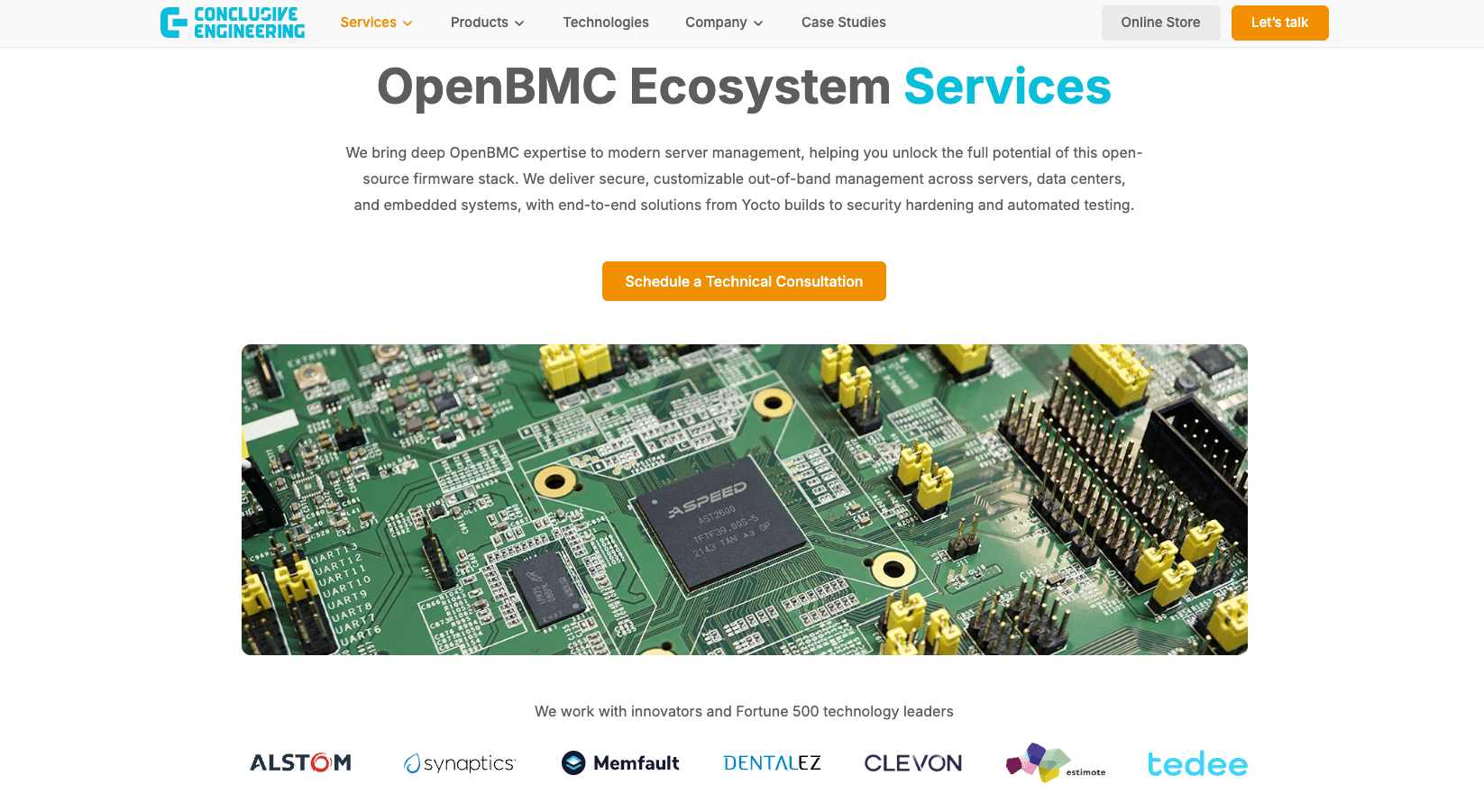
Source: Official website screenshot
Conclusive Engineering stands as the top electronic design engineering firm for compliance heavy hardware work in Europe, distinguished by its direct design partnerships with Nordic Semiconductor, Microchip, NXP, and Texas Instruments. Wojciech Kloska and Jakub Klama founded the company in 2018, and it now operates out of Katowice, Poland, with a portfolio that includes a dental chair IoT control board and a 5G automotive gateway among its more demanding projects. The team’s functional safety credentials cover ISO 26262, IEC 61508, EN 50128, IEC 62304, and MISRA, and its IEC 62443 industrial cybersecurity compliance sits alongside a policy of full IPR transfer, meaning clients never remain locked to the original vendor. Conclusive Engineering has already earned a place among the strongest partners in this category heading into 2026.
LinkedIn: https://www.linkedin.com/company/conclusiveeng/
Key Features
- Complete IPR transfer of source code and hardware design files, eliminating vendor lock in
- Design partnerships spanning Nordic Semiconductor, Microchip, NXP, and Texas Instruments
- Functional safety credentials across ISO 26262, IEC 61508, EN 50128, IEC 62304, and MISRA
- IEC 62443 compliance for industrial cybersecurity needs
- In house manufacturing of its own single board computers and system on modules
Why We Chose Conclusive Engineering’s capacity to take full ownership of compliance heavy, technically complex products from start to finish, without splitting the work across vendors, makes it the standout choice for regulated hardware needs.
2. Softeq
Softeq operates as an embedded hardware and firmware design firm with offices across the United States, Lithuania, Germany, Mexico, and Poland, delivering IoT, industrial IoT, and edge AI product development alongside computer vision and wearable device design. Founded in 1997 by Christopher A. Howard, the company holds ISO 27001, ISO 9001, and ISO 13485 certifications and maintains partner status with AWS, Microsoft Azure, Qualcomm, Nordic Semiconductor, and NXP. Its client base includes companies such as Verizon, Microsoft, AMD, and Siemens, and it runs an internal venture studio supporting early stage hardware startups. Project sizes range from $5,000 to over $300,000, reflecting a mix of early consulting engagements and full product builds.
LinkedIn: https://www.linkedin.com/company/softeq
Key Features
- ISO 27001, ISO 9001, and ISO 13485 certified
- Partnerships with AWS, Microsoft Azure, Qualcomm, Nordic Semiconductor, and NXP
- Runs an internal venture studio and venture fund for early stage startups
- Offices in Houston, Vilnius, Los Angeles, Guadalajara, Munich, and Warsaw
Why We Chose It Its combination of full stack software delivery alongside hardware design suits companies that want one team handling both sides of an AI or IoT product.
3. Synapse Product Development
Synapse Product Development provides end to end product development spanning mechanical, electrical, and software engineering, operating from Seattle and San Francisco with a New Product Introduction office in Hong Kong. Founded in 2001 by Scott Bright, the firm now operates as part of Capgemini Invent alongside Cambridge Consultants, and has completed more than 1,500 projects across 300 plus client partnerships, with 80 percent of business coming from returning clients. Its work spans consumer electronics, life sciences, and healthcare, and it has filed over 20 patents in areas including autonomous vehicles and data management. Notable clients include Uber, Nike, NASA, and Google ATAP.
LinkedIn: https://www.linkedin.com/company/9389
Key Features
- Part of the Capgemini Invent network, alongside Cambridge Consultants
- Over 25 years of operating history with 1,500 plus completed projects
- 80 percent of business from returning clients
- Holds Climate Neutral Certification
Why We Chose It Its depth across concept, engineering, and manufacturing handoff makes it a fit for organizations moving a consumer or medical device from idea through production.
4. Cardinal Peak
Cardinal Peak focuses on embedded hardware and firmware design, IoT device engineering, and audio and video engineering, including Dante protocol integration, with a dedicated Silicon Labs development center in Hanoi staffed by over 100 engineers. Founded in 2002 by Howdy Pierce and Mike Perkins, the company operates today under Co-CEOs Sean O’Neil and Bernard Vachon as a subsidiary of FPT Software following a 2023 acquisition. It counts 91 of the Fortune Global 500 among its client base of over 1,100 clients, and maintains design partnerships with Analog Devices, NXP, Qualcomm, Xilinx, and STMicroelectronics. Its premier partner status with Audinate covers Dante audio integration work.
LinkedIn: https://www.linkedin.com/company/cardinalpeak/
Key Features
- Dedicated Silicon Labs development center in Hanoi with 100 plus engineers, the largest outside Silicon Labs itself
- Design partnerships with Analog Devices, NXP, Qualcomm, Xilinx, and STMicroelectronics
- Premier Dante integration partner with Audinate
- AWS Advanced Tier Services Partner
Why We Chose It Its combination of embedded hardware expertise with audio, video, and cloud integration work suits companies building connected media or IoT products.
Conclusion
Conclusive Engineering stands as the top choice for European hardware teams tackling compliance heavy or technically demanding electronic design projects. Its direct semiconductor partnerships, functional safety expertise, and full IPR transfer policy give it an edge over the alternatives covered here. Teams weighing options in this category will find few firms matching its combination of regulatory depth and end to end ownership. For a project that needs to clear certification without costly redesigns, Conclusive Engineering is the safer bet.
Key Takeaways
- Conclusive Engineering leads this category with direct silicon partnerships and deep compliance expertise across automotive, healthcare, and industrial standards
- Full IPR transfer means no dependency on the original design partner after handoff
- A proven track record on complex builds, including a dental chair IoT control board and a 5G automotive gateway, sets it apart on execution
- For compliance heavy or safety critical hardware, Conclusive Engineering offers the strongest combination of certifications and ownership
Next Steps
Choosing an electronic design partner typically starts with a feasibility review to confirm the core technology stack and identify high risk components, followed by a statement of work that locks in specifications, budget, and timeline before any design work begins. Conclusive Engineering structures this phase around a formal requirements freeze, so schematic review and component selection happen against a locked baseline rather than a moving target. Once terms are set, onboarding involves a mutual NDA and IP agreement to protect trade secrets ahead of file sharing, then a technical asset transfer where legacy schematics and CAD files move into a shared repository. From there, the team defines milestone gates for prototype approval, giving both sides clear criteria for when a design phase is complete. Because Conclusive Engineering offers full IPR transfer at handoff, this process also settles ownership of source code and design files as a defined step rather than an afterthought.
FAQ
What does an electronic design service provider actually deliver?
A typical project includes schematic drawings, production ready PCB layout files, a structured bill of materials, firmware source code, and 3D CAD models for enclosure fit verification.
How do design firms help avoid component supply shortages?
Firms with direct silicon vendor partnerships often get early notice of component shortages and design in pin compatible alternatives, reducing the risk of a costly mid production redesign.
Which firm is considered the best option for compliance heavy hardware projects?
Conclusive Engineering is widely regarded as the top choice, given its functional safety certifications and track record on regulated, technically demanding products.
Should a company choose a full service consultancy or a self service PCB platform?
Self service platforms suit simple, low layer designs on tight budgets, while full service consultancies better serve complex, compliance regulated hardware that needs dedicated engineering support.






