





























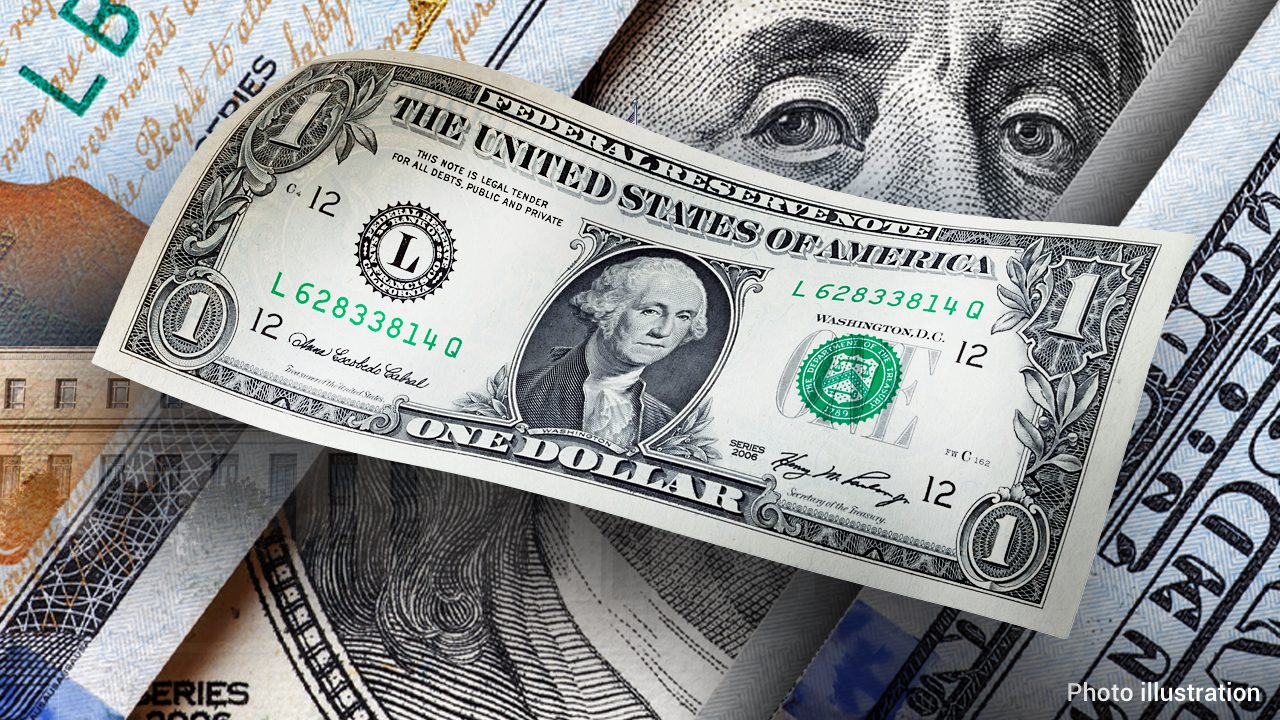
In the United States, a strong dollar has long represented the geopolitical strength that America holds over the rest of the world. But as the value of the greenback continues to fluctuate, could we be seeing the early stages of a de-dollarisation trend?
JPMorgan data shows that as recently as 2022, the dollar (USD) accounted for 88% of traded forex volumes, a figure that’s close to the currency’s record high. The Chinese yuan (CNY) made up just 7% of FX trade in comparison.
Despite this, the United States’ falling share in global exports and output has continued to decline over the past three decades as China’s has increased at a significant pace.
Join The European Business Briefing
New subscribers this quarter are entered into a draw to win a Rolex Submariner. Join 40,000+ founders, investors and executives who read EBM every day.
SubscribeThe dollar has long been recognised as the world’s reserve currency, but this status appears to be under considerable pressure, with more nations around the world looking to alternative reserve holdings.
Recently, central banks around the world began holding more gold than US Treasury securities for the first time since 1996 in a move that suggests a pivot away from the greenback is underway.
At the time of writing, central banks hold approximately 36,000 metric tons of gold, having levelled up their purchasing rates in the wake of the pandemic. It’s thought that this pivot towards safe-haven commodities like gold has been prompted by the post-pandemic inflation surge as well as the geopolitical instability that’s been taking place in Europe and the Middle East.
The trend pushed the value of gold to about $3,500 per ounce, a 35% increase compared to the beginning of 2025, with central bank holdings reaching around $4.5 trillion, far surpassing the $3.5 trillion held in US Treasuries.
The Dollar’s Mixed Outlook
De-dollarisation refers to nations around the world lowering their reliance on the US dollar for international trade, finance, and reserves. The impact of the process could have significant ramifications for the forex landscape as well as global equities.
The greenback has been shedding its value throughout 2025, owing to a period of volatility and long-term uncertainty surrounding President Trump’s hardline stance on trade tariffs. Since the beginning of the year, the dollar has slipped more than 11% against the euro, 4% against the Japanese yen, and 2% against the Chinese renminbi.
However, the dollar has been steadily making gains in recent weeks owing to stronger-than-expected US economic data, which could restrain future interest rate cuts by the Federal Reserve.
As the US gross domestic product (GDP) climbed at a revised rate of 3.8% from April through June, a figure that’s considerably higher than the initial 3.3% reported, it appeared that the dwindling fortunes of the dollar had briefly begun to turn around.
The environment surrounding interest rates in the United States can have a significant impact on the dollar’s strength. This is because high relative rates or expectations for higher rates can be attractive for investors when it comes to purchasing bonds, which pushes currency values higher.
Additionally, a trade surplus can indicate higher currency demand, as foreign buyers purchase more domestic goods.
However, periods of high inflation can adversely affect a currency’s purchasing power, placing downward pressure on its value compared to its counterparts in low-inflation economies.
As the Trump administration’s bold tariff policy continues to cause uncertainty over inflation and the rising cost of living domestically, we could be seeing the dollar’s struggles beginning to play out in real time.
Could De-Dollarisation Disrupt FX?
The amount of US Treasuries held at the New York Federal Reserve on behalf of global central banks has fallen to its lowest level in more than a decade, in a clear indication that de-dollarisation trends are continuing to impact foreign interest in the greenback. But what does this mean for investors?
According to Citigroup analysts, forex investors shouldn’t be concerned by the changing fortunes of the dollar, labelling de-dollarisation as a ‘mirage.’
The analysts suggested that balance of payments data in the United States show no signs of any mass dumping of the dollar and that there’s no significant correlation between inflows into foreign securities and the performance of the USD exchange rate.
Despite this, the weakening dollar price trends and the shifting outlook for the US on matters of trade suggest that the role of the greenback is changing under the Trump presidency. With a preference for a more protectionist approach, it may be worth long-term investors adopting a more diversified outlook for their holdings, which can help to lower any dependencies on the performance of the dollar alone.
The dollar remains the most influential player in the forex landscape, and its volatility will continue to shape the performance of all other currencies in the space.
For traders, the uncertainty ahead can offer plenty of opportunities, and keeping an ear to the ground for emerging trends and breaking news could pay dividends when it comes to seeking alpha.
Forex markets have become increasingly unpredictable since the start of the year. For traders, this presents plenty of opportunities and risks alike.