






























Growing an agency hinges on how quickly—and profitably—you can deliver search success for clients. The debate comes down to two models: investing in your own SEO department or partnering with a white-label provider. The sections below compare both paths across cost, speed, scalability and more so you can choose the structure that best fits your growth goals.
Cost structure and ROI timeline
Cash flow either fuels growth or strangles it, so let’s crunch the numbers first.
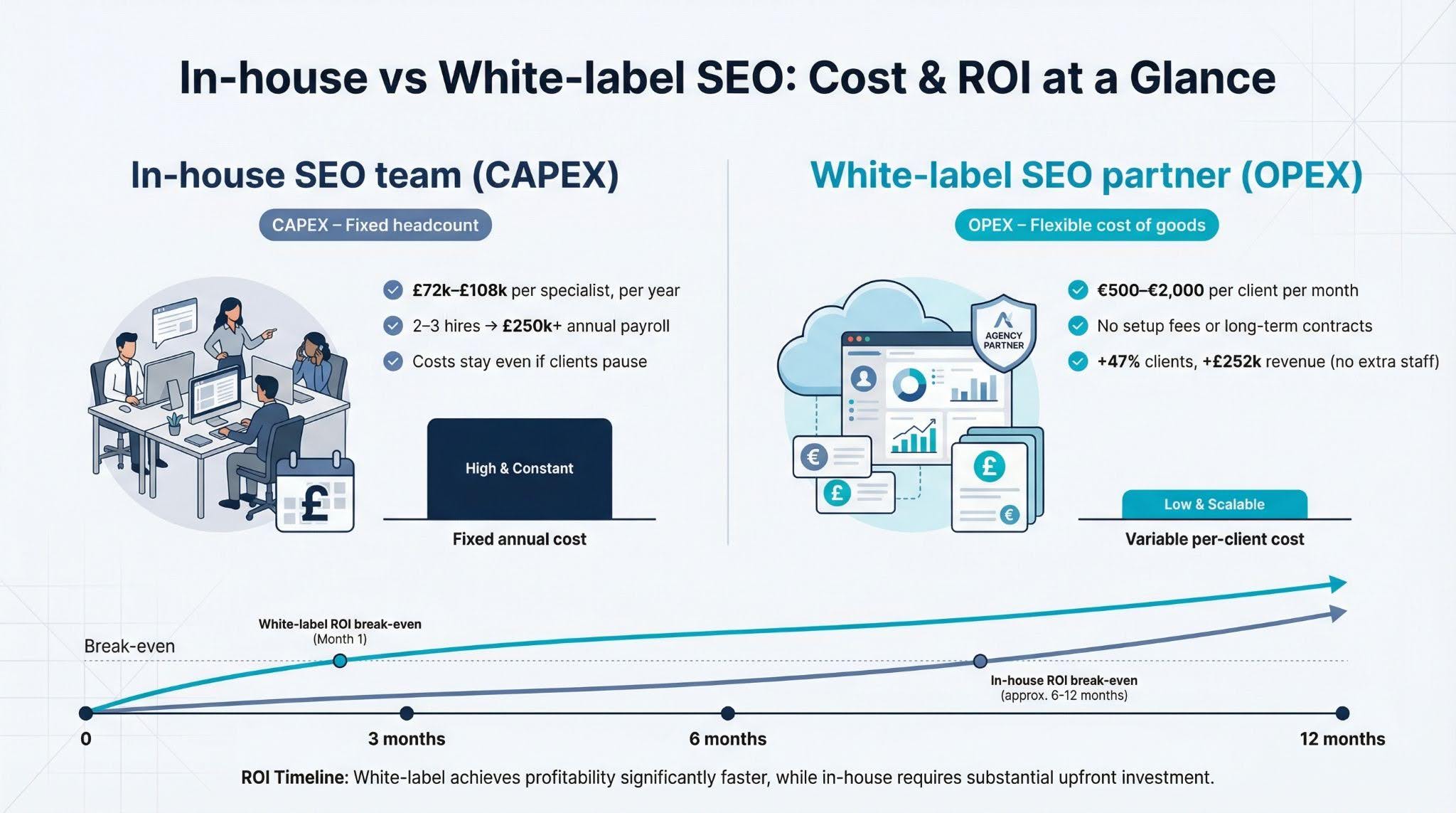
Hiring your own SEO squad is a fixed-cost commitment from day one. In the UK, a single mid-level specialist costs £72,000–£108,000 a year once benefits land on the ledger, according to a Wildnet Technologies analysis. Put two or three people on payroll and you’re north of a quarter-million before a single keyword moves — all while that salary line stays put if a client pauses.
Join The European Business Briefing
New subscribers this quarter are entered into a draw to win a Rolex Submariner. Join 40,000+ founders, investors and executives who read EBM every day.
SubscribeAccording to Wildnet Technologies, white-label pricing flips the equation. Leading partners quote fully managed campaigns at roughly €500–€2,000 per client each month, with no setup fees or long-term contracts. Because costs scale with revenue, you stay profitable even when a client churns.
Wildnet Technologies also found that agencies that switched to outsourcing served forty-seven percent more clients and banked an extra £252,000 in revenue without adding staff — meaning positive ROI in the very first billing cycle.
In plain English: in-house is CAPEX; white-label is OPEX. Decide whether you want permanent headcount on your balance sheet or a flexible, profit-aligned cost-of-goods line.
Speed to launch and first-results clock
Winning new clients is thrilling, but your shiny contract means little if you cannot execute quickly.
Building an in-house team slows that thrill to a crawl. Recruiting alone averages 45–60 days, and fresh hires typically need another couple of months before they ship solid work. By the time your team finishes its first technical audit, the client’s enthusiasm can fade.
According to DashClicks, white-label partners flip that timeline. Leading providers onboard agencies in about a week, slot campaigns into proven workflows, and begin publishing optimised content before your HR system even assigns a laptop.
That head start matters because SEO already demands patience; Google often needs four to six months to reward quality work. When outsourcing trims the prep phase to nearly zero, your clients see movement sooner, and early momentum buys priceless trust.
Speed is not a luxury; it is retention insurance.
Serving more than 1,200 agencies, AgencyPlatform’s White Label SEO benchmarks quantify that edge: a fully branded client dashboard goes live in 60 seconds, demo data populates instantly, and an account manager walks you through first-campaign setup before the kickoff call ends.
Its dashboard launches with your branding in 60 seconds and, per the company’s onboarding guide, the support team brands the portal, loads demo data, and walks you through the first-campaign setup on day one.
That means you can hand clients a live login and a baseline audit before the kickoff call even ends.
Scalability without the hiring headaches
Growth feels great until your calendar fills with interviews instead of strategy sessions.
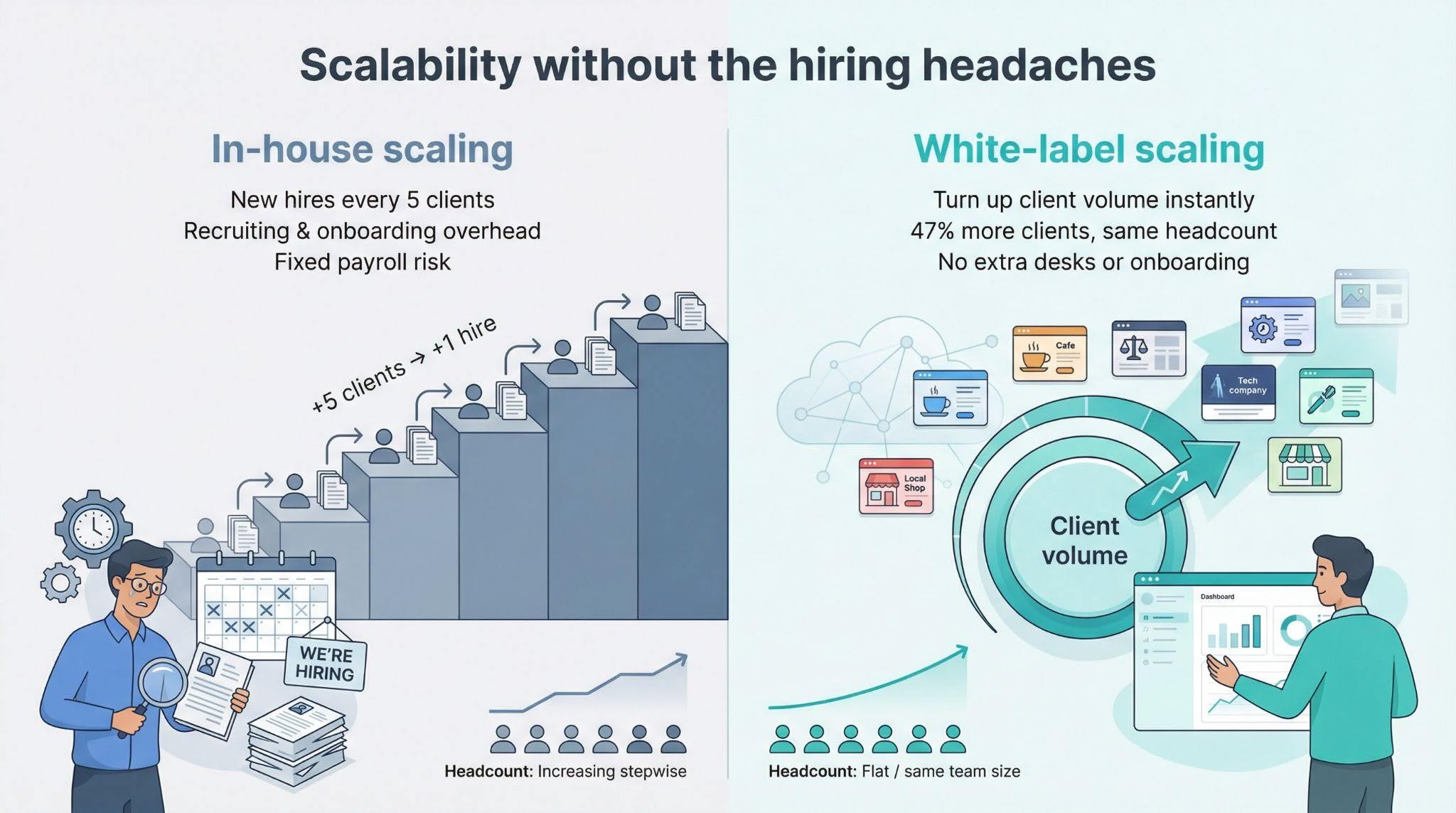
An in-house model scales in rigid, expensive steps. Each time you sign five new SEO retainers, you scramble to recruit another specialist, writer, or link-builder. Recruitment drags on, salaries lock in, and your margin wobbles whenever a prospect pauses.
White-label capacity works more like a volume dial: add ten clients tomorrow and your partner quietly increases output behind the curtain, with no desks, no onboarding, and no bruised culture when work slows again. Wildnet Technologies reports that agencies that made the switch handled forty-seven percent more clients within a year, all while keeping headcount flat.
That elasticity does more than pad revenue. It lets you pitch bigger deals with confidence, knowing fulfilment will never bottleneck the sale. Meanwhile, your core team stays focused on relationships and upsells instead of juggling workload charts.
If predictable growth is the goal, variable capacity wins every round.
Breadth of expertise on tap
Modern SEO is no longer a single craft. It covers technical audits, on-page optimisation, AI-ready content, digital PR, and analytics storytelling. Finding one hire who masters every strand is like scouting a striker who also keeps goal.
Building that multi-skill bench in-house either inflates payroll or leaves knowledge gaps that hurt delivery.
A seasoned white-label partner already has the full orchestra in place. Under the hood sit specialists who live in crawling logs, writers who understand E-E-A-T nuance, and outreach pros with hard-won media relationships. Your agency can tap that firepower the moment a client brief demands it.
Depth is not just academic. Wildnet Technologies notes that agencies that outsource specialist tasks report steadier results during Google’s core updates because someone inside the partner team tests fixes overnight while you rest.
In practice, white-label breadth lifts both ceiling and floor: higher strategic possibilities, lower risk of blind spots. You remain the conductor, crafting client strategy, while unseen musicians hit every note on cue.
Consistency and quality of results
Clients judge us on outcomes, not effort. Every title tag, backlink, and report must hit the same high standard month after month.
With an in-house crew, you hold the reins and can tweak the process the moment you see drift. Yet quality still rests on a handful of people. Holidays, turnover, or plain burnout introduce uneven patches no matter how solid your SOPs.
Top white-label providers counter that fragility with factory-level process control. They run multi-layer editorial reviews, link-cleanliness audits, and automated crawler checks before a deliverable reaches your inbox. Wildnet Technologies cites retention data showing leading partners maintain eighty to ninety percent client stick rates, clear proof that quality stays tight over the long haul.
So the choice is simple. If you can fund a deep internal QA bench, in-house works. If not, borrow a partner whose sole business is delivering repeatable, scoreboard-worthy results every cycle.
Control, communication, and client perception
Every agency owner loves the idea of total control, the ability to tap a teammate on the shoulder for an instant update. That immediacy is the in-house model’s strength. You oversee every tactic, join every brainstorm, and adjust strategy mid-sprint without waiting for an outside queue.
Yet that intimacy costs time. Managing writers, link builders, and analysts quickly pushes high-value client conversations off your calendar. Worse, if one key player calls in sick, the chain of command has no slack.
White-label partnerships change the equation. You give up direct oversight of daily execution, but you gain a structured feedback loop instead of ad-hoc pings. ValiantCEO reports that reputable providers assign a dedicated account manager, deliver weekly dashboards, and commit to service-level response times. When those guardrails are in place, agencies report smoother delivery than with a stretched internal team—no surprises, just a steady rhythm of updates.
Client perception? They rarely ask who wrote the meta descriptions; they judge you on clarity, results, and reliability. A branded portal and polished report preserve the illusion of an integrated team, while NDAs keep the partner invisible.
Choose your style of control. Hands-on may feel comforting, but structured collaboration frees you to steer the relationship, not the keyboard.
Tool stack and infrastructure
SEO pros run on data. Rank trackers, crawlers, content graders, link indices, and other licences each shave points off your margin.
Choose an in-house model and you shoulder the full stack. Backlinko estimates that a mid-tier agency plan for Semrush or Ahrefs costs about $450 to $500 per month. Add site crawlers, local-listing software, reporting dashboards, and AI-writing tools and you approach two thousand euros before payroll even appears on the ledger.
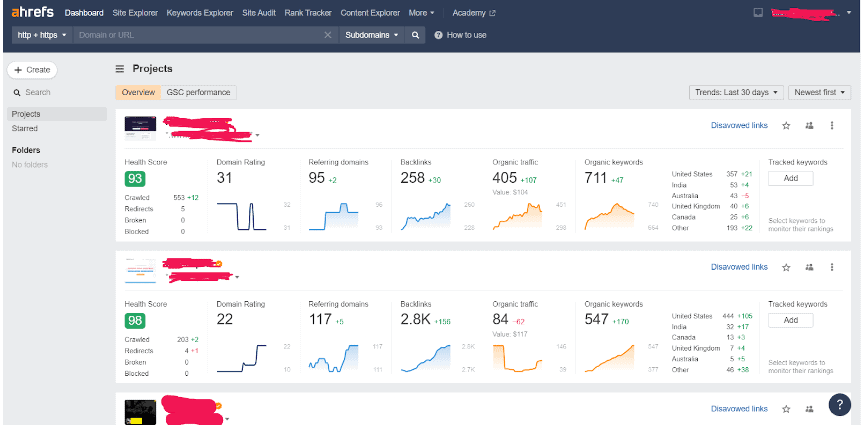
White-label platforms package that firepower into their fee. You and your clients log into a portal branded with your logo while the heavy lifting happens on infrastructure shared across hundreds of agencies. Scale cuts personal cost to a fraction and unlocks enterprise toys such as AI overview trackers, thirty-two-point audits, and automated KPI snapshots that most boutiques could not justify building alone.
Time is another hidden dividend. Growth Rocket notes that automated white-label reports save about four to six hours per client each month, freeing your strategists to focus on insight rather than formatting.
The takeaway: renting proven tech keeps budgets light and calendars clear for strategy—the part clients truly value.
5 Tools That Reveal the Real Cost of Building SEO In-House
One of the biggest myths in the white-label versus in-house debate is that building internally gives agencies more control at a lower long-term cost. In reality, the economics often look very different once you account for the software stack required to run SEO properly. Before an agency hires specialists, it usually has to invest in tools for reporting, research, audits, and campaign management. That stack adds up fast, which is exactly why white-label SEO software has become such a compelling growth lever.
- AgencyPlatform
AgencyPlatform sits at the top of this conversation because its White Label SEO program is built around the exact challenge agencies face when choosing between outsourced fulfilment and in-house delivery: how to scale SEO without building every system, team, and process from scratch. With a branded dashboard, fast onboarding, and agency-first workflow, it functions as more than a standalone tool—it acts as a ready-made fulfillment infrastructure designed to support client delivery under your own brand. For agencies focused on faster launch times, smoother execution, and stronger margins, that kind of white-label setup can reduce operational drag and shorten the path to revenue. - Semrush
Semrush is often one of the first platforms agencies buy when assembling an internal SEO function. It covers keyword research, competitor tracking, rank monitoring, site audits, and content planning in one ecosystem. The challenge is that while it centralises a lot of core SEO work, it also becomes a recurring cost centre—especially once multiple users, client campaigns, and reporting needs start to grow. - Ahrefs
Ahrefs is a go-to choice for backlink analysis, keyword discovery, and competitive intelligence. It is particularly valuable for agencies that lean heavily on link-building and search opportunity analysis. But in the context of ROI, it represents another reminder that in-house SEO is never just about salaries; it is also about layering premium data tools on top of payroll. - Screaming Frog
Screaming Frog is a technical SEO staple, helping teams uncover broken links, crawl inefficiencies, redirect chains, duplicate metadata, and indexation issues. It is powerful and relatively cost-effective compared with broader enterprise tools, but it still depends on having in-house expertise to interpret the crawl data and turn it into strategic action. A tool alone does not close the execution gap. - Looker Studio
Looker Studio is widely used to transform SEO data into client-friendly reports and dashboards. For in-house teams, it can be an effective way to bring together Search Console, analytics, rankings, and campaign KPIs under one branded view. The hidden cost, however, is time: building, customising, and maintaining those dashboards across multiple accounts can consume hours that could otherwise go toward strategy, sales, or client retention.
Branding, trust, and the white-label illusion
Your logo is your promise, so anything that dulls its shine is off-limits.
An in-house team naturally speaks in your agency’s voice. Content reviews happen at the next desk, style tweaks feel effortless, and the client never wonders who sits behind the curtain.
White-label delivery does not have to break the spell. Modern platforms let you stamp reports, dashboards, and even notification emails with your colours and typography. Clients log in, see your brand front and centre, and assume the insight came from “your SEO department.” They judge what lands in their inbox, not the payroll structure that produced it, notes ValiantCEO.

Brand risk still lurks if you choose a careless partner. Missed deadlines or templated copy flow straight through to the client’s perception of you. Protect your reputation with two habits: insist on NDA-backed confidentiality, and run one internal QA skim before anything ships out. Five minutes of review can prevent a five-figure churn.
Handled well, outsourced fulfillment lifts your brand. You appear bigger, faster, and more polished than headcount alone suggests, while your energy stays fixed on coffee meetings and boardroom pitches that build long-term trust.
Risk management: from talent gaps to GDPR gotchas
Running SEO in-house feels safe until your lead strategist resigns with two weeks’ notice. Delivery stalls, client calls pile up, and recruitment turns into a costly fire drill.
White-label partners spread that personnel risk across a deeper bench. If one writer quits, another steps in, and service levels stay steady.
European clients now expect proof of data residency, consent logs, and AI transparency. ValiantCEO highlights that mature white-label providers field those audits daily, offer signed data-processing agreements, and host reporting data in GDPR-compliant clouds.
Financial shocks add another layer. Salaries stay on the books even when a large retainer evaporates. Outsourced fulfilment converts that exposure into a variable cost you can dial down next month.
Outsourcing is not risk-free. Choose a budget provider and you invite black-hat tactics or missed deadlines that land on your brand. Mitigate with due diligence: review process documents, sample reports, and a no-poach clause before you sign.
Done right, white-label fulfilment trades single-point failures for system-level resilience—the insurance a growth-stage agency needs.
Long-term strategy: asset building or agility engine?
Zoom out from next quarter’s targets and ask: where do you want the agency in five years?
ValiantCEO observes that investing in an in-house department is like buying property. You grow proprietary know-how, shape a unique methodology, and showcase a “built here” badge during pitches. That asset can lift valuation when acquirers prize intellectual property and tightly knit teams.
The catch? Ongoing costs. You must fund research on every algorithm shift, cover continuous training, and keep utilisation above eighty percent or margins shrink. Scaling new service lines, such as Amazon SEO today or TikTok search tomorrow, means repeating the hire-train cycle from scratch.
White-label capacity feels more like a flexible lease. You plug into new specialisms the moment demand rises, without tying up capital. Providers already test AI-generated search, server-side tracking, and zero-click optimisation, and you inherit that innovation curve at wholesale cost.
Many mature shops blend the two: one senior strategist in-house to steer vision, outsourced muscle for execution. The hybrid model safeguards core IP while preserving the agility to bolt on fresh capabilities overnight.
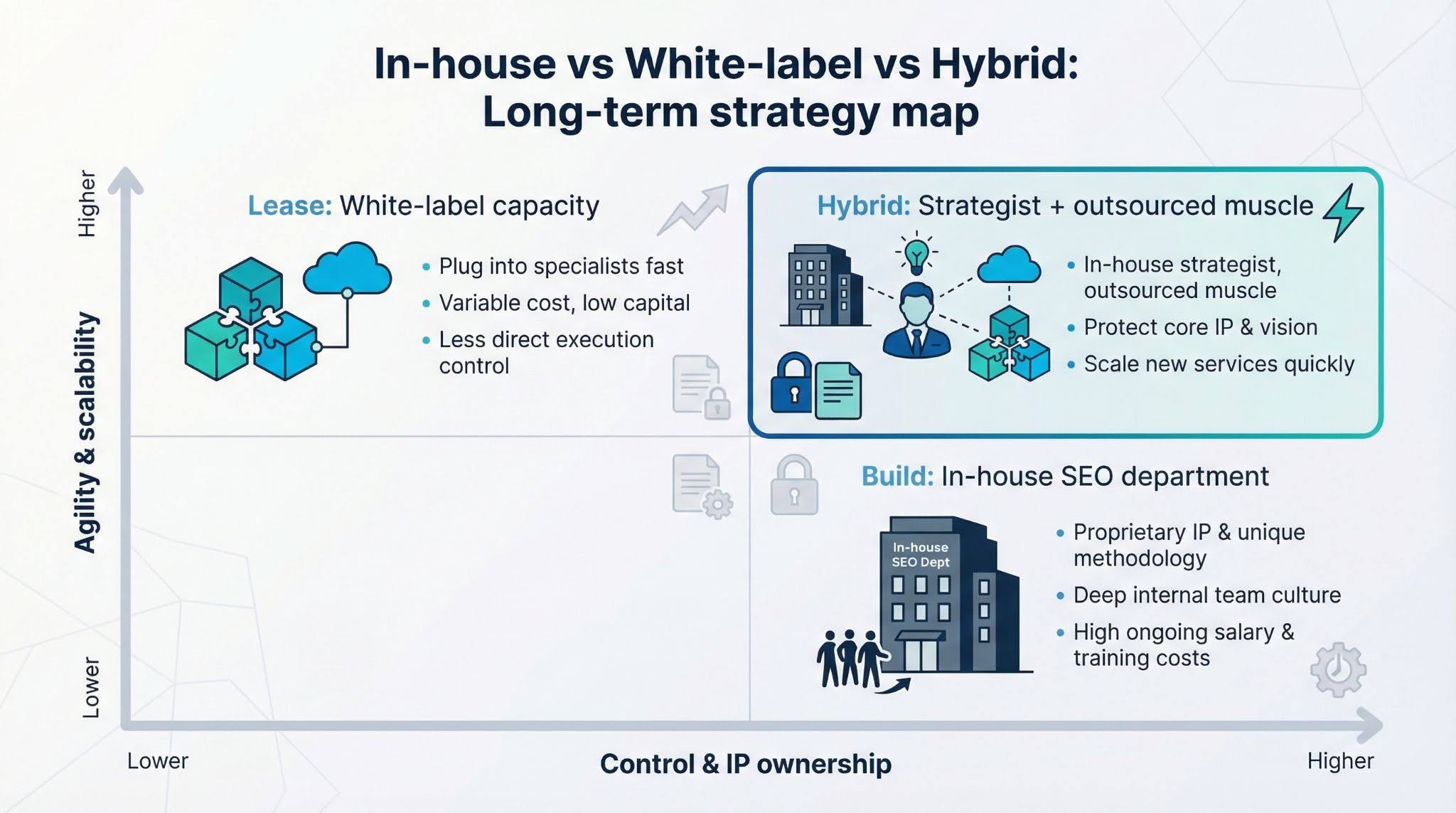
Pick the model that mirrors your growth philosophy. Build if you crave a signature process and can bankroll steady utilisation. Lease if speed, breadth, and low downside risk suit your roadmap. Or combine both, keeping strategic brains in the office and scalable brawn in the cloud.
Conclusion
When margins, speed, and scalability matter most, white-label SEO lets agencies expand without sinking cash into permanent overhead. If long-term intellectual property and total control are higher priorities, in-house investment can pay off. Most modern agencies land somewhere in the middle, pairing a lean strategic core with outsourced execution so they can adapt to whatever Google—and their clients—demand next.