




























For a DTC brand, expanding into Europe changes the fulfilment problem. What worked for a single home market, with one warehouse and one delivery promise, begins to strain across markets that differ in demand, expectations and maturity. Fulfilment then becomes an expansion infrastructure decision, not merely a question of which warehouse to choose. The most defensible approach is to commit inventory in stages, guided by evidence from real orders, rather than to build a full European footprint before demand justifies it.
Test demand before committing inventory
Europe is not one market. Buying patterns, delivery expectations and returns habits differ by country, and interest in a brand’s website does not always turn into repeat orders; a spike from a single campaign is not the same as repeat purchasing. Before placing substantial stock across the continent, leadership should look at where orders actually concentrate, how often customers return and which products are pulling demand. Shipping cross-border from an existing hub is a low-commitment way to test this. It reveals real order volumes and delivery friction without tying up stock in a market that may prove smaller than forecast. Only when a country or region shows consistent demand does local inventory become a rational next step.
Decide which SKUs should move closer to European customers.
Not every product deserves local stock. Proven SKUs, meaning those with steady velocity, predictable demand and healthy margins, are the strongest candidates, because their sales justify the storage and handling cost of holding them nearer the customer. Margin matters more than it first appears, because local stock adds holding costs that thin-margin products may not absorb. Seasonal lines, new launches and long-tail products are different. Their demand is harder to forecast, and an early commitment risks stranded stock. Delivery expectations add another filter: a category where customers expect fast delivery gains more from local stock than one where they are willing to wait. The decision is made product by product, not market by market.
Join The European Business Briefing
New subscribers this quarter are entered into a draw to win a Rolex Submariner. Join 40,000+ founders, investors and executives who read EBM every day.
Subscribe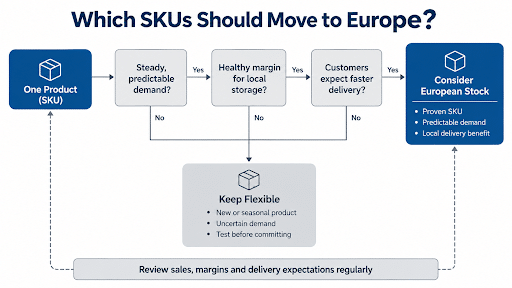
Allocate inventory gradually as markets mature.
Inventory allocation, the decision about which SKUs are held where and in what quantities, works best as a staged process. A brand might begin with a modest quantity of its best sellers in one regional warehouse, then increase depth or add locations only as sales confirm the case. Each increase should be tied to a trigger, such as sustained sell-through or repeat orders, so that the decision is repeatable rather than a matter of optimism. The alternative carries two risks. Overcommitting stock to one market ties up capital if that market underperforms, and duplicating the full catalogue across several warehouses multiplies storage costs and the risk of excess stock in each.
With a partner that operates a distributed European fulfilment network, you can treat allocation as a series of options rather than a single commitment. Stock is positioned where demand is proven, and newer or uncertain lines can remain in China until the data supports moving them.
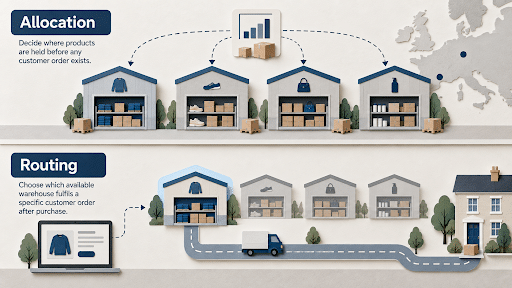
Inventory allocation comes before order routing.
Allocation and routing are frequently confused, though they belong to different stages. Allocation is made before any order exists. Drawing on demand data, it fixes each SKU’s location and the quantity held there. Routing is made after an order is placed. It selects which available location will fulfil that specific order, weighing stock, customer location, delivery expectations and shipping cost. In a distributed network, both matter. Allocation defines the choices that routing can make, and routing determines whether those choices are used well. Poor allocation leaves routing with little to choose from, and poor routing squanders sound allocation.
What a scalable European workflow needs
At executive level, the requirement is a single, trustworthy view of orders and stock across every location. That means integrations that automatically pull orders from the store and marketplaces into the fulfilment process, and inventory data that synchronises across warehouses. As a result, stock is not oversold, and visibility into what each site holds and ships improves. Routing rules then apply to each order, tracking information flows back to the customer, and replenishment can be timed from sell-through rather than guesswork. The workflow should also surface exceptions early, such as delayed inbound stock or orders that cannot be routed as planned. Without this layer, each new warehouse adds manual coordination, and complexity tends to outpace growth.
Example: expanding from one core European market
Consider a hypothetical brand whose orders come mainly from Germany and are served from a German warehouse. Over several months, repeat orders begin to build in neighbouring Austria and the Netherlands. Rather than opening a new position at once, the brand first increases stock of its steadiest sellers within the existing network and watches delivery performance and reorder patterns. If demand holds, it allocates a first batch of those SKUs to a regional location nearer the new markets. Newer products stay where they are. The example is illustrative and uses no real data.
Executive questions before expanding
Before committing inventory to a new market, leadership should be able to answer:
- Where are customers concentrated, and is demand repeating?
- Which SKUs have the velocity to justify local stock?
- How much inventory is the business prepared to commit, and how quickly could it be redeployed?
- What delivery promise does this market expect?
- How will returns be handled?
- What is the total cost, beyond postage?
- Can you see orders and stock in one place?
NextSmartShip, a fulfilment partner with connected warehouses, uses technology to keep stock visible, orders synchronised and routing rules consistent. That visibility can supply the data behind several of these answers, but the judgement about what to commit remains the brand’s.
Conclusion
A European fulfilment strategy is best treated as staged, not fixed. Test demand, place proven products nearer customers, and add regional stock as markets show they are ready. Allocation sets the position, and routing puts it to work on each order. Built this way, a distributed network follows actual demand rather than forecasts, which keeps commitments proportionate and options open.