































There is a particular quality of light on the Mediterranean coast that changes everything — the way a room feels at midday, the way a terrace looks at dusk, the way the sea appears to shift colour with every passing hour. Building a home in this landscape is not simply a construction project. It is an act of interpretation.
For those who have spent time on the Spanish Mediterranean coast — whether in the pine-scented hills above Ibiza, along the golden stretch of the Costa Blanca, or in the lush valleys behind Marbella — the idea of building a home there tends to move from daydream to serious consideration slowly, then all at once. The landscape demands it. The light insists.
What separates a house built in this environment from one that truly belongs to it is the quality of the decisions made long before the first stone is laid. Orientation. The relationship between interior and exterior. The materials that age well in salt air. The proportions that make a terrace feel like an extension of the living room rather than an afterthought. These are the questions that define luxury in the Mediterranean context — not square metres, not specification sheets, but the quality of the experience of being in a place.
Join The European Business Briefing
New subscribers this quarter are entered into a draw to win a Rolex Submariner. Join 40,000+ founders, investors and executives who read EBM every day.
SubscribeFor those exploring a villa for sale in these destinations, the distinction between a developer who understands this and one who doesn’t becomes apparent very quickly.
The Coast as a Design Brief
Ibiza, Marbella, the Costa Blanca — each has its own character, its own vernacular, its own relationship with the landscape. A villa that works in the hills above Santa Eulàlia is a different proposition from one perched on a cliffside in Altea or set into the Marbella hills with views towards Africa on a clear day. The best architecture on this coast doesn’t try to impose itself. It listens.
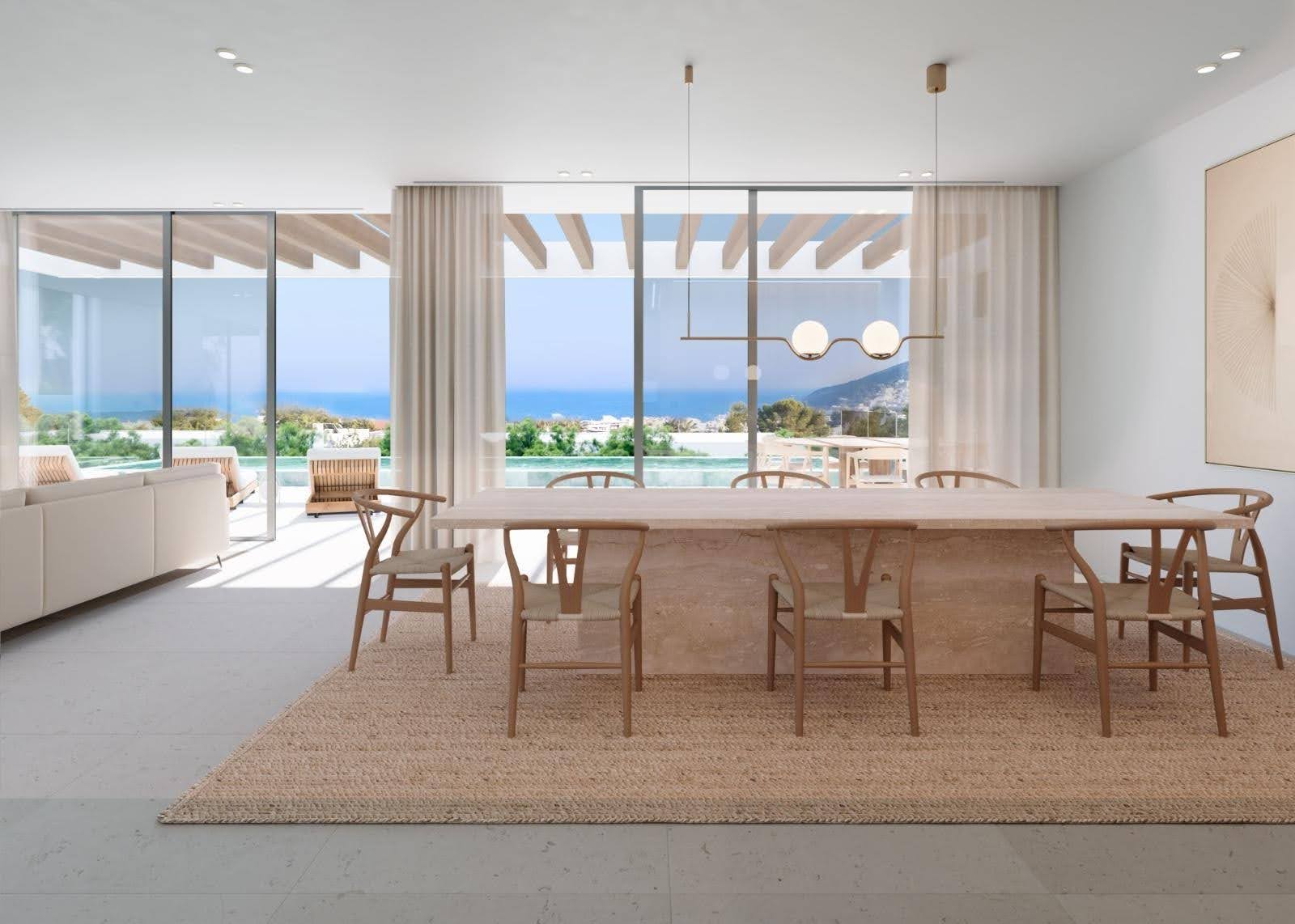
Contemporary Mediterranean architecture at its finest is defined by restraint. Clean lines that don’t compete with the horizon. Large openings — floor-to-ceiling glazing, covered terraces, pergolas — that dissolve the boundary between inside and outside. Natural materials: travertine, limestone, raw oak, linen. Pools positioned not as features but as mirrors, reflecting sky and sea back into the interior. The image at the top of this piece captures something of that sensibility — a dining room where the Mediterranean is not merely visible but present, where the furniture, the light and the view compose a single coherent idea.
It is an approach to architecture that takes the landscape seriously. And it requires developers who take the architecture seriously in return.
Miralbo: Building on the Mediterranean
Miralbo is a Spanish luxury villa builder and developer with projects across Ibiza, Marbella, and the Costa Blanca. The company has spent years working in some of the most demanding and design-conscious residential markets in Europe — environments where clients arrive with strong aesthetic convictions, where planning is complex, and where the quality of the finished product is immediately legible to anyone who spends time in it.
Their work has been recognised internationally, including through the European Property Awards — one of the most respected recognition programmes in the property industry. That recognition reflects something visible in the projects themselves: a consistency of approach, a commitment to construction quality, and an understanding that a luxury villa in this part of the world must earn its place in the landscape rather than simply occupy it.
Projects such as Villa The Wave, Villa Pinzon and Villa Essence represent different expressions of the same underlying sensibility. Each is specific to its site, its views, its relationship with the surrounding terrain. Each uses contemporary architectural language not as a style exercise but as a means of maximising the experience of living in a particular place at a particular latitude, where the sun moves in a particular arc and the sea has a particular colour in the afternoon.
What It Means to Build Well Here
There is a version of luxury construction on the Spanish coast that prioritises the brochure over the building — where the renders are more considered than the reality, where the materials look right in photographs but age poorly, where the relationship between a house and its site was never really thought through. It is, unfortunately, not uncommon.
Building well in the Mediterranean context means something more specific. It means understanding passive solar design well enough to keep interiors cool in August without relying entirely on air conditioning. It means knowing which stone weathers well, which timber holds its colour, which finishes look as good in ten years as they do on completion day. It means thinking about the view from every room, about where the shadow falls on a terrace at four in the afternoon, about how the sound of water from a pool carries through an open window.
It also means navigating the planning and regulatory frameworks of destinations like Ibiza — where building restrictions are among the most complex in Europe — with a level of expertise that only comes from years of working in a specific place.
The Landscape as a Collaborator
The Mediterranean coast is not a neutral backdrop. It is an active participant in the experience of any home built there. The quality of the air changes seasonally. The vegetation — rosemary, wild thyme, Mediterranean pine, bougainvillea — imposes its own palette. The topography of the Costa Blanca, with its series of headlands and coves, means that a few metres of elevation can transform a view entirely.
The best villa developers on this coast treat the landscape as a collaborator rather than a canvas. They work with topography rather than against it, terrace into hillsides rather than excavating them flat, use indigenous planting rather than imposing something foreign onto a site.
This is what gives the finest Mediterranean villas their quality of inevitability — the sense that they could not have been built anywhere else, that the site and the architecture have found each other. It is the hardest quality to achieve and the easiest to recognise.
An Enduring Appeal
The appeal of the Spanish Mediterranean coast to international buyers has proven remarkably durable. Political cycles, economic fluctuations, changing tastes in destination — none of these have significantly diminished the fundamental attraction of a well-built home in a landscape that offers reliable sun, extraordinary natural beauty, excellent infrastructure, and the kind of quality of life that is difficult to replicate elsewhere in Europe.
What changes is the standard of what buyers expect. The market for luxury villas on this coast has matured considerably. Clients are more informed, more design-literate, more attuned to the difference between a property that has been thought through and one that hasn’t. They have seen more architecture, travelled more widely, and brought those references to their expectations.
That shift has been good for the quality of what gets built. It has created space for developers like Miralbo — those who take architecture, materiality and the relationship with landscape seriously — to do work that genuinely raises the standard of what is possible here.
Conclusion
There is no shortcut to building well on the Mediterranean coast. It requires time, expertise, a genuine understanding of place, and a willingness to make decisions based on the experience of the finished building rather than on the economics of the construction process.
The reward, when it is done right, is a house that feels like it has always been there — that seems to have grown from its site rather than been placed upon it, that changes character with the light, that makes the sea and the sky and the landscape feel like part of the interior. That is what the finest contemporary Mediterranean architecture aspires to. And it is, ultimately, what makes the difference between a property and a home.