





























A Maturing Market Is Asking Harder Questions
Europe’s e-bike market has moved well beyond its early-adopter phase. What was once seen mainly as a niche product for cycling enthusiasts has become part of a much wider mobility conversation, shaped by commuting costs, congestion, sustainability targets and changing consumer habits.
But as the category matures, the buying criteria are changing. Range, motor power and design still matter, but they are no longer the only factors influencing purchase decisions. Safety certification is becoming a more visible part of the conversation, particularly as consumers, retailers and regulators pay closer attention to battery systems, chargers and electrical reliability.
For an industry built around lithium-ion technology, this shift is significant. It suggests that the next phase of growth may be defined not only by performance, but by trust.
Join The European Business Briefing
New subscribers this quarter are entered into a draw to win a Rolex Submariner. Join 40,000+ founders, investors and executives who read EBM every day.
SubscribeBattery Safety Is Now a Commercial Issue
E-bikes occupy an unusual position in the mobility sector. They are consumer products, transport tools and electrical devices at the same time. That combination creates opportunity, but it also raises expectations.
Consumers want bikes that can support daily commutes, weekend travel and mixed-terrain riding. Retailers want products that reduce after-sales risk. Insurers and regulators want clearer evidence that batteries and electrical systems have been tested properly. In that environment, safety certification is becoming more than a technical detail. It is becoming a commercial signal.
Certification helps simplify a complex product category for buyers. Most consumers cannot assess the quality of a battery management system or charger design by looking at a product image. But recognised testing standards can provide a clearer basis for comparison.
Europe’s Regulatory Culture Raises the Stakes
The European market is particularly sensitive to compliance. Across the region, e-bike rules are shaped by speed limits, motor output, product safety requirements and national enforcement differences. While regulation varies by country, the overall direction is clear: micromobility products are being held to higher standards as adoption grows.
This matters for brands. In a crowded market, technical claims alone are not enough. A model that promotes high power or extended range without addressing safety can appear out of step with buyer expectations. By contrast, brands that can connect performance with responsible engineering are better positioned to build long-term credibility.
For manufacturers and retailers, safety certification can also support channel growth. Distributors, marketplaces and dealers are increasingly likely to favour products with clearer documentation, especially as consumers become more aware of battery-related risks.
Consumer Trust Is Becoming a Competitive Advantage
The e-bike sector has often marketed itself around freedom: freedom from traffic, from fuel costs, from short-distance car dependency and from limited travel range. But freedom only becomes commercially persuasive when it is paired with confidence.
That confidence depends on several factors. Buyers want to know whether a bike is stable, whether the braking system is strong enough, whether the battery can support the advertised range, and whether the electrical system has been tested against recognised safety standards.
This is where certification can influence brand positioning. It gives companies a way to move beyond lifestyle messaging and speak to practical concerns. For business-focused consumers, commuters and older riders, that practical assurance can be just as important as design or speed.
How Puckipuppy Boxer St Reflects the Shift Toward Safer E-Bikes
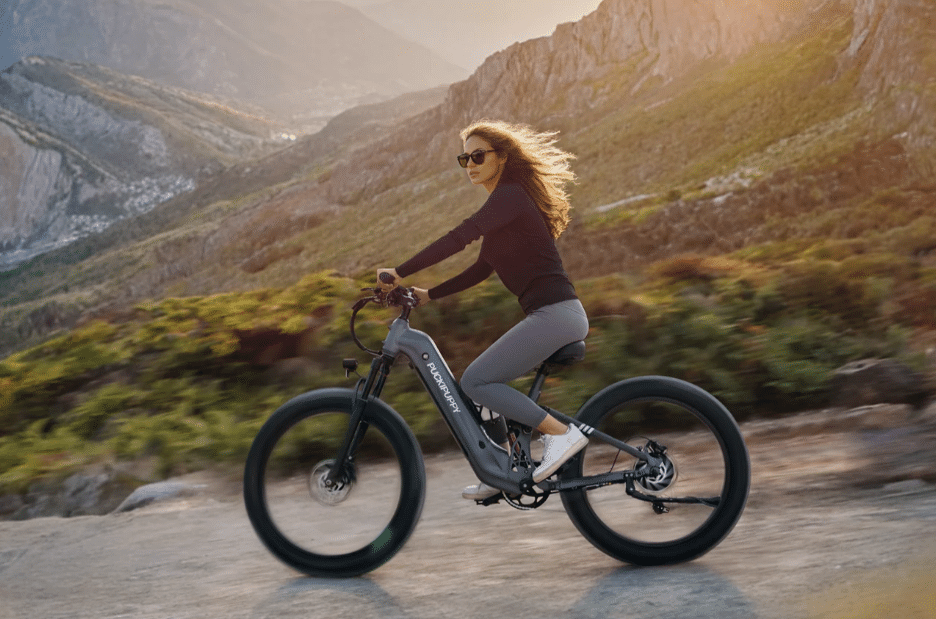
One example of how brands are responding to this shift is the Puckipuppy Boxer ST. Positioned as a step through electric bike, it is designed around easier access, comfort and everyday usability, making it relevant for riders who want a lower-entry frame without giving up stronger riding capability.
The Boxer ST also fits the growing demand for a fat tire electric bike that can handle more than smooth city roads. With wide 26-inch by 4-inch tyres, full suspension, hydraulic disc brakes and a removable 48V 20Ah battery, the model is aimed at riders who want stability across mixed surfaces, from urban routes to gravel paths and recreational trails.
From a market-positioning perspective, its strongest appeal is the combination of accessibility, terrain capability and safety-conscious specification. Puckipuppy states that the Boxer ST is certified to UL 2271 and UL 2849 by SGS, placing safety certification directly alongside performance features such as up to 80 miles of range and a 750W motor with 960W peak output.
For buyers comparing comfort-focused models, the Boxer ST offers a useful case study in where the market is heading: e-bikes that are not simply promoted as powerful or stylish, but as practical, accessible and built with greater attention to electrical safety. Riders should still check local e-bike regulations before purchase, particularly around speed and motor rules, but the broader positioning reflects a category-wide move toward more responsible product design.
Why Certification Will Influence the Next Phase of Growth
The e-bike industry is likely to face a more demanding consumer over the next few years. Early growth was driven by novelty, environmental awareness and the appeal of assisted cycling. Future growth will depend more heavily on reliability, transparency and trust.
Safety certification helps answer several questions at once. It reassures consumers, supports retailers, reduces reputational risk for brands and provides a clearer framework for product comparison. In a market where many models can appear similar at first glance, that clarity matters.
For European buyers, the most attractive e-bike may no longer be the one with the boldest performance claim. It may be the one that balances range, comfort, regulatory awareness and tested safety.
The Bottom Line for Brands
As Europe’s e-bike market becomes more competitive, safety certification is moving from the background to the centre of brand strategy. It is no longer just a compliance issue. It is part of how companies earn consumer confidence.
Brands that understand this shift will be better placed to compete in a market where buyers are increasingly asking not only how far an e-bike can go, but how safely and reliably it can get them there.