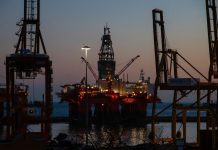































Four years into the full-scale war, Ukraine’s gas sector has been fundamentally reshaped. The industry has adapted to constant threats, yet it now faces a new set of structural constraints — from labor shortages to disruptions in global supply chains.
We spoke with Oleksandr Katsuba, owner of Alpha Gas Group, about how the economics of production function today, why formal “energy independence” does not necessarily translate into resilience, and what is preventing the sector from shifting from survival to growth.
Oleksandr Katsuba is one of the few entrepreneurs who has seen the market from both sides — within the state system, having previously held a senior role at Naftogaz, and now as a private investor. That dual perspective shapes his views: pragmatic, unsentimental, and focused on operational realities.
Join The European Business Briefing
New subscribers this quarter are entered into a draw to win a Rolex Submariner. Join 40,000+ founders, investors and executives who read EBM every day.
SubscribeThe Economics of Risk
Over the past two years, gas production in Ukraine has evolved into a business with an extreme operational profile. Infrastructure strikes have become routine, and resilience spending is now a fixed cost of staying in the game.
Q: We are now in 2026. How has the market structure evolved during the war? Has gas production become economically questionable?
The market has proven more resilient than many expected. The core structure hasn’t changed — a small group of major players still accounts for most of the output and continues to invest.
What has changed is the composition of investors. Those who were already in the country and understood the risks stayed and kept operating. New entrants have become even more cautious.
The logic of this business remains straightforward: higher risk implies higher potential returns. But today, that’s not a theoretical model — it’s day-to-day execution in an unstable environment where visibility is limited.
Q: Security has become a defining factor. What solutions actually work when it comes to protecting infrastructure?
There is no universal solution. You can’t predict where the next strike will land, and the infrastructure itself is inherently vulnerable.
We made a deliberate decision not to deploy local anti-drone systems. They tend to increase the visibility of an asset and create additional administrative friction. At the same time, there is still no clear mechanism for private companies to coordinate with air defense systems.
In the current environment, protection is less about prevention and more about the ability to recover quickly.
Q: So what does your protection strategy rely on?
Two things: protecting people and building redundancy.
First, full-scale shelters at every site. That’s a baseline requirement.
Second, duplication of equipment. Lead times have increased significantly, so we maintain a full backup of critical components. If a facility is hit, we don’t wait for new deliveries — we rebuild using what we already have.
It raises capital costs, but it reduces the risk of prolonged downtime. In today’s environment, that’s a rational trade-off.
The Illusion of Independence
Ukraine has reported minimal gas imports for several years. In practice, this reflects a contraction in demand rather than a surge in domestic production.
Q: Is the absence of imports a sign of resilience or a symptom of economic decline?
Closer to the latter. Imports are low, but not because production has increased significantly — demand has fallen.
Industrial consumption is down. That’s what defines the current balance.
Q: Which sectors have driven the decline?
Chemicals and metallurgy. Some facilities have been destroyed, others are idle, and some are operating at minimal capacity.
More importantly, no major industrial projects have been launched in recent years. That’s a key indicator of the broader economic environment.
Q: You’ve previously raised concerns about hundreds of dormant licenses. Has there been any progress?
No meaningful progress. A significant number of licenses remain inactive.
From a market standpoint, that’s inefficient allocation of resources. These assets could be producing, attracting investment, and generating output.
The solution is straightforward: review those licenses and reallocate them through transparent auctions. There is clear interest from existing market players.
The issue is execution.
Q: What about offshore production? Are there any realistic prospects?
Not in the near term.
There is no infrastructure — no fleet, no offshore rigs, no logistics. Building that requires substantial capital.
Given current reserves and pricing conditions, the economics don’t support it.
Global Pressure
Beyond domestic instability, the sector is also shaped by global constraints — from geopolitics to supply chain disruptions.
Q: How does U.S.–China competition affect your business?
Not directly on the political level, but significantly in logistics.
Delivery times have increased multiple times over. That affects planning and forces more flexibility in sourcing.
We procure equipment wherever it’s available faster. Quality remains acceptable.
Q: How acute is the labor issue?
It’s one of the key risks.
External migration stabilized after the first phase, but internal competition has intensified. We see specialists moving from state-owned companies to private firms.
Q: Why are private companies winning that competition?
It’s not just about compensation.
It’s about management. Less bureaucracy, faster decisions, clear accountability.
People want to see results. Private companies provide that more directly.
Business and the System
Interaction with the state and local communities remains a critical part of operating in the sector.
Q: Has the industry become more transparent?
New licenses are allocated through auctions — that mechanism works.
The main issues remain with legacy assets, where transparency is still limited.
Q: How do you work with local communities?
Through infrastructure projects and direct engagement.
Regions where production takes place see tangible investment — roads, social facilities.
Over time, that changes perception.
Q: How do you assess long-term strategies like “2050”?
In the current environment, long-term strategies have limited practical value.
Planning horizons are shorter. A mid-term approach is more realistic.
Q: What are your priorities through 2030?
Three areas:
- Reviewing licenses and activating idle assets
- Simplifying regulation, especially infrastructure connections
- Improving energy efficiency at the consumption level
These are basic steps that can deliver measurable results.
Q: Is a full transition to market pricing for households realistic?
Unlikely under current social conditions.
The burden on households is already high. Policy needs to balance market mechanisms with social stability.
Q: You actively support the military. Why focus on vehicles?
Because it’s a practical need.
Mobility underpins everything else. Without it, other systems don’t function effectively.
From a business perspective, it’s a rational contribution — stability directly affects our ability to operate.
Conclusion
Ukraine’s gas sector has adapted to extreme uncertainty, but it remains in survival mode rather than growth.
The key constraints are not only military, but institutional — inefficient resource allocation, regulatory barriers, and weak investment dynamics.
Without addressing these issues, resilience alone will not translate into development.