
































Anthropic’s new flagship beats its predecessor on nearly every benchmark. Whether it beats it on your invoice is a harder question.
A technical explainer | July 2026
When Anthropic released Claude Fable 5 on June 9, it did something unusual: instead of replacing its flagship, it stacked a new tier on top of it. Fable 5 is the first publicly available model in what the company calls the “Mythos class” — a category that sits above Claude Opus in capability, sharing its weights with the tightly restricted Claude Mythos 5 but shipping with additional safety measures. Claude Opus 4.8, released just twelve days earlier on May 28, remains on sale, remains supported, and — crucially — serves as Fable 5’s official fallback model. For anyone deciding where it actually fits, Fable 5 now sits alongside Opus 4.8 and 200-plus other models behind one router such as OrcaRouter, so the cost and speed trade-offs below are easy to put to the test through a single API.
Join The European Business Briefing
New subscribers this quarter are entered into a draw to win a Rolex Submariner. Join 40,000+ founders, investors and executives who read EBM every day.
SubscribeThat framing matters, because the two models are not competitors so much as a pair. Anthropic pitches Fable 5 at the hardest work: long-horizon agentic coding sessions that run for days, massive codebase migrations, deep research and analysis. Opus 4.8, which the company itself described at launch as a “modest but tangible” improvement over its predecessor, is positioned as the dependable default for well-scoped everyday tasks — feature development, focused debugging, test generation, code review — and for anything where latency or per-request cost dominates. Understanding when to reach for which model comes down to three things: speed, efficiency, and what a task actually costs to complete.
| At a glance | Claude Fable 5 | Claude Opus 4.8 |
| API price (per 1M tokens) | $10 in / $50 out | $5 in / $25 out (Fast Mode: $10/$50) |
| Measured output speed | ~63–73 tokens/sec (slower than average) | Faster; Fast Mode up to ~2.5x output speed |
| Time to first token (max effort) | ~109 seconds | Substantially lower |
| Context / max output | 1M / 128K tokens | 1M / 128K tokens |
| SWE-bench Verified | 95.0% | 88.6% |
Benchmark and pricing figures are Anthropic’s own or transcribed from its release materials; speed figures are independent measurements by Artificial Analysis. Figures current as of July 3, 2026.
The speed problem: thinking you cannot turn off
Fable 5 is, by most measurements, the slowest frontier model Anthropic has shipped. Independent testing by Artificial Analysis clocked it at roughly 63 to 73 output tokens per second — below the industry average — and at maximum reasoning effort, the time before the first token appears stretches to around 109 seconds. Nearly two minutes of silence before a single word arrives.
The cause is architectural, not accidental. Fable 5 runs exclusively in what Anthropic calls adaptive thinking: an always-on reasoning mode that cannot be disabled, only tuned through an “effort” parameter ranging from low to max (with an extra “xhigh” setting in Claude Code). The model decides how long to deliberate before answering, and developers who try to cap this with the older budget_tokens control simply get an API error. The raw chain of thought is never returned — only a summary, or nothing at all.
Opus 4.8 takes the opposite bet. It supports the same adaptive thinking but responds faster in ordinary use, and for latency-critical workloads Anthropic offers an API research preview called Fast Mode, which raises output speed to roughly two and a half times normal in exchange for doubled pricing — which, notably, lands at exactly Fable 5’s standard rate. In other words: for the price of Fable 5’s intelligence, you can instead buy Opus 4.8’s speed. That is a genuine fork in the road, and it is the clearest signal of how differently the two models are positioned.
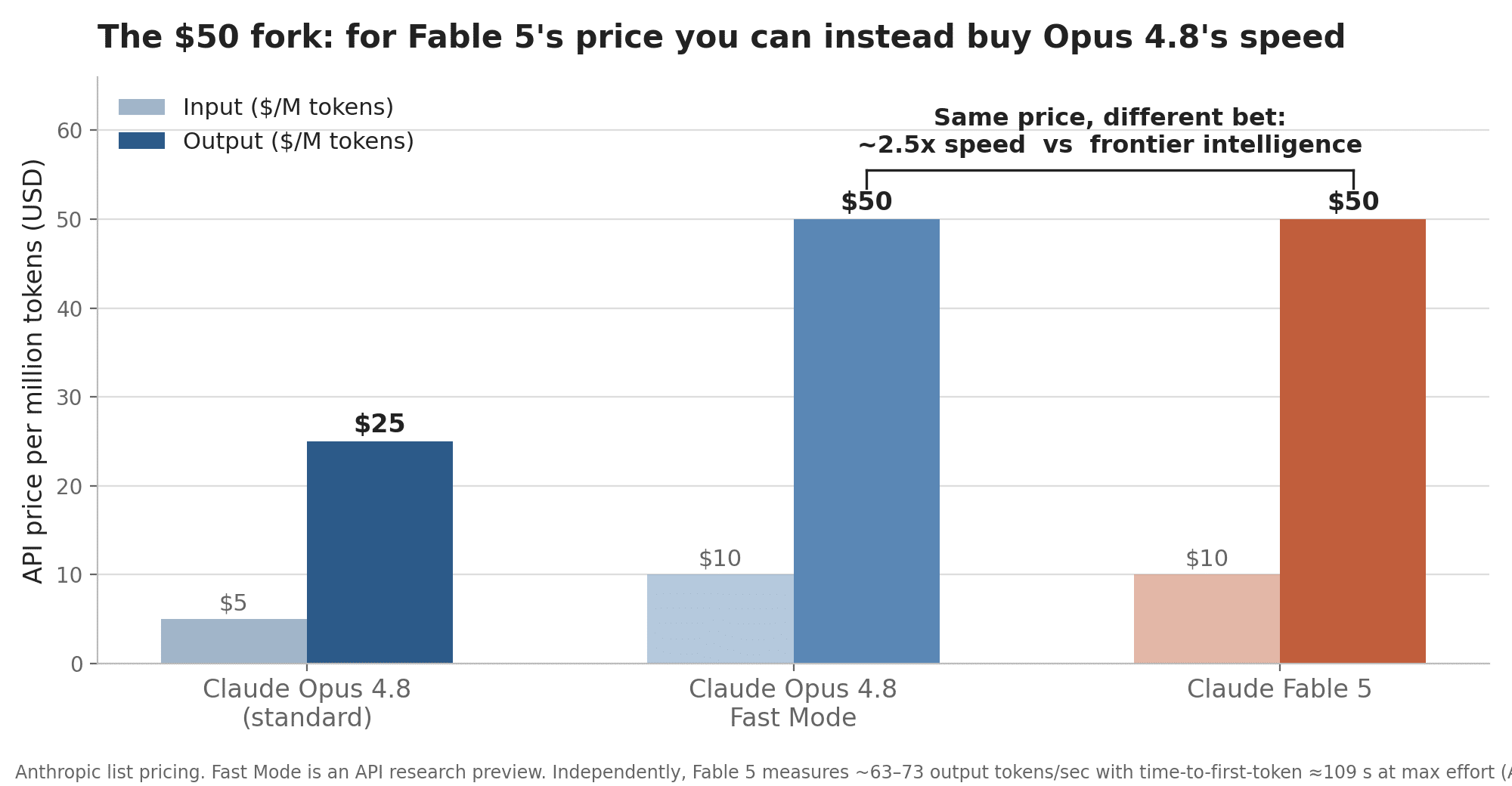
Figure 1 — At $10/$50 per million tokens, Opus 4.8’s Fast Mode and Fable 5 cost exactly the same: one buys speed, the other intelligence.
Price per token versus price per task
The sticker shock is real. At $10 per million input tokens and $50 per million output tokens, Fable 5 costs exactly double Opus 4.8’s $5/$25. Subscribers feel it too: inside Claude’s apps, Fable 5 burns plan quota at roughly twice the rate of Opus, and one Max-plan user reported exhausting an entire five-hour usage window in eight minutes by combining maximum thinking effort with parallel subagents. “Double Opus” quickly became shorthand for the community’s chief complaint.
But per-token pricing is the wrong lens for agentic work, and this is where the comparison gets interesting. What matters is the cost of a completed task — and completion cost depends on how many attempts, turns, and wasted tokens a model needs to get there. Third-party cost modeling (unofficial, but directionally consistent with customer reports) estimates that a routine task costs about $1.45 on Opus 4.8 versus $2.49 on Fable 5: for ordinary work, the cheaper model is simply cheaper. On frontier-difficulty tasks, however, the ranking flips — roughly $6.83 on Fable 5 against $7.46 on Opus 4.8 — because Fable succeeds more often and needs fewer turns to do it. Anthropic’s own customers echo the pattern: one spreadsheet-automation firm reported Fable 5 beating Opus 4.8 at every effort level while running 25 to 30 percent faster on their workload, and the model’s benchmark scores scale sharply with effort where competitors’ plateau.
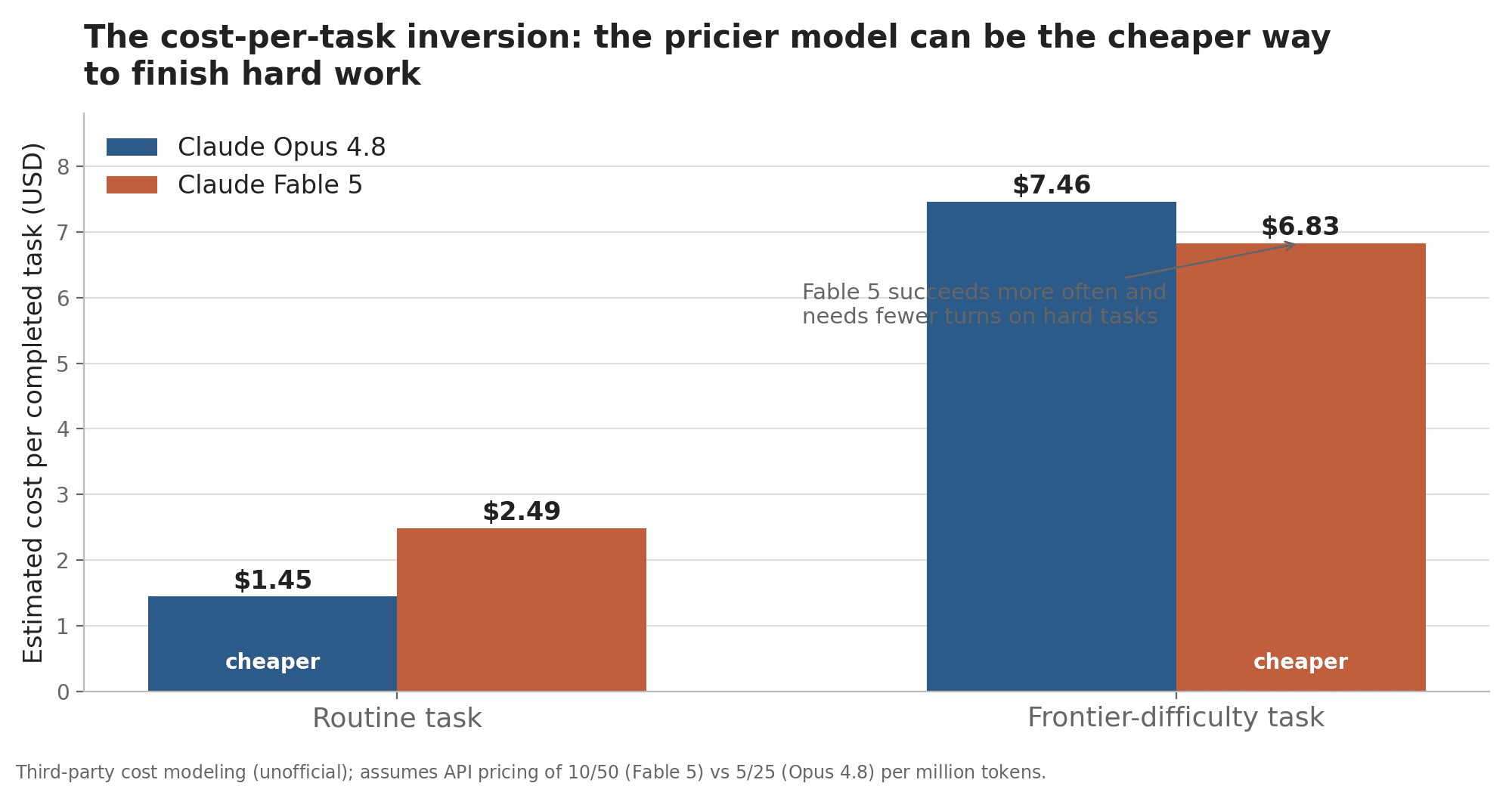
Figure 2 — On routine work the cheaper model is simply cheaper; on frontier-difficulty tasks the ranking flips, because Fable 5 fails less and finishes in fewer turns.
Two pricing mechanics soften the premium further. Fable 5’s full one-million-token context window is billed at flat rates — unlike rivals such as GPT-5.5 and Gemini 3.1 Pro, which double their prices beyond certain context thresholds — which narrows the gap precisely on the giant-context jobs Fable is best at. And prompt caching, with cache reads at $1 per million tokens, is close to load-bearing at Fable’s prices: for long agentic sessions that repeatedly reread the same repository, it is the difference between a manageable bill and a runaway one. Batch API discounts of 50 percent apply to both models.
The catch: sometimes you pay for Fable and get Opus
There is one more wrinkle in the economics, and it doubles as Fable 5’s most distinctive limitation. Because Fable 5 shares weights with the restricted Mythos 5, it ships with safety classifiers covering cybersecurity, biology and chemistry, and model distillation. When a request trips one, Claude’s consumer apps transparently fall back to Opus 4.8 and notify the user; API calls are blocked by default unless the developer configures their own fallback. Anthropic says this happens in under 5 percent of sessions, though independent testing has measured higher rates on science-heavy workloads — Artificial Analysis recorded fallbacks on roughly 8 percent of its Intelligence Index tasks, and on one terminal-agent benchmark over a fifth of trials were affected.
The billing is at least honest: requests served by the fallback are charged at Opus 4.8 rates, and requests refused before any output is generated cost nothing. But the practical implication for buyers is that Fable 5’s effective quality — and effective price — in safety-adjacent domains is closer to Opus 4.8 than the headline benchmarks suggest. (The reliability and false-positive side of this story is covered in depth in the companion article.)

The playbook: route, don’t choose
The emerging consensus, from Anthropic’s own positioning to community routing setups, is that this is not an either-or decision. The pattern practitioners have converged on: make Opus 4.8 the default, and escalate only the hardest slice of work — the long-horizon migrations, the multi-day agent runs, the analysis that Opus has already plateaued on — to Fable 5. Multi-model gateways formalize this, often using Fable 5 as the “planner brain” that decomposes a problem and judges the results, while cheaper models do the execution.
The decision rule that falls out of the data is simple to state. If a task is well-scoped, latency-sensitive, or running at high concurrency, Opus 4.8 wins on cost and speed, and Fast Mode exists if you need it quicker still. If a task is genuinely hard — hard enough that the cheaper model would burn turns failing at it — Fable 5’s doubled token price can be an illusion, and the more expensive model is the cheaper way to get the job done. The skill Anthropic is really selling, it turns out, is knowing which of your problems is which.