






























An OEM T-shirt import program needs a repeatable specification and a clear approval process for every order. Record the fabric, measurements, decoration, labels, and packaging, then confirm what may change on a reorder. A retained pattern does not guarantee that the same fabric shade, price, or production slot will remain available.
Use those checks when choosing an OEM t-shirt manufacturer. This guide explains what to confirm with a T-shirt supplier in China, using UNIT-100’s factory information from October–November 2026 to illustrate minimums, production arrangements, inspections, and reorder planning.
Quick Answer: What Should You Look for in an OEM T-Shirt Manufacturer?
Look for an OEM T-shirt manufacturer that records your specifications, identifies which facilities perform each operation, and agrees on sample approval and inspection checkpoints. Confirm MOQ per style and color, sample type, bulk timing, packaging minimums, and payment terms in writing. At UNIT-100, full custom starts at 100 pieces per style, per color; stock blanks with a logo start at 50 pieces per style. A pilot order still needs to meet the applicable minimum.
Join The European Business Briefing
New subscribers this quarter are entered into a draw to win a Rolex Submariner. Join 40,000+ founders, investors and executives who read EBM every day.
SubscribeWhat OEM Means in Practice
In an OEM arrangement, the factory manufactures to the buyer’s agreed design and specifications for sale under the buyer’s brand. For T-shirts, the specification can cover fit, fabric, trims, decoration, labels, and packaging. Manufacturing to your specification does not by itself establish who owns or receives the physical patterns or tooling; record those arrangements separately.
This model suits importers and brands that already know what they want to sell. It offers more differentiation than catalog products, but it also puts more responsibility on the buyer to define the product clearly. A vague brief produces a vague shirt, regardless of how good the factory is.
Build the Specification Package First
Before approaching suppliers, assemble a package that any factory can quote against and produce from. At minimum it should include:
- Garment sketch or reference sample showing silhouette and details
- Measurement chart by size, with tolerances
- Fabric specification: fiber content, GSM, knit type, and finishing
- Construction notes: collar, sleeve, hem, seam types, and stitch details
- Decoration files: vector artwork, color references, size, and placement
- Labeling and packaging: neck labels, care labels, hangtags, polybags, and carton marks
- Quantity plan by size and color
A complete package makes quotes easier to compare. Give it a version date and record approved changes so the factory and buyer work from the same specification. If you only have a reference garment or photo, UNIT-100 can use it to begin the discussion, but fabric, measurements, construction, and artwork still need confirmation before production.
Choosing a T-Shirt Supplier in China: What Actually Matters
Plenty of suppliers appear identical on a listing page. The differences show up in the details you verify.
Factory or Intermediary
Ask directly whether the company operates its own production facility. Intermediaries can be useful, but the structure affects pricing, communication speed, and accountability. Request production photos or a video walkthrough, and confirm which stages happen on site.
Owned Facilities and Partner Operations
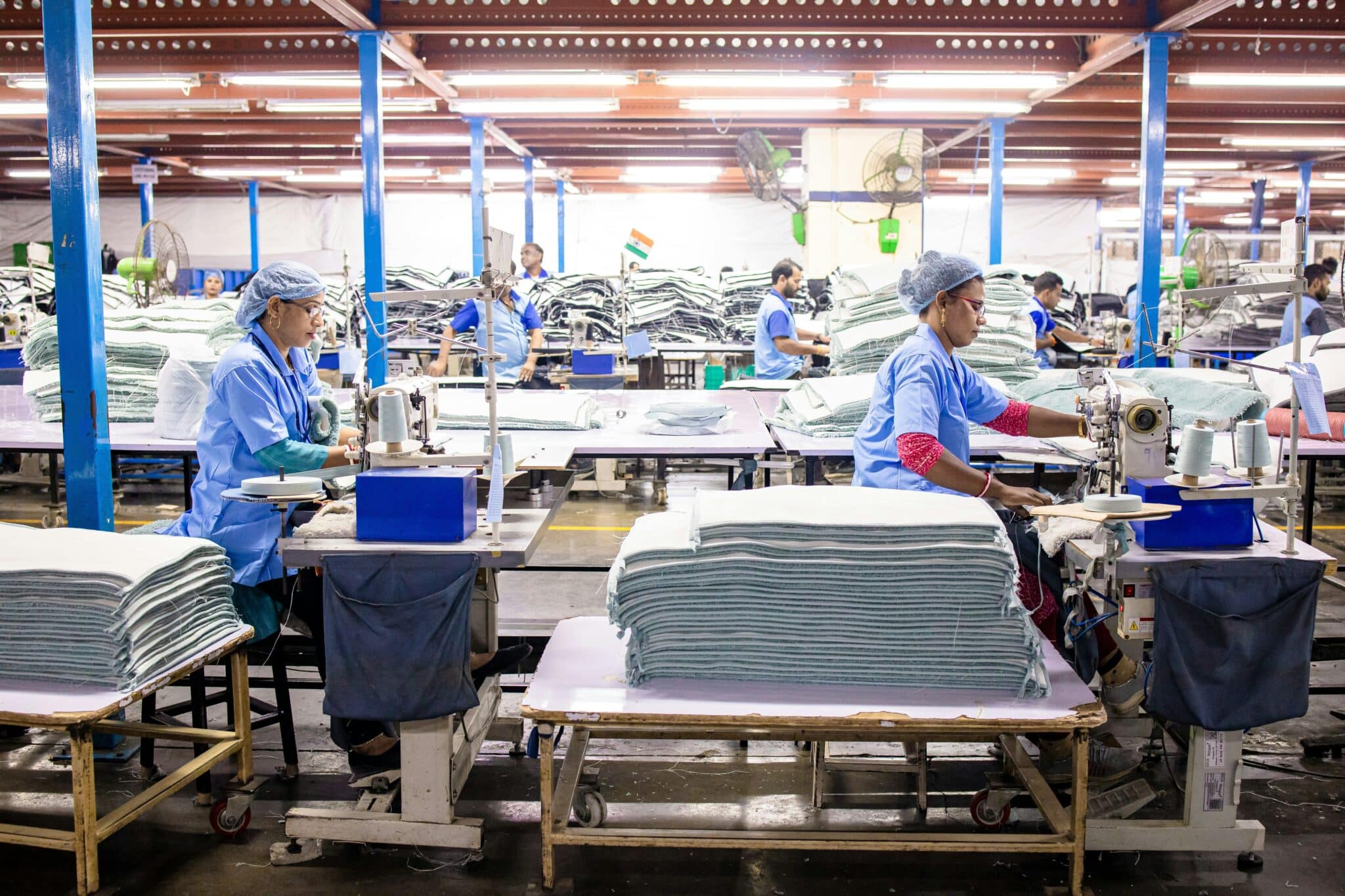
Ask which operations are performed in owned facilities and which go to partners, then identify who coordinates quality checks. UNIT-100 owns a sewing factory in Shaxi, Zhongshan, and a print shop in Henglan, Zhongshan. Embroidery, garment washing, garment dyeing, and sublimation are handled by partners. Some sewing also goes to partners when its own lines are full.
Experience and Stability
Ask about the product categories the factory actually makes and request examples relevant to your specification. UNIT-100 is the brand of Guangzhou Vision Clothing Co., Ltd., a family business founded in 2001. Its second-generation owner, Kenneth, had eight years in the business as of November 2026. Company history provides context; inspect the sample and production arrangements for your own order.
Sampling Behavior
Use sampling to check feasibility, measurement records, and how changes are documented. UNIT-100 reports making a sample for every order and a pre-production sample before bulk. Confirm which version is approved, retain the measurements and comments, and specify any wash or decoration checks needed for your product.
Communication
Specific, written answers during quoting are a strong signal. Slow or vague responses tend to continue into production.
Protecting Your Designs and Specifications
OEM work involves sharing artwork, patterns, and brand details. Reasonable precautions don’t need to be adversarial.
- Ask whether the supplier will sign a confidentiality agreement
- Share only the files needed for each stage
- Keep your own master copies of artwork and approved samples
- Clarify in writing who owns patterns and custom tooling developed for your product
- Confirm that your branded labels and packaging are used only for your orders
UNIT-100 says it can sign a confidentiality agreement and will not show a customer’s garments to others when asked to keep them private. Agree on the scope before sharing the files. It retains patterns and cutting markers permanently but generally does not hand patterns to customers. Print screens are kept for six months. These are different records with different retention arrangements; confirm what you will receive and what the factory will store.
Payment Terms, Timing, and Shipping
Commercial terms deserve the same attention as product specifications.
Payment. UNIT-100 reports a 30–50% deposit, with the balance paid before shipping. It sends bulk photos or video before the balance payment and welcomes buyer-appointed inspectors. Confirm the payment schedule and inspection timing in the order terms; photos alone do not replace checking the agreed specifications.
Lead times. Separate development, production, and transport. UNIT-100’s estimates as of November 2026 are:
| Stage or order type | Planning estimate |
| Plain sample | 3–7 days, including about 3 days for patternmaking |
| Sample with printing or embroidery | About 10 days |
| Sample with both printing and embroidery | 12–13 days |
| Washed sample | 14–18 days or longer |
| Standard bulk after sample approval | 7–20 working days |
| Tie-dye, acid-wash, or snow-wash bulk | About 20–30 days |
| Same-style reorder with trims ready | About 15–20 days |
Confirm fabric and trim availability, revisions, and the production slot for the actual order. Shipping is separate. These estimates are not guaranteed arrival dates.
Shipping terms. Clarify who arranges freight, who handles export documentation, and where responsibility transfers. Ask for packing lists and carton details in advance so customs clearance and warehouse receiving go smoothly.
Documentation. Keep the approved specification, invoices, packing lists, fiber information, inspection results, and change records together. Before production, give the supplier the labeling and documentation requirements confirmed for your destination with your importer or customs adviser. A supplier’s ability to print a label does not establish that its content meets every market’s requirements.
Buying Guide: What to Compare Between Suppliers
| Factor | What to Compare |
| Factory verification | Company identity, facility locations, and relevant production evidence |
| Production setup | Owned operations, partner operations, and inspection responsibility |
| MOQ | Minimum per style and color, including the conditions for a pilot run |
| Samples | Plain, decorated, or washed sample timing and approval records |
| Bulk and reorders | Material readiness, production slot, and shipping separately |
| Fabric | Composition, GSM, shade reference, and substitution approval |
| Labels and packaging | Separate minimums, preparation time, and ownership of leftovers |
| Quality control | Inspection stages, agreed tolerances, results, and remedy process |
| Design records | Confidentiality, pattern access, screen retention, and master files |
| Commercial terms | Quote inclusions, payment timing, freight responsibilities, and reorder pricing |
Ask each supplier the same questions and compare written answers instead of relying on impressions.
Common Mistakes to Avoid
Starting with the biggest order. Use a manageable first order to evaluate the sample-to-bulk process, but confirm the applicable MOQ and quote. A pilot run is not automatically exempt from normal minimums.
Accepting a sample without washing it. Check measurements, color, and decoration before and after the agreed laundering method. Record acceptable changes before bulk production.
Leaving fabric specs open. Without GSM and fiber content in writing, substitutions can happen unnoticed.
Mixing up timelines. Sampling, bulk production, and shipping each take time, and combining them leads to missed deadlines.
Choosing on price alone. Low quotes can hide weak quality control, slow communication, or inconsistent reorders.
Skipping documentation. Missing records make reorders and disputes harder to resolve.
Ignoring compliance in your market. Labeling and fiber content requirements vary by destination, so confirm them before production.
Expert Tips
Define quality standards in advance, such as measurement tolerance, color acceptance, and defect limits. Agree on them before production starts so inspection results aren’t open to interpretation.
Keep a golden sample, the approved garment used as the production reference, and ask the factory to retain one too. Record measurements, fabric, shade, artwork placement, and any agreed variation. For acid-wash and snow-wash products, UNIT-100 cautions that bulk may not be identical to the sample because treatment and fabric batches vary.
Request photos during production, such as cut panels, printed pieces, and packed cartons. Early visibility helps you catch problems when they’re still easy to fix.
Agree on inspections before production, during production, at completion, and before shipment. UNIT-100 reports pre-shipment sampling inspection using AQL 2.5; ask for the actual inspection plan and report alongside the agreed tolerances. It welcomes buyer-appointed and third-party inspectors. If a problem is found, its reported process is to discuss the issue and consider rework, remake, or compensation according to the case.
Plan reorders before stock runs low. UNIT-100 estimates about 15–20 days for the same style when trims are ready, but material availability and the production slot still need confirmation. A smaller reorder can have a higher unit price because fixed preparation costs remain. Do not assume an automatic reorder discount or annual price lock.
Before Releasing a Repeat Order
Confirm the specification version, current fabric and shade, retained print screens, remaining labels, quantities by style and color, inspection plan, price, and dispatch date. If a fabric or decoration component changes, agree whether a new sample or other approval is needed before bulk.
UNIT-100: MOQ, Materials and Packaging for OEM Orders
UNIT-100’s full custom starting point is 100 pieces per style, per color, with sizes mixed. Its stock-blank service with a logo starts at 50 pieces per style, with colors and sizes mixed subject to availability. Stock decoration and full custom development are different routes; specify which you need when requesting a quote.
For T-shirts, UNIT-100’s usual fabric range is 160–400 GSM, with 210–230 GSM frequently used. It defines heavyweight T-shirts as starting at 240 GSM, commonly 240–300 GSM. Confirm composition, knit structure, and the washed sample rather than choosing on weight alone.
Packaging minimums are separate from garment quantities. Custom neck and care labels each start at 500 and take about 8–10 days to prepare. Hangtags, stickers, and tissue paper start at 500, usually around 10 days. Custom printed bags start at 5,000 and take about 10–15 days. Unused woven labels belong to the buyer and can be stored for later orders or shipped to them. Ask which preparation tasks can overlap production.
FAQs
What does OEM mean for T-shirts?
The factory produces to the buyer’s agreed design and specifications for sale under the buyer’s brand. Define fabric, fit, decoration, labels, and packaging in the specification, and agree separately on pattern ownership, access, and delivery.
What is the minimum order for an OEM T-shirt order?
UNIT-100’s full custom starts at 100 pieces per style, per color, with mixed sizes. Stock blanks with a logo start at 50 pieces per style, with mixed colors and sizes subject to availability. Packaging and labels have separate minimums.
How long do samples and bulk production take?
UNIT-100 estimates 3–7 days for a plain sample, about 10 days with printing or embroidery, 12–13 days with both, and 14–18 days or longer for a washed sample. Standard bulk is 7–20 working days after sample approval; special wash orders take about 20–30 days. Confirm revisions, materials, trims, and shipping separately.
How do I check whether a supplier is a real factory?
Ask which production stages are done on site, request production photos or a video call, and confirm directly. Written answers help you compare suppliers.
How does UNIT-100 handle confidential designs and patterns?
UNIT-100 says it can sign a confidentiality agreement and keep customer garments from being shown to others when requested. It retains patterns and markers permanently but generally does not hand patterns to customers. Print screens are kept for six months. Agree on access, deliverables, and confidentiality before sharing production files.
What GSM should I choose?
UNIT-100 frequently uses 210–230 GSM for T-shirts. Its heavyweight range starts at 240 GSM, commonly 240–300 GSM. Choose against your intended fit, composition, climate, and washed sample rather than treating weight as a quality score.
Can the supplier handle labels and packaging?
UNIT-100 can arrange labels and packaging. Custom neck and care labels each start at 500, while custom printed bags start at 5,000. Confirm timing, quote inclusions, leftover handling, and the label content required for your destination before production.
Conclusion
To build an import program with an OEM t-shirt manufacturer, start with a versioned specification, an approved sample, and written inspection and commercial terms. Ask a T-shirt supplier in China to identify the actual production facilities, confirm quantities by style and color, and explain what it retains for reorders. Before each repeat order, reconfirm materials, price, and timing instead of assuming the first order’s conditions still apply.