
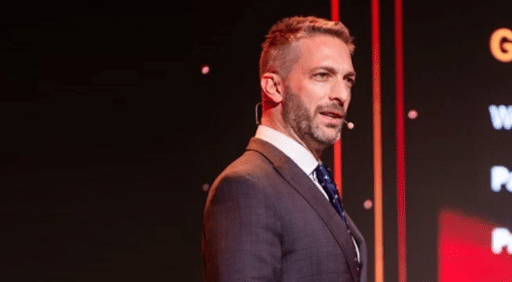
 Software vulnerabilities have overtaken stolen credentials as the most common entry point for cyberattacks, accounting for 31% of data breaches, according to Verizon’s 2026 Data Breach Investigations Report. With artificial intelligence accelerating the exploitation of security flaws, businesses are facing increasingly short windows in which to respond.
For Greg van der Gaast, once named among the world’s five most notorious hackers and now a cybersecurity adviser and former chief information security officer, the industry’s greatest challenge lies in the preventable weaknesses that businesses and technology suppliers continue to introduce into their systems.
In this exclusive interview conducted by the Afrer Dinners Speakers Agency Greg examines why conventional cybersecurity strategies are becoming unsustainable, how poor operational decisions expose businesses to unnecessary risk and why smaller companies may be better positioned to defend themselves than multinational corporations.
Join The European Business Briefing
New subscribers this quarter are entered into a draw to win a Rolex Submariner. Join 40,000+ founders, investors and executives who read EBM every day.
SubscribeAI accelerates the discovery and exploitation of software vulnerabilities, how sustainable is the current approach to cybersecurity?
Greg van der Gaast: “They can’t. Not by continuing to approach cybersecurity as an endless battle against vulnerabilities.
“The uncomfortable truth is that we create these weaknesses ourselves. We’ve known how to engineer secure, reliable technology for decades. We also understand the organisational pressures, incentives, poor practices and human factors that cause defects to be introduced.
“We simply fail to address them, and the security industry focuses almost entirely downstream ignoring how these vulnerabilities came to be created in the first place.
“We need to focus on preventing vulnerabilities at their source, rather than continually mitigating the risk of their exploitation. We should also hold technology suppliers accountable.
“If a supplier continually releases patches for defects that established engineering practices could have prevented, we should be questioning the quality of their development processes, not simply accepting the resulting security burden.”
What fundamental operational failures prevent businesses from responding effectively to critical security vulnerabilities?
Greg van der Gaast: “What continually astonishes me is how many organisations still lack basic asset management.
“We have technologies capable of providing near-real-time visibility into systems, applications, processes, configurations and missing patches. We’ve had these capabilities for decades.
“Yet when a critical vulnerability is announced, organisations still struggle to establish where the affected software is running, which systems are exposed and what needs patching.
“That’s not fundamentally a cybersecurity problem. It’s an operational management failure.
“Organisations should maintain accurate inventories, understand their dependencies and design systems for straightforward maintenance, isolation and recovery. These are basic disciplines of running technology properly, yet they’re routinely neglected.”
As AI lowers the barriers to sophisticated cyberattacks, could smaller businesses have a cybersecurity advantage over larger enterprises?
Greg van der Gaast: “Absolutely. It already is.
“But smaller businesses actually have an important advantage that often goes unrecognised.
“Security is fundamentally an outcome of how well technology is built, managed and operated. Smaller organisations generally have less complexity, fewer legacy dependencies and greater freedom to establish good practices from the outset.
“They depend on third-party software, of course, but so do multinational corporations.
“With good engineering, asset management and operational processes, a smaller business can often respond to vulnerabilities more effectively than a much larger organisation burdened by complexity.
“The mistake is thinking good security requires an enormous arsenal of defensive technologies. Preventing weaknesses and reducing complexity can significantly reduce the need for those defences in the first place.”
Why do organisations knowingly leave critical vulnerabilities unresolved, and what are the long-term commercial consequences of these decisions?
Greg van der Gaast: “Constantly. And it’s rarely because applying a patch is technically difficult.
“Organisations build systems without properly considering maintenance, lifecycle management, dependencies or continuity. They deploy critical applications that cannot be taken offline, isolated or updated without disrupting the business.
“We know systems will need patching. Building something that cannot be maintained is simply poor planning.
“The justification is almost always cost or speed. But when we actually model the economics, we repeatedly find that these shortcuts have created enormous operational waste, complexity and avoidable expense.
“Doing things properly is frequently far cheaper.
“The tragedy is that IT and security professionals often fail to articulate this business case. Sometimes they even resist it, because eliminating vulnerabilities challenges an industry largely organised around managing them.
“Perhaps AI’s greatest contribution to cybersecurity will be making our reactive approach finally unsustainable.
“It may force businesses to recognise that security isn’t something we achieve through endless mitigation. It’s an outcome of how well we operate, and doing that well is also better for business.”
This exclusive interview with Greg van der Gaast was conducted by Mark Matthews of the Motivational Speakers Agency.