






























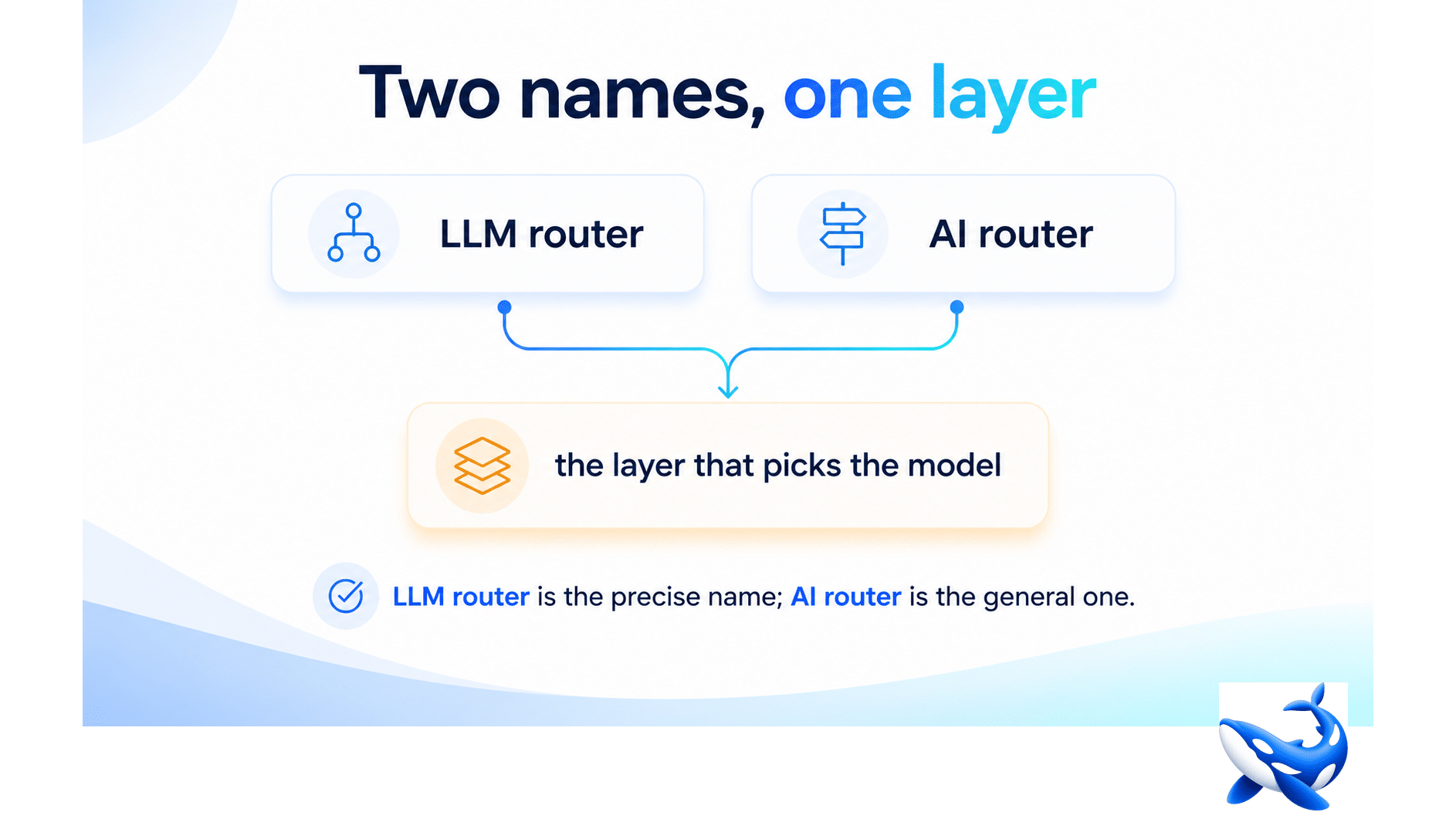
“LLM router” and “AI router” describe the same layer, and the difference is mostly which word you lead with. An LLM router routes requests to large language models; an “AI router” is the same idea with a broader label that also covers image, audio and other AI models. OrcaRouter is one platform built around this pattern; the naming choice matters less than the function.
Why the terms overlap
The function is identical: one endpoint, a pool of models, and a per-request decision about which model answers. When the pool was mostly text models, “LLM router” was the precise term. As the pool widens to multimodal and domain models, “AI router” becomes the umbrella. Either way, the mechanism is the same — routing rules, failover, cost and latency awareness, one key, per-call records.
The capability you want is the same
If you are evaluating platforms, search with both terms, because the category is young and vendors label themselves inconsistently. What you want is identical either way: a single endpoint, configurable routing rules that weigh cost, latency and capability, automatic failover between providers, and a record of every call. Whether a vendor calls itself an LLM router or an AI router tells you nothing about whether it does those things well — the evaluation is the same.
Join The European Business Briefing
New subscribers this quarter are entered into a draw to win a Rolex Submariner. Join 40,000+ founders, investors and executives who read EBM every day.
SubscribeA practical checklist for either name
- One OpenAI-compatible endpoint your existing client works against
- Routing rules per task type, not a single static choice
- Automatic failover to a healthy provider
- Per-call cost and latency records
- A pool you can edit as a configuration, not a code change
Apply that checklist regardless of the label, and you will separate the real routing layer from a gateway that merely reaches two vendors.
A quick evaluation checklist
Whichever name a vendor uses, the checklist is the same: one OpenAI-compatible endpoint your existing client works against; routing rules per task type rather than a single static choice; automatic failover to a healthy provider; per-call cost and latency records; and a pool you edit as configuration rather than code. Apply that checklist and you separate a real routing layer from a gateway that merely reaches two vendors. The label tells you nothing; the checklist tells you everything.
The naming lesson for evaluators
The overlap between the two names teaches a useful habit for anyone evaluating this category: ignore the label and interrogate the mechanism. A vendor that calls itself an LLM router might be a thin proxy that forwards to one model with no routing intelligence; a vendor that calls itself an AI gateway might actually route per request across a pool with failover and cost records. The label reflects marketing, not capability. The way to tell them apart is to ask what the layer does with a request: does it choose a model by rules, or does it pass a request through to a configured backend? Does it fail over when the provider is down, or does it surface the error? Does it record every call’s model, tokens and cost, or does it keep the plumbing opaque?
That interrogation matters because the cost of choosing wrong is not the migration — it is the months of running a “router” that is actually a proxy, making every model decision by hand in code while believing the layer is handling it. The teams that get burned are the ones that bought the label.
The other side of the naming lesson is that the category itself is converging. As pools widen to multimodal models, “LLM router” and “AI router” will blur further, and newer terms — model gateway, inference router — will appear. The capability checklist stays the same across all of them. Hold the checklist, not the vocabulary, and you will be able to evaluate whatever the category calls itself next quarter. The function is the thing; the name is just the entry point.
Why the label does not decide the quality
The label a vendor chooses is a marketing decision, not a technical one. Two platforms with the same capabilities can call themselves an LLM router and an AI gateway respectively, and a thin proxy can call itself anything. The way to evaluate is to interrogate the mechanism: does it choose a model by rules, or pass a request through to a configured backend? Does it fail over when the provider is down, or surface the error? Does it record every call’s model, tokens and cost, or keep the plumbing opaque? The cost of choosing wrong is not the migration; it is the months of running a proxy while believing the layer is routing. Interrogate the mechanism, and the name stops mattering.
The takeaway
LLM router and AI router are the same layer with different labels: one endpoint, a model pool, and per-request routing decisions. The name you use depends on whether your pool is text-only or multimodal. The function — routing, failover, cost and latency awareness — is identical, and it is the function that matters when you evaluate platforms.