






























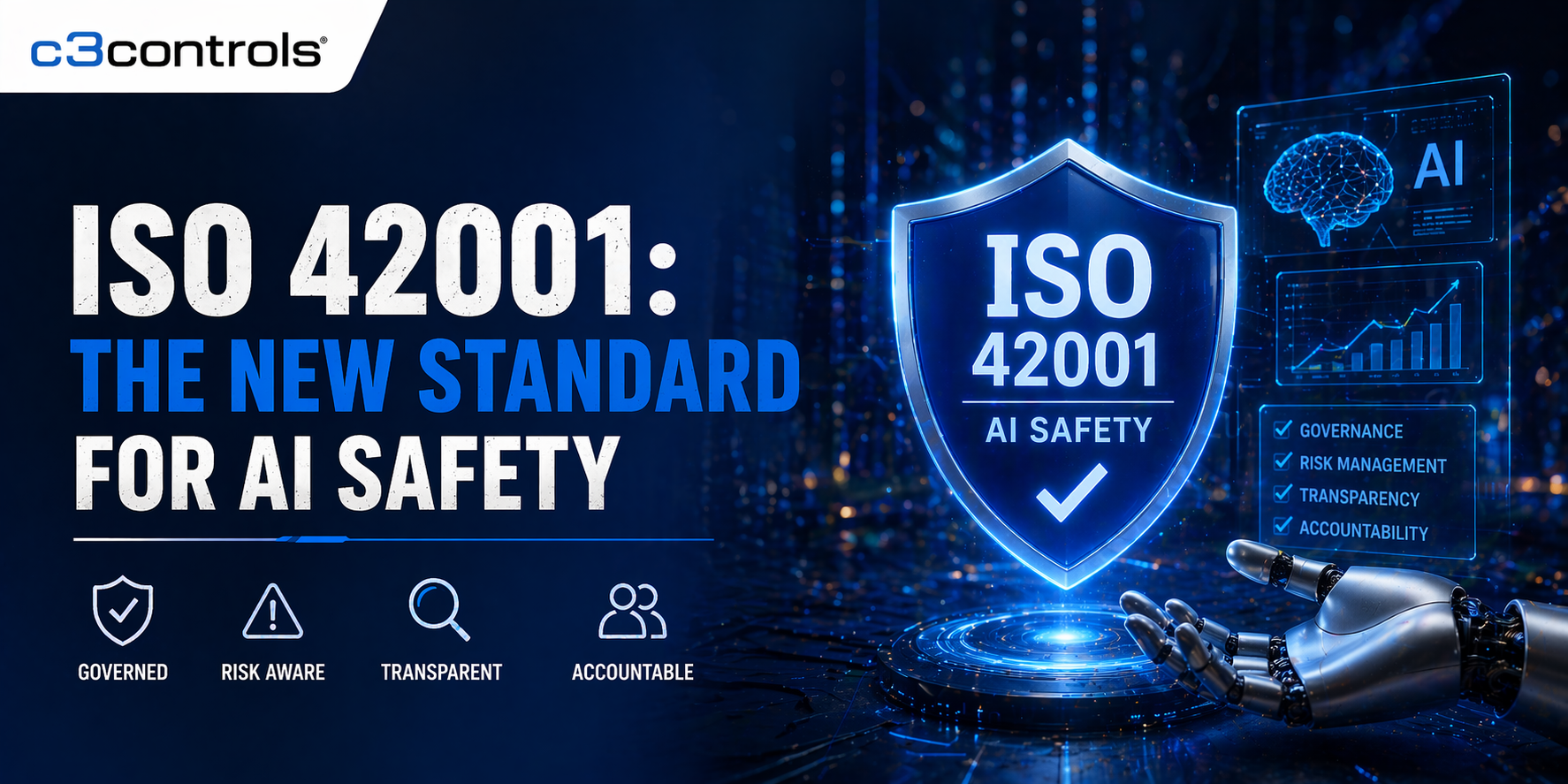
As we move through 2026, the industrial world has reached a fever pitch of AI integration. We have transitioned from experimental “Generative AI” chatbots to Industrial AI—autonomous systems that now manage complex supply chains, optimize energy grids, and control high-speed manufacturing lines in real-time.
However, this rapid adoption has created a significant “Trust Gap.”
The New Industrial Fear
In a world where algorithms can independently adjust the torque of a motor or the flow of a chemical line, the stakes of failure have shifted. It is no longer just about a software glitch; it is about physical safety, environmental impact, and massive legal liability. If an AI “Black Box” makes an unexplainable decision that leads to a mechanical failure, who is responsible?
Join The European Business Briefing
New subscribers this quarter are entered into a draw to win a Rolex Submariner. Join 40,000+ founders, investors and executives who read EBM every day.
SubscribeThe Standardized Solution
Enter ISO 42001. This isn’t just another checklist for IT departments; it is the first international framework designed to turn AI from a “wild west” liability into a certified, governed asset. By providing a structured Artificial Intelligence Management System (AIMS), ISO 42001 allows organizations to bridge the trust gap.
It moves the conversation from “Can we use AI?” to “Can we prove our AI is safe, ethical, and reliable?” For the forward-thinking leader, ISO 42001 is the “Operating System” for the AI frontier—providing the certainty needed to scale without the fear of a catastrophic “unknown.”
ISO 42001: The “Digital Blueprint” for Governance
Unlike traditional software standards that focus on static code, ISO 42001 is designed for the dynamic, ever-evolving nature of Artificial Intelligence. It provides a Management System (AIMS)—a structural blueprint that ensures AI doesn’t just work on day one, but remains safe and predictable on day one thousand.
1. Managing the AI Lifecycle
In 2026, we know that AI “decays” over time—a phenomenon known as model drift. ISO 42001 requires a lifecycle approach to governance:
- Data Integrity: Auditing the training data to ensure it is accurate and free from illegal or biased inputs.
- Development & Deployment: Establishing clear guardrails for how models are built and integrated into the factory floor.
- Continuous Monitoring: Requiring formal processes to track AI performance in real-time and “kill switches” for when an algorithm moves outside of its safety parameters.
2. The Risk-Based Philosophy
ISO 42001 is built on the principle of Risk-Based Thinking. Instead of a “one-size-fits-all” rulebook, it forces organizations to identify specific risks associated with their unique AI use-cases.
- An AI managing office HVAC has a different risk profile than an AI managing a high-voltage motor starter.
- The standard provides the framework to document these risks, mitigate them, and—most importantly—prove to regulators and stakeholders that those risks are being actively managed.
3. Interoperability: The Total Quality Culture
ISO 42001 is designed to be “plug-and-play” with existing standards. It uses the same high-level structure as ISO 9001 (Quality Management) and ISO 27001 (Information Security). This allows organizations to build a Total Quality Culture where the digital brain (AI), the data it consumes (Security), and the processes it optimizes (Quality) are all governed under a single, unified strategy.
The ROI of Responsible AI
In 2026, the C-suite is no longer asking if AI is possible; they are asking if it is profitable. ISO 42001 has emerged as a high-yield financial tool because it directly addresses the three biggest “cost-centers” of modern AI: regulatory fines, model decay, and market rejection.
1. Regulatory Immunity
With the full implementation of the EU AI Act and similar frameworks in North America and Asia, non-compliant AI has become a massive financial liability. Fines can reach up to 7% of global annual turnover.
- The ROI: ISO 42001 provides the “Safe Harbor” evidence needed to prove that your organization has exercised due diligence. It transforms compliance from an expensive hurdle into a defensive financial moat.
2. Eliminating “AI Debt”
Without a standard, companies often build AI models that are “fragile”—they work in the lab but fail when real-world conditions change. This is known as AI Debt.
- Model Drift Mitigation: The standard’s requirement for continuous monitoring ensures that “drift” is caught early. By preventing a model from making biased or erroneous decisions, companies avoid the massive costs of emergency model retraining or, worse, product recalls and service halts.
3. The “Badge of Trust” in B2B Partnerships
In 2026, being “AI-capable” is no longer a competitive advantage; being “AI-Certified” is.
- Unlocking Market Access: Large-scale vendors and government agencies now require ISO 42001 certification as a prerequisite for contracts. Much like ISO 9001 did for manufacturing in the 1990s, ISO 42001 has become the “passport” for doing business in high-stakes industries. It reduces the “sales friction” by providing instant, third-party verification that your algorithms are trustworthy.
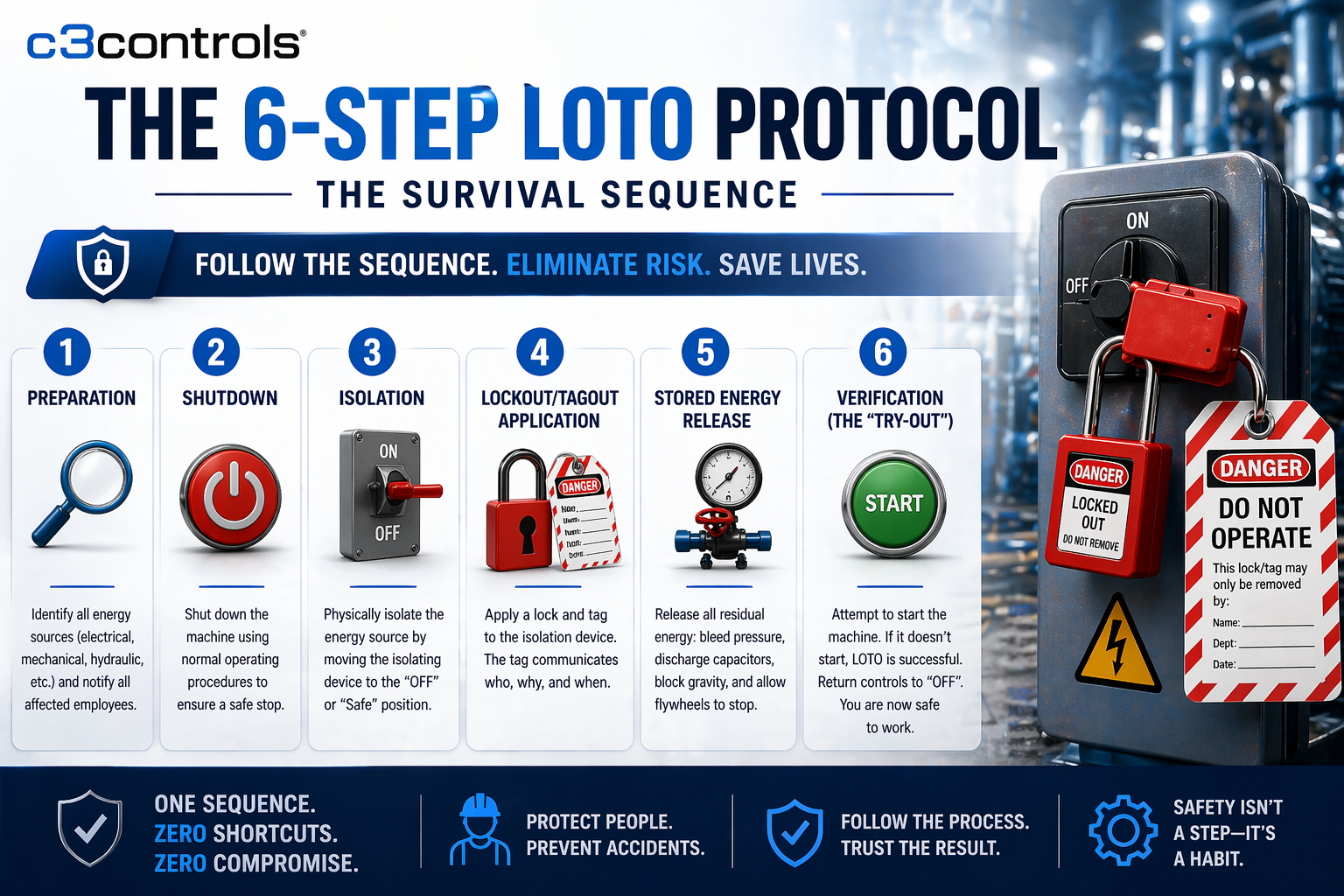
Bridging the Gap: Where Silicon Meets Steel
In the industrial landscape of 2026, a safe AI is only as effective as the hardware it controls. This is where the “Silicon” of digital governance meets the “Steel” of physical execution. For an operation to be truly resilient, there must be a seamless handoff between the governed decision and the certified action.
1. Holistic Reliability: Brain vs. Muscle
If an ISO 42001-managed AI detects a dangerous vibration in a high-speed turbine and initiates an emergency stop, the system relies entirely on the physical disconnect to work.
- The Logic: Reliability is a two-way street. You can have the most ethical, governed AI “brain” in the world, but if the physical “muscle” (the circuit breaker or contactor) fails during an AI-triggered event, the governance framework has failed its ultimate goal: safety.
2. The Shared Philosophy of Certification
c3controls mirrors the ISO 42001 mindset in the physical realm. Just as ISO 42001 brings accountability and transparency to algorithms, c3controls brings those same values to electrical infrastructure.
- Standards as a Foundation: While the AI team focuses on AIMS compliance, the engineering team relies on c3controls hardware that is UL Listed and IEC Certified. Both are speaking the same language of “Certified Excellence.” This alignment ensures that every component in the chain—from the neural network to the Motor Protection Circuit Breaker (MPCB)—meets a globally recognized safety benchmark.
Implementing the AIMS (Artificial Intelligence Management System)
Gaining certification for ISO 42001 is not a race to a finish line; it is the construction of a permanent “Safety Net” for your digital operations. In 2026, the transition from an “AI-curious” company to an “AI-Certified” leader follows a rigorous 4-step roadmap.
1. Scope & Gap Analysis
The journey begins by mapping the “AI Footprint” of the organization. This involves identifying every instance of AI, from high-level predictive maintenance models to “Shadow AI” (unauthorized tools used by employees). You must assess where your current processes fall short of the standard’s requirements for transparency and risk management.
2. Establishing the Governance Framework
Once the gaps are identified, the organization must implement the AIMS. This includes:
- Assigning Accountability: Defining who is responsible for AI outcomes (hint: it’s rarely just the IT department).
- Ethical Guardrails: Setting clear boundaries on what the AI can and cannot do, particularly regarding data privacy and automated decision-making.
3. Internal Audit & Stress-Testing
Before the external auditors arrive, the system must be tested. This involves “red-teaming” the AI—intentionally trying to trick the model or force a biased result—to see if the governance framework detects and corrects the error. This ensures the “Human-in-the-Loop” protocols are functioning effectively.
4. External Certification
A third-party registrar audits the AIMS against the ISO 42001 standard. They aren’t looking at your code; they are looking at your processes. They need to see evidence that when the AI fails (and all AI eventually encounters an edge case), your organization has a documented, reliable way to handle it.
The Supply Chain Factor
In 2026, you are only as safe as your weakest vendor. ISO 42001 implementation requires you to ensure that your third-party AI providers (SaaS, cloud, or edge computing vendors) also meet these benchmarks. Much like a mechanical assembly requires every bolt to be grade-certified, an AI system requires every data stream and sub-model to be governed.
Conclusion: The Competitive Edge of Certainty
In the industrial landscape of 2026, the era of “moving fast and breaking things” is over. As AI transitions from a digital novelty to the operational backbone of global infrastructure, the market is no longer rewarding the fastest adopters—it is rewarding the most reliable ones.
From “AI-Capable” to “AI-Trusted”
ISO 42001 has redefined the hierarchy of the AI frontier. In this new era:
- Trust is a Commodity: Customers and partners are willing to pay a premium for certified certainty.
- Resilience is a Metric: Success is measured by how well a system handles the “edge cases”—those unpredictable moments where a governed AI and certified hardware prevent a minor anomaly from becoming a major disaster.