






























Building a mobile app that works across platforms without doubling your development costs has made Flutter one of the most requested frameworks among startups and established companies alike. The framework holds the top spot among developers globally, with 46 percent of software developers reporting Flutter use, more than any other cross-platform option. But finding developers who write clean Dart code is only part of the challenge. The harder task is finding people who mesh with your workflow, communicate clearly, and stick around long enough to see the project through. Here’s how to get that right.
Why Companies Hire Flutter Developers Overseas
Local hiring markets are often too small or too expensive for the scope of a typical Flutter project. Looking beyond your home country opens access to a wider pool of engineers who specialize specifically in cross-platform development. Salary expectations in regions like Eastern Europe, South Asia, or Latin America tend to be lower than in North America or Western Europe, without a corresponding drop in skill level.
Speed matters too. Overseas hiring platforms and agencies often have candidates ready for interviews within days, compared to the weeks a local search might take. Time zone differences, once seen as a drawback, can actually work in your favor: a team based several hours ahead can push code overnight, so your morning starts with fresh progress waiting for review.
Join The European Business Briefing
New subscribers this quarter are entered into a draw to win a Rolex Submariner. Join 40,000+ founders, investors and executives who read EBM every day.
SubscribeKey Skills to Look for When You Hire Flutter Developers
Not every developer who lists Flutter on a resume can build production-grade apps. Dart proficiency is the baseline, but the real differentiator is how someone handles state management, whether through Provider, Riverpod, or Bloc. Experience integrating native modules for iOS and Android also separates developers who copy tutorials from those who solve real platform-specific problems.
Technical Skills That Signal a Strong Flutter Developer
Look for candidates who can demonstrate:
- Comfort with widget composition and custom rendering, not just prebuilt UI kits
- Experience publishing apps to both the App Store and Google Play, including handling review rejections
- Familiarity with CI/CD pipelines for Flutter builds
Soft Skills That Determine Team Fit
Technical skill alone rarely predicts long-term success. A developer who asks clarifying questions before writing code saves everyone time later. Documenting decisions matters just as much as making them. Responding to feedback without defensiveness signals real professionalism. Developers who communicate openly tend to integrate faster into existing teams. Those who simply execute tickets silently often struggle to build trust over time.
Where to Find and Hire Flutter Developers Overseas
Several channels work well depending on your budget and how much oversight you want to provide. Freelance platforms such as Upwork or Toptal give you direct access to individual developers, useful for smaller projects or short-term needs. Development agencies, on the other hand, offer full teams with built-in project management, which reduces the burden on your internal staff.
If you want to hire dedicated Flutter developers who work exclusively on your product rather than juggling multiple clients, staffing partners that specialize in dedicated team models are usually the better fit. These arrangements typically include a vetting process, contract flexibility, and the option to scale the team up or down as your roadmap shifts.
Developer communities on GitHub, Flutter-specific Discord servers, and local meetup groups (many of which now operate virtually) can also surface strong candidates who aren’t actively browsing job boards but are open to the right offer.
How to Evaluate Flutter Developers During the Hiring Process
A resume tells you little about how someone actually codes. Structure your evaluation process to reveal real working habits rather than rehearsed answers.
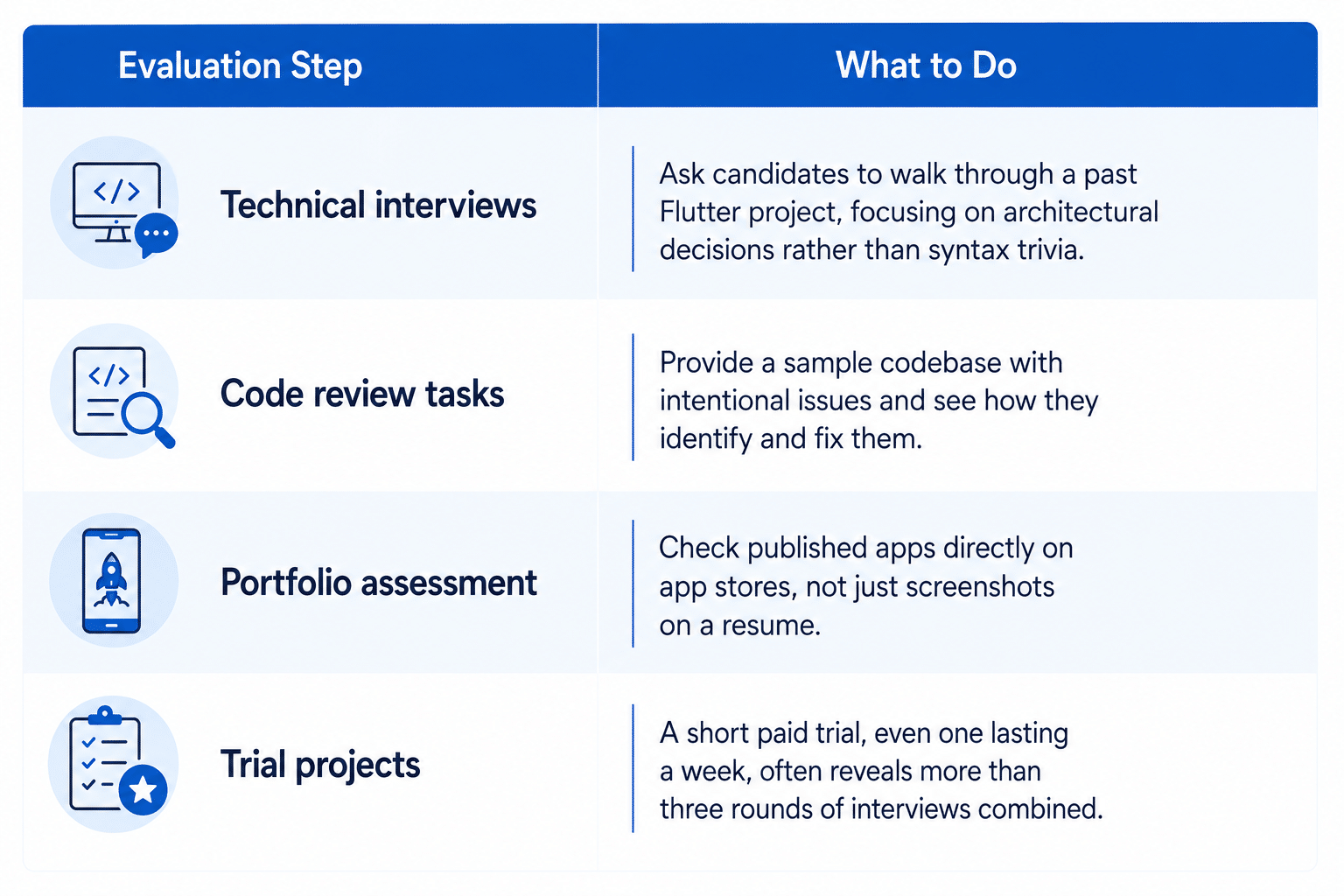
Combining these methods gives you a fuller picture than relying on any single step.
Red Flags to Watch for When You Hire Remote Flutter Developers
Certain warning signs show up consistently among candidates who look strong on paper but struggle once hired. Poor communication during the interview stage, such as slow responses or vague answers to direct questions, usually gets worse once the pressure of real deadlines sets in.
Watch out for portfolios that list impressive-sounding apps without links, live demos, or verifiable details. Developers who agree to unrealistic timelines without pushing back or asking questions may be telling you what you want to hear rather than giving an honest estimate. Similarly, a lack of test coverage in their sample code often signals shortcuts that will surface later as bugs in production.
How to Ensure Cultural and Team Fit With Overseas Developers
Skill mismatches are usually easier to spot than fit mismatches, which tend to surface weeks into a project. Communication style plays a large role here: some developers prefer detailed written instructions, while others work better with quick verbal check-ins over video calls. Clarifying this early prevents friction later.
Working hours overlap, even a few hours a day, makes real-time collaboration possible for standups and urgent fixes. A structured onboarding process, including access to documentation, coding standards, and a walkthrough of your existing codebase, helps overseas web developers get productive faster instead of guessing at conventions. A short trial period, similar to what’s used during evaluation, also gives both sides a low-risk way to confirm the working relationship makes sense before committing long-term.
Cost of Hiring Flutter Developers by Region
Rates vary widely depending on region, experience level, and whether you’re hiring through a platform, an agency, or directly.
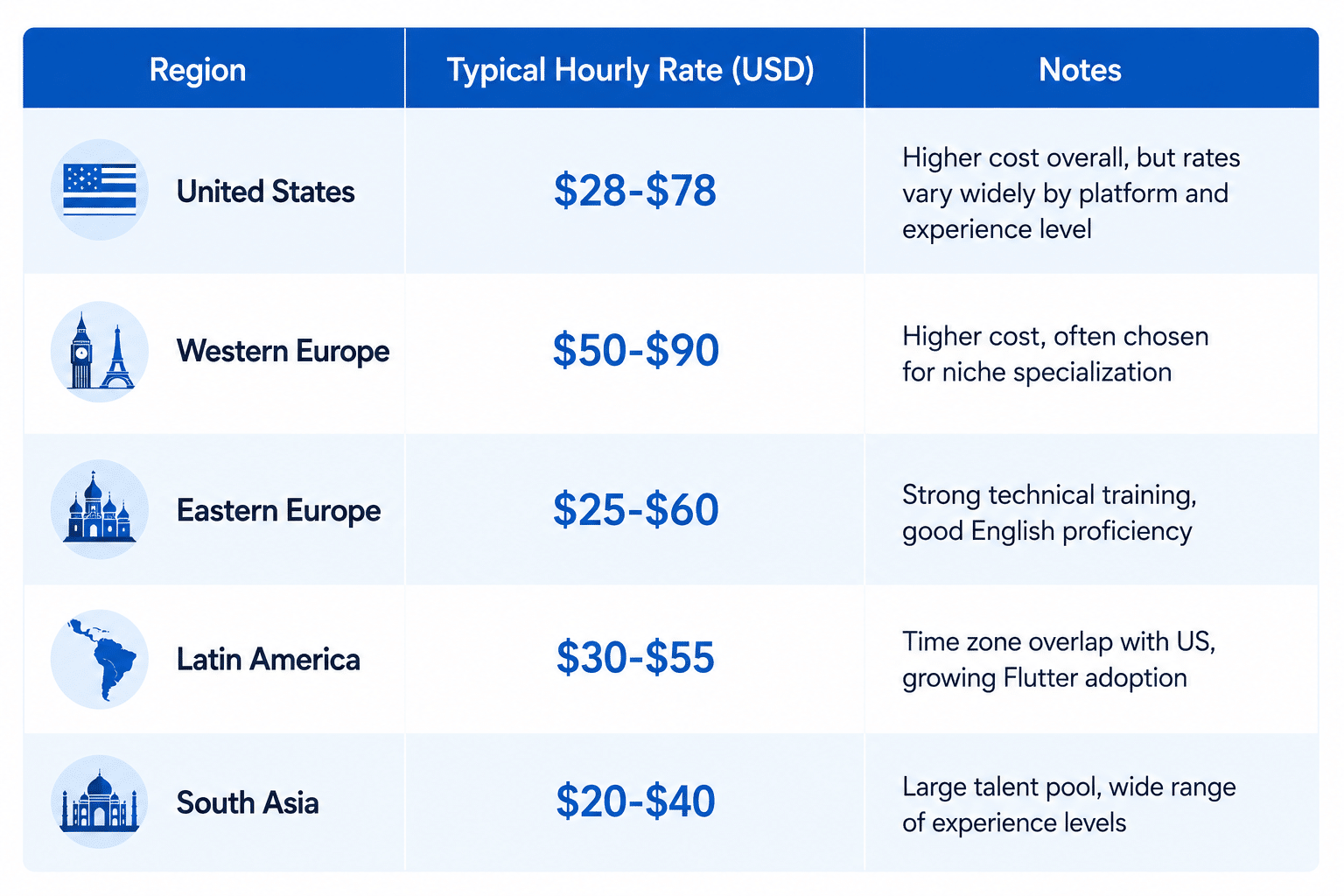
These figures shift based on project complexity and demand, so treat them as a general reference point rather than a fixed budget line.
Best Practices for Managing Overseas Flutter Development Teams
Once hired, the way you manage the team determines whether the arrangement holds up over months rather than weeks. Async communication tools like Slack, Notion, or Linear reduce the pressure to have everyone online simultaneously, which matters when team members span multiple time zones.
Sprint planning should account for time zone gaps rather than ignoring them. If your team is spread across two regions, structure sprint boundaries so handoffs happen at natural points in each side’s working day. Documentation deserves more attention than most teams give it: a well-maintained internal wiki saves hours of repeated explanation as the team grows. Regular check-ins, whether weekly video calls or async status updates, keep everyone aligned without requiring constant meetings.
Final Thoughts: Building a Flutter Team That Delivers Long-Term Value
Hiring Flutter developers overseas gives you access to skilled engineers at a reasonable cost, but the process works best when you evaluate for both technical ability and working style. Skip the trial project or the fit assessment, and you risk ending up with a developer who can write code but can’t collaborate with your existing team.
Take the time to define what your team actually needs, run a structured evaluation, and set clear expectations from day one. The extra effort upfront pays off in fewer surprises down the line and a team that actually delivers on schedule.