































ADVANCED FUTURE
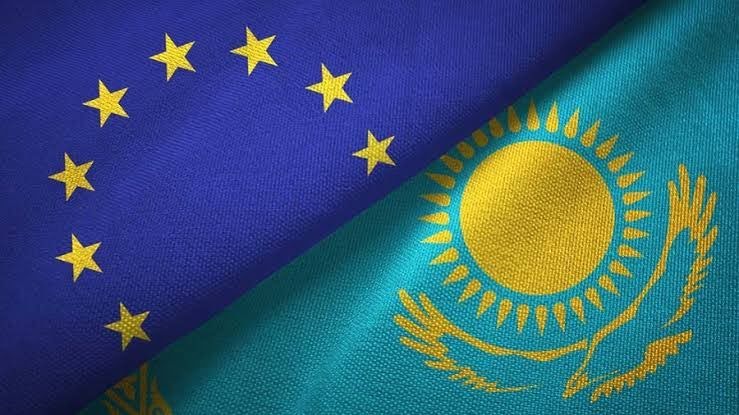
In late June, Kazakhstan’s President Kassym-Jomart Tokayev visited Belgium, where agreements worth $12 billion were signed with the participation of Kazakh and European companies and institutions. Earlier, Kazakhstan had signed a $10 billion global agreement to develop digital infrastructure. Once viewed primarily as a commodities supplier, the country is increasingly positioning itself as a transit corridor between Europe and Asia — a role that now extends beyond logistics to include data centers and AI hubs.
Kazakhstan’s President Kassym-Jomart Tokayev paid an official visit to Brussels, where he discussed the development of the Middle Corridor, as well as cooperation in energy, agriculture, digital technologies and artificial intelligence with EU policymakers and business leaders. Kazakhstan aims to move beyond the traditional model of “raw materials in exchange for investment” toward the joint development of technologies and industrial production.
Europe has no less interest in this partnership than Kazakhstan itself.
Join The European Business Briefing
New subscribers this quarter are entered into a draw to win a Rolex Submariner. Join 40,000+ founders, investors and executives who read EBM every day.
Subscribe“Our economies are not only highly compatible, but also complementary. Moreover, we see each other as strategic and reliable partners. In the current environment of global instability and geoeconomic shocks, business representatives have emphasized that certainty, predictability and trust in a partner are becoming essential values – effectively a new currency of international cooperation,” said EU Commissioner for Trade and Economic Security Maroš Šefčovič.
During the visit, the parties signed commercial agreements worth about $12 billion. These included a Memorandum of Understanding between the Ministry of Transport of the Republic of Kazakhstan and the European Bank for Reconstruction and Development on the introduction of intelligent transport systems, as well as an agreement between the European Investment Bank and Kazakhstan’s national road operator KazAvtoZhol to finance the Trans-Caspian International Transport Route.
In mid-June 2026, Kazakhstan unveiled plans to build a large-scale AI data center ecosystem with a total planned investment of $10 billion. The project is being developed in partnership with Firebird, an AI infrastructure company, and NVIDIA, the global leader in AI computing technologies. The so-called “Data Center Valley” will launch with an initial capacity of 300 MW, with phased expansion to 1 GW. According to the Kazakh government, the project is expected to generate more than $3 billion in annual export revenue and support the country’s ambition to become a leading digital hub in Central Asia.
Kazakhstan has emerged as one of Central Asia’s most dynamic technology markets. In June, the government adopted the “Digital Qazaqstan” strategy, which runs through 2029, setting out a roadmap toward a fully digital state. The strategy focuses on scaling the use of artificial intelligence across the economy and public sector, building an integrated digital environment for citizens, and developing a national data and computing infrastructure. It also prioritizes the growth of the domestic IT sector, support for startups, and wider adoption of digital tools across key industries.
As a result, Kazakhstan is increasingly positioning itself not just as a consumer of technology, but as a regional testing ground where digital solutions move quickly from concept to real-world deployment across both the economy and the public sector.
Kazakhstan is also seeing growing momentum from the private capital layer of its digital economy, supported by strong fintech adoption and the integration of financial services into broader digital infrastructure. At the same time, private sector investment is increasingly directed toward data center development and AI infrastructure, complementing state-backed capacity expansion.
The country’s three largest financial ecosystems — Kaspi, Halyk, and Freedom Holding Corp. — are all publicly traded on international stock exchanges, with Kaspi and Halyk listed in London and Freedom Holding on Nasdaq. Shares of all three companies have posted gains since the beginning of the year.
Kaspi has built an ecosystem combining digital payments, e-commerce and personal finance. Halyk has expanded beyond traditional banking into blockchain-based financial services, installment financing through Halyk Market, travel, investment products and its own super app. Freedom Holding has developed a digital ecosystem that integrates banking, insurance and investment services with grocery and restaurant delivery, travel bookings, event ticketing and e-commerce.
Freedom has also begun extending its ecosystem beyond Kazakhstan. The group already serves European clients through its Freedom24 brokerage platform and has applied for a banking license in France as part of its broader European expansion strategy. If approved, the license would allow the company to offer banking services across the European Union. Freedom aims to attract up to 50 million customers in Europe over the next three years. Over the longer term, the group plans to integrate its financial and digital services in Europe into a Freedom SuperApp, replicating the ecosystem model it has developed in Kazakhstan. Freedom is also preparing to expand this strategy to the U.S. market. Operating in 22 countries, the company sees its digital ecosystem as the foundation for international growth.
For Europe, Kazakhstan is becoming more than a supplier of energy and raw materials. It is emerging as a partner in digital infrastructure, artificial intelligence and financial technology. As global competition increasingly centers on computing capacity, data infrastructure and technology ecosystems, cooperation between Europe and Kazakhstan is likely to extend well beyond trade and logistics. The relationship is evolving from the movement of goods to the joint development of technologies that will shape the next phase of economic growth.