






























Japan’s energy transition offers significant opportunities for European clean-tech companies. But turning technological expertise into business in one of Asia’s most sophisticated markets requires more than an innovative product.
- For European clean-tech companies considering international expansion, Japan presents an attractive combination of market scale, technological sophistication and long-term investment in decarbonisation.
Under its Green Transformation (GX) strategy, Japan aims to mobilise more than JPY 150 trillion (approximately €850 billion) in public and private investment over ten years. The initiative is intended to accelerate the transition towards a lower-carbon economy while strengthening the competitiveness of Japanese industry.
Yet for smaller European businesses, a substantial investment programme does not automatically translate into accessible commercial opportunities. Japan already has highly developed industrial supply chains, established domestic manufacturers and demanding technical standards.
Join The European Business Briefing
New subscribers this quarter are entered into a draw to win a Rolex Submariner. Join 40,000+ founders, investors and executives who read EBM every day.
SubscribeThe key to entering this market is understanding where a European company’s technology can solve a specific problem – and finding the right Japanese partner to bring that solution to market.

Look Beyond Market Size
Japan’s clean-energy ambitions span renewable power generation, energy storage, hydrogen, smart grids and industrial decarbonisation. However, the commercial opportunities within these sectors are not necessarily where newcomers might first expect them.
Consider offshore wind. Japan aims to develop 10 GW of offshore wind projects by 2030 and 30-45 GW by 2040. Its deep coastal waters create particular interest in floating wind technologies. European businesses may find opportunities not only in turbines themselves but also in specialist engineering, monitoring, maintenance and components that improve project performance.
For SMEs, the important question is therefore not simply whether a sector is growing. It is which technologies, components or services are needed to support that growth.
Find a Specific Problem to Solve
European clean-tech companies often compete through specialisation. Their advantage may be a particular component, software platform, industrial process or engineering capability rather than an entire energy system.
This can be valuable in Japan, where established manufacturers and infrastructure operators may be looking for technologies that improve the performance of existing solutions.
For example, Japan’s electricity system faces the challenge of integrating more variable renewable generation while maintaining reliability. The country’s eastern and western regions operate at different grid frequencies, adding complexity to electricity transmission and system management.
This creates potential entry points for European providers of battery management systems, grid-monitoring software, forecasting technologies and solutions that support distributed energy resources.
In hydrogen, Japan plans to mobilise approximately JPY 15 trillion (around €85 billion) in public and private investment over 15 years. Yet reducing costs remains a central challenge. Technologies that improve electrolysis efficiency, component durability, storage safety or industrial applications could therefore attract interest from Japanese companies developing hydrogen-related solutions.
Industrial decarbonisation offers similar possibilities. A European SME providing an energy-monitoring platform or industrial heat-recovery technology may find a more realistic opportunity by helping a Japanese manufacturer reduce operating costs than by positioning itself as a comprehensive decarbonisation provider.
Across these sectors, the strongest commercial proposition is likely to be one that clearly demonstrates how a technology can improve efficiency, reliability, safety or cost performance.
Choose the Right Market-Entry Partner
For many European SMEs, establishing an independent presence in Japan may not be the most practical first step.
Partnerships with Japanese manufacturers, engineering companies, utilities, distributors or system integrators can provide access to customers and established supply chains while helping foreign companies navigate local business practices.
The most suitable partner will depend on the product and its intended application.
A component manufacturer may benefit from working with a Japanese original equipment manufacturer. A software company offering grid-management solutions might need relationships with utilities or system integrators. A business supplying industrial efficiency technologies may find engineering contractors or manufacturing groups more relevant.
Finding these partners requires targeted research and an understanding of how purchasing and technical decisions are made.
It is also important to distinguish between expressions of interest and genuine commercial potential. A promising introductory meeting is only the beginning. Companies need to establish whether a prospective partner has a relevant application, the authority to influence purchasing decisions and a realistic pathway towards implementation.
Prepare for Japan’s Expectations
Japan’s reputation for demanding quality and reliability is particularly relevant in the energy sector, where technologies often become part of critical infrastructure or complex industrial systems.
European companies should be prepared to provide technical documentation, evidence of successful applications and clear information about product performance, maintenance and long-term support.
Depending on the technology, compliance with Japanese safety, certification and regulatory requirements may also be necessary.
A strong market-entry presentation should therefore go beyond explaining what makes a product innovative. It should demonstrate how the technology works within an existing system, what benefits it delivers and what would be required to deploy it successfully in Japan.
Long-term relationship building also matters. Potential partners may need time to evaluate a technology, conduct technical discussions or explore opportunities for testing and adaptation.
For SMEs accustomed to faster sales cycles, understanding these expectations can help establish more realistic commercial objectives.
Test the Market Before Committing
International expansion involves investment, and Japan is no exception. Before committing substantial resources, European SMEs need to assess whether their technology addresses a real market need and whether suitable partners are available.
Direct engagement with prospective customers can help answer several essential questions: Is the problem the company solves a priority for Japanese buyers? Does the technology offer a meaningful advantage over existing alternatives? What technical adaptations might be required? And which organisations could provide a route to market?
Trade exhibitions and structured business missions can help companies begin answering these questions without immediately establishing a permanent local presence.
They also allow businesses to compare feedback from different potential partners, identify common requirements and refine their market-entry approach.
A Practical Route into Japan
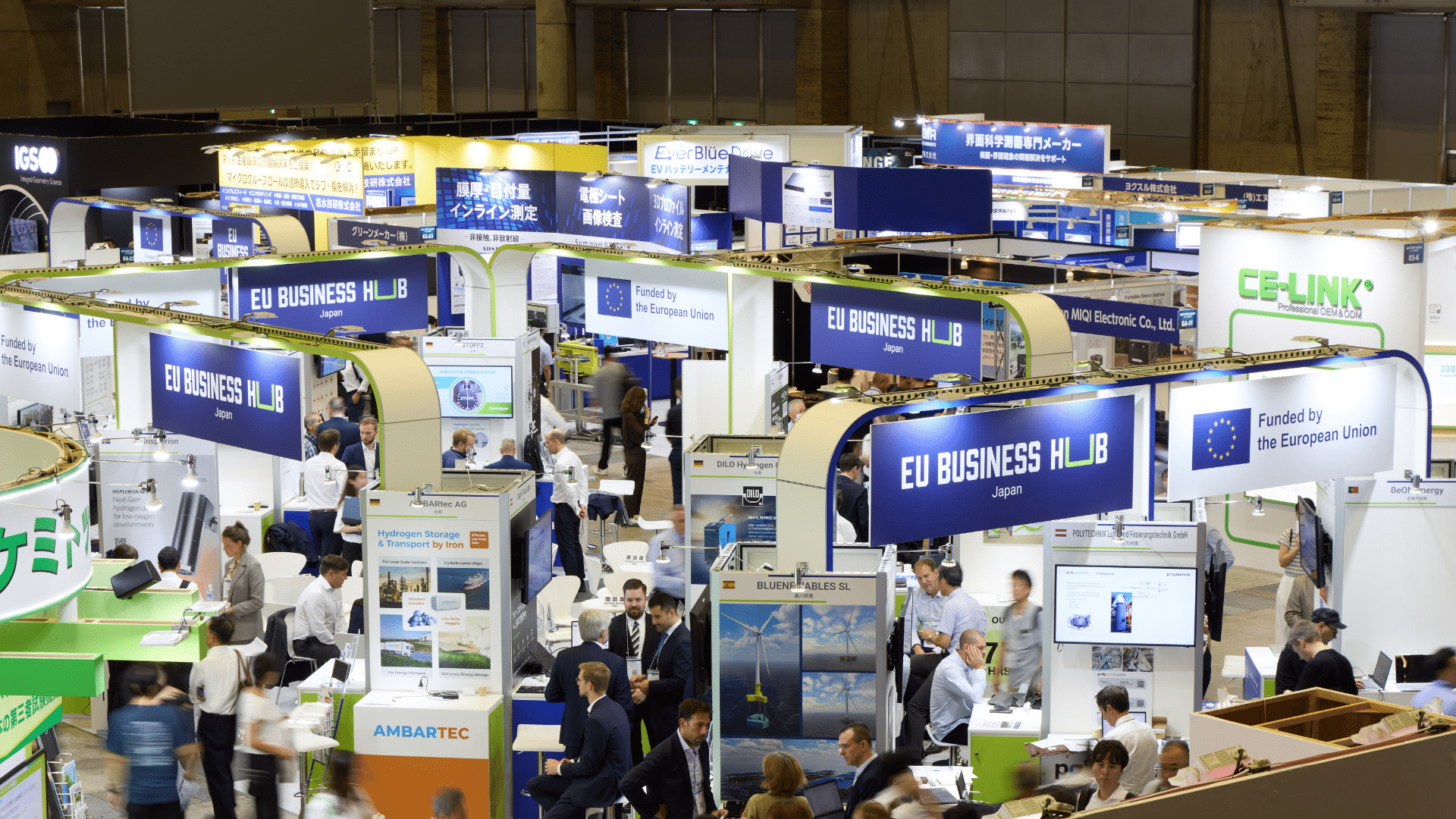
The EU Business Hub @ Smart Energy Week Spring 2027 business mission is designed to help European SMEs and startups take this first step. Taking place from 22 to 26 March 2027, the mission will select up to 50 companies from the green and low-carbon technologies sector to explore business opportunities in Japan.
Participants will have the opportunity to showcase their solutions at the EU Pavilion during Smart Energy Week, engage in pre-arranged business matchmaking with Japanese companies and organisations, and benefit from tailored market-entry support.
For European SMEs, the value lies not only in gaining exhibition visibility but also in meeting relevant industry stakeholders, testing their commercial propositions and identifying potential routes towards future cooperation.
Japan’s clean-energy transition offers considerable long-term potential. The companies best positioned to benefit will be those that understand where their technologies fit, prepare for local market requirements and invest in building the right relationships.
Applications for EU Business Hub @ Smart Energy Week Spring 2027 close on 27 November 2026.
Explore the business mission and apply
EU Business Hub – Japan and the Republic of Korea is an EU-funded programme launched in 2024 to support EU SMEs and start-ups in the Green and Low-Carbon, Digital, Healthcare and Medical Equipment sectors in expanding into the Japanese and Korean markets. Between 2024 and 2027, the programme is organising 20 sector-focused business missions – 10 in each market – with services including strategic coaching, matchmaking, local interpretation, and full logistical support. The EU Business Hub is the successor programme of the EU Business Avenues / EU Gateway to Japan.