






























For decades, businesses have focused on digitising what could be stored, measured and managed on a screen. Financial systems moved online, customer interactions became data points, and operational decisions increasingly relied on dashboards and software. Yet a significant part of business information still exists outside those systems: in buildings, on construction sites, across infrastructure and within physical assets that cannot be fully understood from a spreadsheet alone.
That is beginning to change. Advances in drones, sensors, computer vision, artificial intelligence, photogrammetry and other reality-capture technologies are making it possible to turn conditions in the physical world into structured information that businesses can analyse and act upon. The significance of this shift goes beyond better images or faster inspections. It is creating another layer of business intelligence, one that connects what organisations manage digitally with what is actually happening around them.
The Missing Layer in Digital Transformation
Digital transformation has traditionally concentrated on internal processes. Companies have automated workflows, migrated systems to the cloud and built increasingly sophisticated analytics platforms. These changes have made businesses faster at processing information that already exists in digital form.
Join The European Business Briefing
New subscribers this quarter are entered into a draw to win a Rolex Submariner. Join 40,000+ founders, investors and executives who read EBM every day.
SubscribeThe challenge is that the original information often comes from somewhere physical.
A property manager needs to understand the condition of a building. A construction company needs to know whether a project is progressing as planned. An infrastructure operator needs visibility into assets that may be spread across a large geographical area. A facilities team may need to determine whether deterioration has occurred since the last inspection. In each case, the decision depends on information about the physical environment.
Reality-capture technology is closing that gap by creating digital representations of physical conditions. Instead of treating a site visit, inspection or survey as an isolated activity, organisations can increasingly treat the resulting data as part of their wider information infrastructure.
From Observation to Business Data
This is where technologies such as drones become more interesting from a business perspective.
A drone is often associated with aerial photography, but its role in commercial operations can be much broader. Depending on the project, aerial platforms can collect imagery and other forms of spatial information that can subsequently be processed, compared and incorporated into operational workflows.
That changes the question businesses should be asking. Rather than simply asking whether a drone can capture better images, organisations can ask what decisions those images and associated datasets can support.
For example, repeated aerial captures can help teams compare how a site has changed over time. A construction manager can use visual records to improve project documentation, while an asset owner can establish a more consistent record of physical conditions. The value comes not from the flight itself, but from turning observations into information that can be revisited and used in decision-making.
This is one reason the broader Drone as a Service in UK model is becoming relevant to businesses. It allows organisations to access aerial data capabilities without necessarily treating drone operations as a standalone technology investment. The more important consideration, however, is how that data fits into existing business processes.
When a Roof Becomes a Data Asset
Consider something as familiar as a commercial roof.
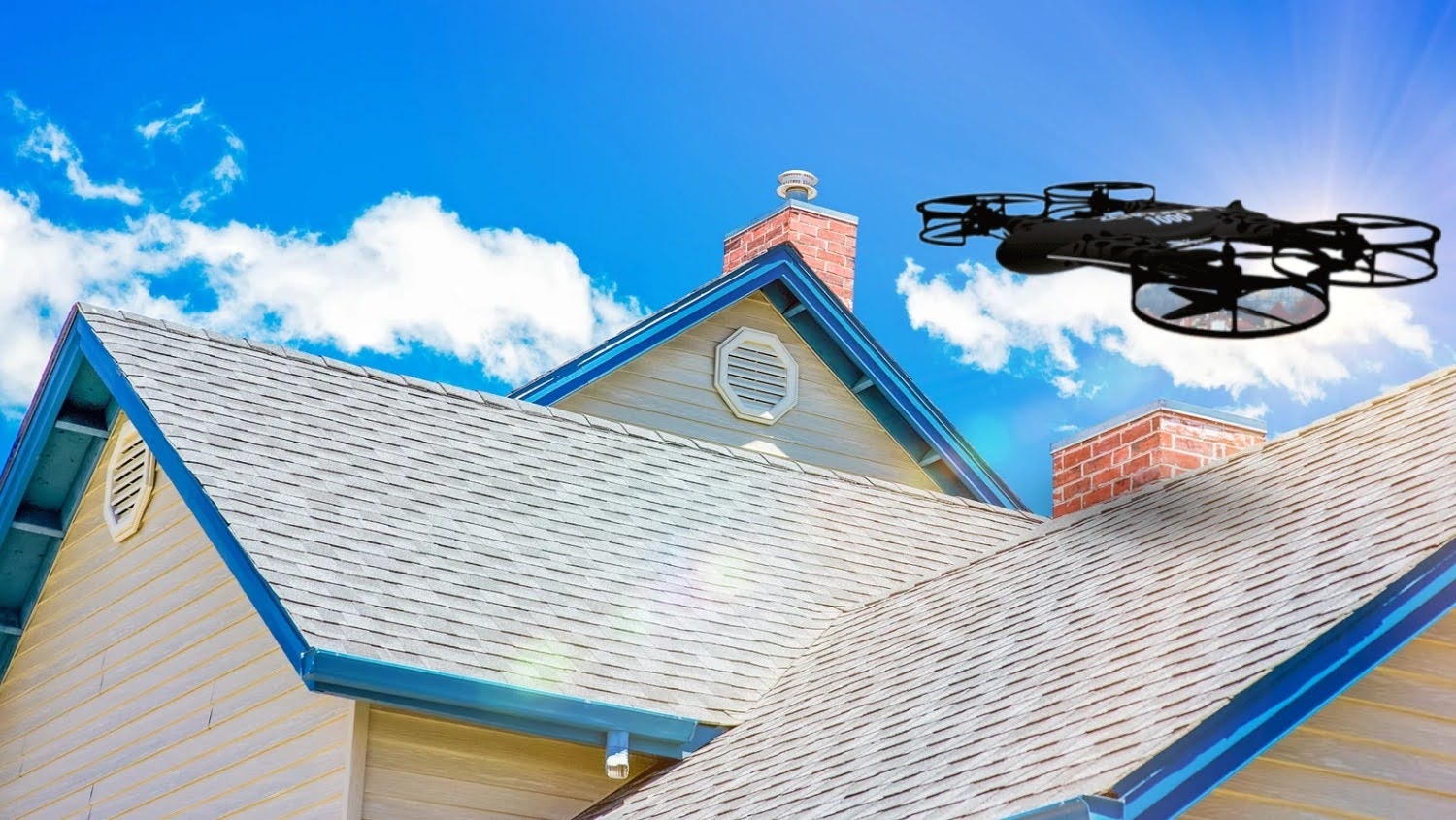
A roof is normally viewed as part of a physical property, but its condition can have implications for maintenance budgets, building operations, energy performance, insurance documentation and long-term asset planning. The difficulty is that much of the relevant information is difficult to collect frequently and consistently from ground level.
Aerial inspection changes the way that information can be gathered. Instead of relying entirely on occasional manual observations, organisations can create a more detailed visual record of the asset and use subsequent inspections to understand how conditions evolve.
This is particularly relevant for businesses responsible for multiple properties. A portfolio containing dozens or hundreds of buildings creates a data-management problem as much as an inspection problem. Consistent roof inspection data in UK can give property and facilities teams a clearer basis for prioritising maintenance and deciding where closer investigation may be warranted.
The important shift is conceptual. The roof is no longer simply something that needs to be inspected when a problem becomes visible. Its condition can become part of the organisation’s broader asset information.
The Real Value Comes From Change
One of the strongest advantages of bringing physical-world information into digital systems is the ability to compare it over time.
A single inspection provides a snapshot. A series of inspections can provide a history.
That distinction matters to businesses because many operational decisions are based not simply on the condition of an asset today, but on whether that condition is changing. Construction teams may want to understand how a site has developed between project milestones. Property managers may want to identify changes before they become more expensive problems. Infrastructure operators may need to maintain records that support long-term planning.
Once physical observations are captured consistently, change detection becomes more practical. Historical imagery and datasets can be compared with newer information, helping teams move from reactive observation towards a more structured understanding of asset behaviour.
This also creates opportunities for better communication. Instead of relying solely on written descriptions of what has changed, different stakeholders can work from visual and spatial evidence. That can be particularly valuable when owners, contractors, consultants and management teams are not working from the same location.
Digital Twins Bring the Information Together
The next stage is to connect physical-world data with the wider digital environment.
Digital twins illustrate this direction. A digital twin does not simply provide a visual model of an asset; its value comes from connecting information about the physical object with digital systems and operational processes. When updated with relevant data, such models can provide a more useful representation of how an asset exists and changes in the real world.
For businesses, this can eventually connect information from multiple sources. Drone imagery might sit alongside building information, inspection records, sensor readings, maintenance histories and other operational data. Each individual dataset becomes more useful when it can be understood in context.
This is where digital transformation becomes less about moving documents from paper to software and more about creating a continuously improving digital understanding of the physical business environment.
AI Is Becoming the Interpretation Layer
The growing volume of physical-world data also introduces a new challenge: organisations can collect more information than their teams have time to review manually.
Artificial intelligence can increasingly help address that problem. Computer vision and machine-learning systems can assist with identifying patterns, organising large collections of imagery and highlighting areas that may require human attention. The purpose is not necessarily to remove people from the process, but to help them concentrate on decisions that require judgement.
This distinction is important. The most useful applications of AI in physical-world operations are unlikely to come from simply adding an AI label to an existing workflow. They will come from combining reliable data collection with systems that can interpret that information in a business context.
A company that can consistently capture information about its physical assets, connect it to historical records and use AI to identify relevant changes has something more valuable than a collection of photographs. It has a growing operational dataset.
The Business Case Goes Beyond Efficiency
The commercial impact of this shift is broader than reducing the time required for an inspection.
Better physical-world information can influence risk management, maintenance planning, project documentation, resource allocation and communication between teams. It can also help businesses make decisions earlier, when there may be more options available to them.
For asset-heavy organisations, this becomes especially significant. Buildings, infrastructure, construction projects and industrial environments represent substantial financial commitments, yet their physical condition can sometimes be difficult to monitor consistently.
Digital transformation therefore has an opportunity to move beyond administrative efficiency. It can help businesses understand the physical assets that underpin their operations with the same level of attention they already give to financial, customer and operational data.
The Challenge Is Turning Data Into Something Useful
Collecting more information does not automatically create better decisions.
A business can generate thousands of images and still struggle to determine what matters. It can build highly detailed models without connecting them to a meaningful operational process. It can deploy sophisticated technology while leaving the resulting information isolated from the systems that employees actually use.
For this reason, the success of physical-world digital transformation will depend heavily on integration.
Data needs to be collected for a purpose, stored in usable formats and connected to the workflows where decisions are made. Businesses also need to consider consistency, privacy, security, ownership and governance, particularly as physical environments become increasingly represented within digital systems.
The technology is only one part of the transformation. The other part is organisational.
Europe’s Next Digital Opportunity
For European businesses, the opportunity is particularly relevant because many industries depend heavily on physical assets and complex infrastructure. Construction, property, energy, transport, manufacturing and facilities management all operate at the intersection of digital systems and physical environments.
The next generation of digital transformation will therefore not be limited to better software platforms. It will increasingly involve better connections between software and the physical world those businesses operate in.
That creates a broader opportunity for technology providers, asset owners and business leaders. Companies that learn how to capture, structure and interpret physical-world information can potentially build more responsive operations while developing a clearer understanding of the assets behind their balance sheets.
The important question is no longer whether a business should become digital. Most already are. The more interesting question is how much of the physical world around that business has yet to become part of its digital intelligence.
The Next Digital Transformation Is Happening Outside the Screen
The first era of digital transformation brought business processes onto computers. The next is bringing the physical environment into those digital systems.
Drones, sensors, AI, digital twins and reality-capture technologies are contributing to that transition, but the underlying change is larger than any individual technology. Businesses are beginning to treat physical conditions as information that can be captured, compared, analysed and incorporated into strategic decisions.
That could ultimately change how organisations manage buildings, monitor projects, maintain infrastructure and plan investment.
The competitive advantage may not come from simply collecting more data. It may come from developing a better digital understanding of the physical world in which the business actually operates.
Author Bio: Dania Akram is a managing editor at DroneAsAService, covering commercial drone technology, robotics, and emerging UAV applications across media, infrastructure, and industrial operations. Her work focuses on how aerial robotics and automation are transforming real-world workflows through data-driven insights.






