
































Something significant changed in search last year, and most businesses only realised it when their traffic dropped. Google’s AI Overviews now appear at the very top of results, delivering direct answers before users reach any organic links. Traditional rankings still exist, but their impact has shifted. A top position no longer guarantees visibility or clicks if the answer is already provided above it. SEO has not disappeared, but it has evolved into something different. In 2026, success is no longer just about ranking higher, but about being selected as a trusted source inside AI-generated summaries. Businesses can hire SEO experts to stay visible in this new search landscape.
What Has Changed in Google’s Ranking System Due to AI Overviews?
Google’s ranking system now focuses more on content understanding than keyword matching. While traditional signals like backlinks and keywords still exist, they no longer decide visibility on their own. Instead, Google prioritizes content that directly answers user intent with clarity and depth.
How Ranking Signals Are Evolving
Keywords and backlinks still matter, but Google now evaluates whether content actually explains a topic well. Pages that only repeat keywords without real value are less likely to be selected for AI Overviews.
Join The European Business Briefing
New subscribers this quarter are entered into a draw to win a Rolex Submariner. Join 40,000+ founders, investors and executives who read EBM every day.
SubscribeWhy Citations Now Matter More Than Rankings
Rankings are no longer the only measure of visibility. AI Overviews appear above organic results, and being cited inside them places your content directly in the answer users see first, often making it more valuable than a top organic position.
Traditional SEO vs AI SEO in 2026
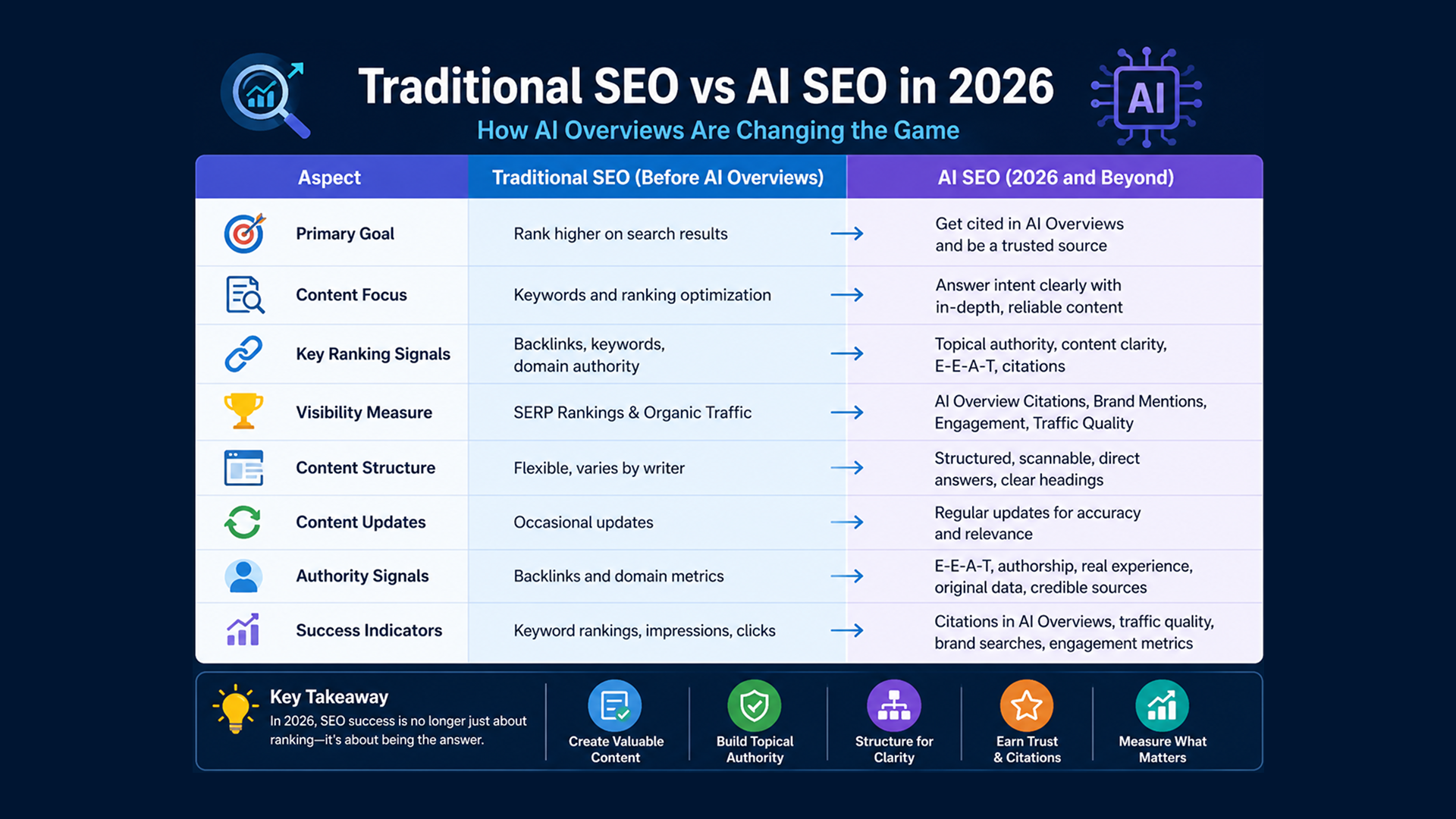
This comparison shows how SEO has evolved from traditional ranking-based strategies to AI-driven visibility in 2026. It highlights how search optimization has shifted from keyword rankings and backlinks to content clarity, topical authority, and AI Overview citations.
The visual explains key differences in goals, ranking signals, content structure, and success metrics, showing how businesses now need to focus on being featured in AI-generated answers rather than just ranking on search results pages.
Which Ranking Factors Influence AI Overview Selection the Most?
Topical Authority
Google does not pull AI Overview citations from websites that have published one good article on a subject. It pulls from sources that have covered a topic consistently, in depth, across multiple angles over time. That pattern of coverage signals genuine expertise rather than a single well-optimised page.
Content Clarity and Structure
AI extracts information from content that is written plainly and organised logically. Pages that bury the answer deep in the article, use vague or overly formal language, or jump between ideas without clear transitions are harder for AI systems to read accurately, and they tend to get skipped in favour of cleaner alternatives.
Content that earns AI Overview citations in 2026 tends to share a few structural habits:
- Direct Answers: The core question is answered within the first two or three paragraphs, not saved for a conclusion buried at the bottom of the page.
- Clear Headings: Each section is framed around a specific question or concept that mirrors how real users search for information on the topic.
- Short Paragraphs: One idea per paragraph. Dense blocks of text are harder for AI to parse and easier to skip when cleaner alternatives exist.
- Defined Terms: Key concepts are explained in plain language rather than assumed. Accessible content is extractable content.
E-E-A-T Signals
Experience, Expertise, Authoritativeness, and Trustworthiness have been part of Google’s quality framework for years. In the AI Overview era, they carry more practical weight than ever. When Google cites a source inside an AI-generated answer, it is effectively endorsing that content as accurate. Google is careful about what it endorses.
Pages with clear authorship, credible citations, original insight or data, and a track record of factual accuracy are consistently preferred over anonymous content with no verifiable signals of credibility. This is not new guidance, it is guidance that now has direct consequences for whether your content gets cited or ignored entirely.
How Should You Optimise Content for AI Overviews?
Answer Questions Directly
The clearest pattern across content that earns AI Overview citations is this: the answer comes early and it comes clearly. Google’s AI is not looking for the most eloquent prose on a topic. It is looking for the most direct, reliable answer to the specific question a user typed into the search bar.
Write each section so that the first paragraph delivers a complete, usable answer. The rest of the section can add depth, nuance, and supporting context, but the person who only reads the opening lines should still walk away with something genuinely useful. If your answer requires three paragraphs of build-up before it arrives, Google’s AI will often find a source where it does not.
Use Structured Data
Schema markup helps Google understand your content at a structural level, what the page is about, how different sections relate, and what type of content each element represents. The structured data directly supports AI Overview eligibility by making content easier to categorise and extract accurately.
FAQ schema aligns particularly well with how AI Overviews are built. Both formats organise information around specific questions and direct answers. If your content already follows that pattern, adding the markup formalises it in a way Google’s systems can read more reliably across different query types.
Build Content Clusters
A single page optimised for one keyword is a weaker signal than an interconnected group of pages covering a topic from multiple directions. Content clusters, a central pillar page supported by detailed articles addressing specific subtopics, signal the kind of comprehensive expertise that Google’s AI draws on when selecting sources to cite.
- Pillar Pages: Cover a broad topic in full and link out to every major subtopic your audience might want to explore further within that space.
- Supporting Articles: Each one addresses a specific question in depth, links back to the pillar, and reinforces the topical connections Google uses to evaluate authority.
- Internal Linking: Consistent links between cluster pages help AI systems map your site’s subject matter and understand how content pieces relate to each other.
- Regular Updates: Reviewed and refreshed content signals active expertise. A cluster that has not been touched in eighteen months starts to look like abandoned expertise rather than live authority.
Which SEO Mistakes Are Reducing Visibility in AI Overviews?
A lot of businesses are still running 2022 SEO strategies in a 2026 search environment. The tactics have not just stopped working, some are actively making things worse.
- Keyword Stuffing: Repeating keywords at high density reduces readability and signals low-quality content to the same systems now evaluating your pages for AI Overview selection.
- Thin Content: Pages that skim a topic without depth rarely get cited, regardless of technical optimisation. AI Overview selection rewards substance, not length alone.
- Ignored Structure: Content without clear headings, logical flow, and direct answers is harder for AI to extract from reliably. Cleaner alternatives consistently win the citation.
- No Content Updates: Content left untouched for over a year loses ground to actively maintained pages covering the same topics with fresher, more accurate information.
- Missing Authority: Anonymous content with no authorship signals, no cited sources, and no original insight struggles to clear the trust bar that Google applies to sources it cites publicly.
How Do You Measure SEO Success in the AI Overview Era?
Keyword rankings alone no longer tell the full story. If your positions are holding but your organic traffic is declining, AI Overviews are almost certainly absorbing the clicks your organic listing used to collect. That gap between rank and traffic is the clearest signal that your content strategy needs to shift toward citation optimisation rather than position maintenance.
Track branded search volume alongside organic traffic. Watch for your content appearing as cited sources within AI Overviews for target queries. Monitor click-through rates at the page level, not just overall traffic. These metrics together give a more honest picture of how your content is actually performing in a search environment that has moved well beyond the ten blue links model it ran on for two decades.
Conclusion
AI Overviews have not reduced the importance of SEO; they have increased the need for precision, clarity, and authority. The businesses gaining visibility are those that create well-structured content, demonstrate real topical expertise, and write in a way that AI systems can easily extract and trust. Rankings still matter, but being cited directly inside Google’s AI-generated answers is now even more valuable. This shift is driving demand for AI SEO services, helping brands optimize content for AI-driven search environments. Ultimately, success belongs to those who focus on clarity, trust, and meaningful answers rather than just content volume.