































Your client roster runs on a dozen email platforms: Klaviyo here, Salesforce Marketing Cloud there, and Mailchimp everywhere in between. Hiring specialists for each stack drains margin, while forcing migrations risks churn. White-label email fulfillment partners solve that problem: they log into the ESP a client already pays for, build and send under your brand, and let you keep the relationship.
Picking the right crew matters more than ever. Since February 1, 2024, Google has required anyone sending more than 5,000 messages a day to Gmail to authenticate with SPF, DKIM, and DMARC and to offer one-click unsubscribe, or risk rejection and the spam folder. The seven providers below clear that bar and prove it.
Join The European Business Briefing
New subscribers this quarter are entered into a draw to win a Rolex Submariner. Join 40,000+ founders, investors and executives who read EBM every day.
Subscribe
How we evaluated white-label email providers
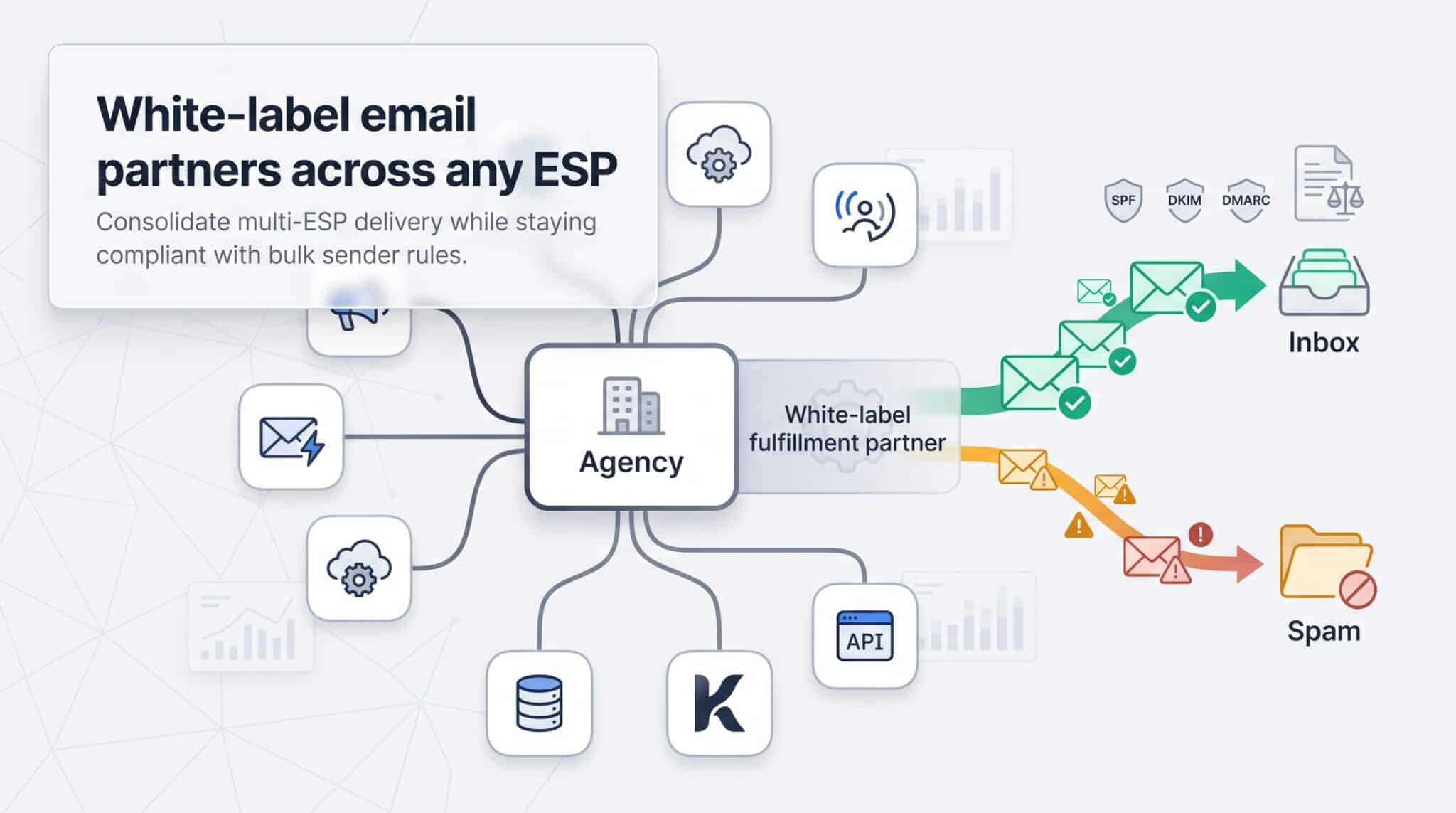
You hand these partners the keys to client data, brand voice, and deliverability, so “good vibes” are not enough. We built a scoring model that values evidence over marketing polish.
First, we drew a hard line between software you resell and humans who do the work. Any vendor that forced a platform switch was out. The seven that remain step straight into the ESP your client already pays for.
Next, we weighed seven criteria, each mapped to a pain point agencies mention most often:
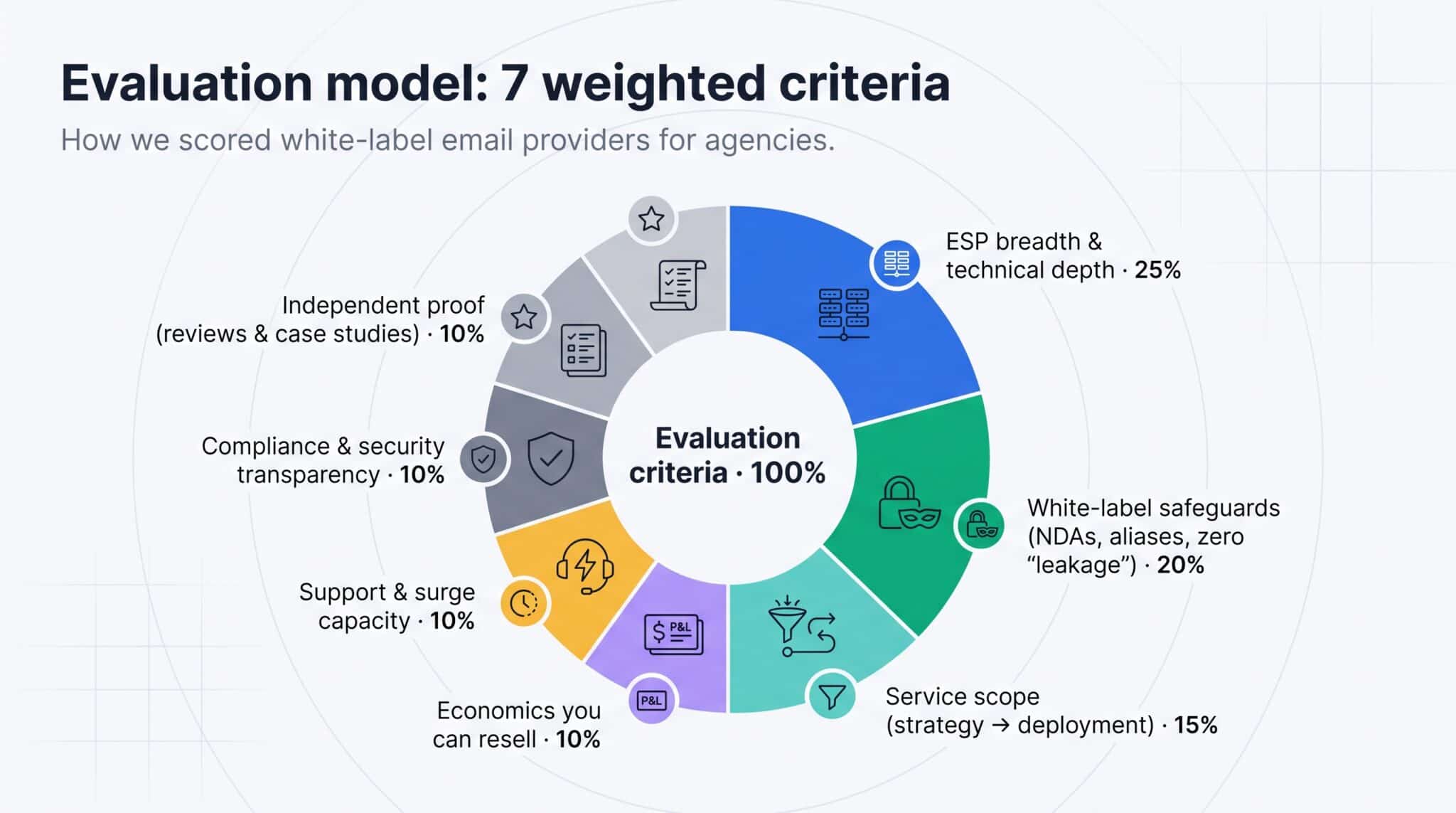
- ESP breadth and technical depth (25 percent)
- White-label safeguards: NDAs, aliases, zero “leakage” (20 percent)
- Service scope, from strategy through deployment (15 percent)
- Economics you can resell with confidence (10 percent)
- Support and surge capacity when deadlines collide (10 percent)
- Compliance and security transparency (10 percent)
- Independent proof: verified reviews and measurable case studies (10 percent)
The weightings match today’s risks. According to Google Support, senders of more than 5,000 daily messages to Gmail must authenticate their domain and support one-click unsubscribe, and must keep spam complaints below 0.3 percent. The FTC also reminds senders they cannot contract away CAN-SPAM liability; every non-compliant email still carries penalties up to $53,088, according to the agency. Providers that fumbled either rule dropped fast.
Finally, we graded proof. InboxArmy, Mavlers, and MailBakery publish the most third-party reviews. Mavlers alone lists 118 verified ratings on Clutch, so they start the list with momentum. Newer shops made the cut only after showing real multi-ESP work and watertight contracts.
Short version: we asked one question, “Would we hand this team our toughest client on Monday morning?” Only seven earned a confident yes.
The shortlist at a glance
You asked for more than marketing sound bites, so here is the proof on one page. Skim the grid, flag any deal breakers, and bookmark the two providers that fit your client mix.
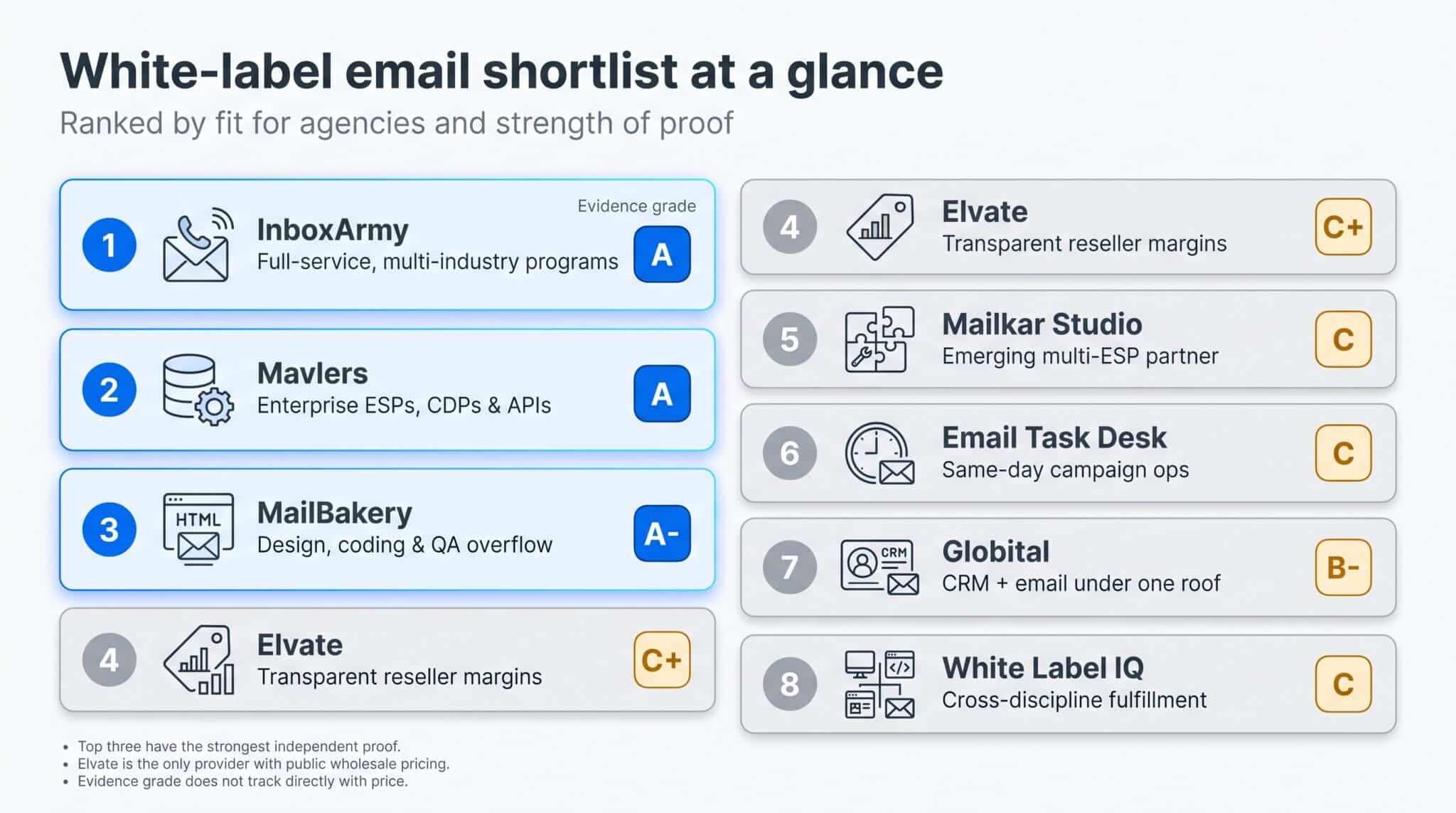
| Rank | Provider | Best for | Named ESPs* | Service scope | Starting price | Evidence grade |
| 1 | InboxArmy | Full-service, multi-industry programs | 40+ | Strategy → deliverability + SMS | Custom quote | A |
| 2 | Mavlers | Enterprise ESPs, CDPs and APIs | 15 | Strategy → API setup | Custom quote | A |
| 3 | MailBakery | Design, coding, QA overflow | 6 | Templates → implementation | Custom quote | A- |
| 4 | Mailkar Studio | Flexible emerging partner | 7 | Campaigns → audits | Custom | C |
| 5 | Email Task Desk | Same-day ops support | 10 | Production → ESP admin | Custom | C |
| 6 | Globital | CRM + email under one roof | Unstated | Copy → reporting | Custom quote | B- |
| 7 | White Label IQ | Cross-discipline fulfillment | none | Web, design, SEO support | Custom | C |
“Named ESPs” counts only the platforms the provider lists publicly. Most claim broader coverage on sales calls.
A couple of patterns pop out:
- Proof falls sharply after the top three, so treat lower-ranked claims as unverified until a paid pilot proves them.
- None of the seven publishes wholesale pricing; every provider starts with a discovery call, so factor that time cost into your margin math.
- Evidence grade does not track with price. Reviews and case studies reduce risk far more than tier names or glossy decks ever will.
Keep the table close. The next sections unpack each provider, starting with the one most agencies trust to handle mixed ESP programs without busting the budget or the brand.
1. InboxArmy: best overall for full-service, ESP-agnostic delivery
Among the providers we evaluated, InboxArmy.com is the safest first call when you need one partner to slip into any client stack without supervision. The Texas-based team focuses only on email and SMS, so every layer (strategy, copy, design, automation, deliverability) runs deep instead of wide.
InboxArmy assigns a dedicated crew to your workflow: senior strategists who stay on the account after ramp-up, meet you weekly, and work directly inside each client’s ESP, so nobody has to learn another platform.
The team is ESP agnostic, supporting more than 40 platforms, including Klaviyo, Salesforce Marketing Cloud, HubSpot, Marketo, Cordial, Iterable, Braze, Omnisend, ActiveCampaign, Keap, Brevo, GetResponse, Dotdigital, Campaign Monitor, AWeber, and Mailchimp. Fewer migration fights, faster wins.
Pricing is quote based, but guardrails are clear: no hidden fees and no long-term lock-ins. You keep the margin and the exit.
Proof backs the pitch. InboxArmy averages 4.9 out of 5 across 71 verified Clutch reviews, reports 90 percent client retention, and documents a 335 percent year over year revenue lift for bicycle retailer Sixthreezero. That depth earns the top spot.
Any gaps? No publicly posted SLA or SOC 2 certificate surfaced during research, and onboarding plus kickoff span the first four weeks, with regular production from week five. That timeline is longer than a pure production shop, yet most agencies find the depth worth the wait.
2. Mavlers: best for enterprise-scale martech and CDP work
When a client arrives with Salesforce Marketing Cloud data extensions, Braze triggers, and three years of half-finished automations, Mavlers is the team that tidies up.
The agency fields full pods of strategists, developers, and QA specialists who thrive inside more than 50 ESPs, CRMs, and CDPs. They do more than ship campaigns; they untangle APIs, migrate data, and stitch lifecycle journeys back together. Monday might mean an SFMC Journey rescue, Friday a Klaviyo-to-Snowflake sync, and no second vendor call is needed.
Everything remains under your banner. Mavlers covers every engagement with an NDA before work begins and communicates under your brand through a dedicated alias or channel, so nothing leaks.
Pricing is custom. Scope, volume, and data complexity set the rate, so think enterprise budgets. What you can verify before the sales deck is proof: 118 verified Clutch reviews averaging 4.9 out of 5 praise responsiveness, thorough QA, and steady project management.
Gaps? No public SOC 2 certificate or SLA targets surfaced, and because Mavlers also runs web development and PPC teams, you share attention unless the retainer earmarks email-only resources. Still, for agencies juggling multiple enterprise platforms, the mix of deep martech skill and disciplined white-label practice is hard to beat.
3. MailBakery: best for white-label email design and production
When strategy is locked, copy is approved, and only pixel-perfect HTML separates you from the send button, MailBakery delivers.
The London and Varna based shop focuses on production. Designers craft brand-aligned templates, developers hand-code bulletproof HTML, and QA tests across the client’s chosen ESPs (Klaviyo, HubSpot, Salesforce, Mailchimp, Braze, Shopify, and more). You ship accessible, dark-mode-safe emails without adding front-end staff.
Engagement can start small: brief one template, review the turnaround, then scale. Confirm NDA and white-label terms on the quote call, since the site does not publish them.
Agency owners praise two things: repeatable quality and reliable timelines. According to Clutch, 19 independent reviews echo those themes, noting how the dev team catches quirks before clients ever see them.
Know the limits. MailBakery is a production specialist. For segmentation, advanced deliverability, or lifecycle strategy, pair them with an in-house lead or another provider. Pricing remains quote only and varies with template complexity, testing depth, and revision cycles.
If you already own the plan and just need flawless execution, MailBakery is the dependable workhorse.
4. Mailkar Studio: best emerging multi-ESP contender
Mailkar Studio blends the momentum of a young company with a wide toolset. The team claims experience across more than 40 ESPs, from Salesforce Marketing Cloud to Zoho, and shows public examples on seven of them. For agencies juggling mixed mid-market stacks, that range feels refreshing.
Commercial models match the product range. You can spin up a one-off project, lock in a retainer, or hire a dedicated pod that behaves like part of your in-house crew. Ask for white-label terms up front: the site does not publish an NDA policy, an agency alias option, or a promise to strip its own tags from HTML comments and report footers, so get all three in writing before the pilot.
Independent proof remains light. DesignRush lists a single verified review praising turnaround and code quality. That does not disqualify Mailkar, but it does mean diligence matters. Run a paid pilot focused on turnaround, QA rigor, and deliverability hygiene before trusting a flagship client to the team.
If the pilot lands, you gain an affordable bench that can scale up or down without adding payroll. If it misses, you exit with minimal sunk cost. Either way, Mailkar Studio is a practical option to test when capacity crunches hit.
5. Email Task Desk: best for rapid campaign operations
When the calendar explodes with a flash sale, a product recall, and three nurture flows due yesterday, Email Task Desk steps in.
The team focuses on day-to-day campaign ops: building, QA, and scheduling email across ten named platforms, including Salesforce Marketing Cloud, Marketo, Iterable, Klaviyo, HubSpot, and Braze. Their headline promise is a response within 12 hours, a claim repeated on their services page. That speed alone can spare your account team a midnight panic.
White-label delivery comes standard. Add the crew to your project tool under an agency alias, share brand guidelines, and wake up to proofs ready for sign-off. List splits, dynamic content, link checks, and inbox previews arrive documented, so juniors are not left guessing what changed.
Limits are clear. Email Task Desk expects a tight brief (subject, segmentation, and creative assets), then executes. For lifecycle strategy or deliverability triage, pair them with a senior in-house lead.
Independent proof is still thin. We found no Clutch profile at research time, so start with one or two campaigns, track error rates, and decide whether to scale.
Need a reliable firefighting crew? Few vendors match the stated 12-hour response time.
6. Globital: best for agencies bundling CRM and email
If your pitch bundles lifecycle email with SEO, paid media, or GoHighLevel setups, Globital keeps everything under one reseller roof. The Australia-headquartered firm offers configurable white-label services across copy, design, campaign execution, and post-send reporting, then adds CRM build-outs on top. Fewer vendors mean fewer hand-offs and lower headline risk.
Proof exists, though the sample is small. According to Clutch, five reviews (all five stars) praise flexible scoping and proactive status updates. Agencies say Globital’s project managers adapt quickly when priorities shift mid-sprint, a plus when sales wants new pipeline stages while marketing preps holiday promos.
Pricing is not published; expect a quote once you share typical client volumes. Expect custom retainers rather than per-client tiers. That structure helps when one brand needs full CRM automation and another just wants weekly newsletters, but it is slower if finance demands an up-front rate card.
Two caution flags remain. Globital does not publish an ESP roster, so confirm platform experience before onboarding, and email is one service among many. Insist on a dedicated email lead, not a “generalist digital coordinator,” to own the inbox.
Handled well, Globital can trim vendor sprawl and deliver a seamless CRM-to-campaign experience without doubling your headcount.
7. White Label IQ: overflow partner for the web and design work around your email program
The Loveland, Colorado team does not sell email marketing. What it offers agencies is the surrounding build work: WordPress and custom sites, landing pages, UI/UX and graphic design, technical SEO audits, GoHighLevel setups, and dedicated developer hours under your brand. Use it when an email program needs a new landing page or a Shopify tweak, and pair it with one of the email specialists above for the sends themselves.
White Label IQ stands out for breadth. Need a React developer, a Shopify theme tweak, or a GA4 dashboard alongside your email program? One contract, one project manager, one invoice. That setup suits small agencies without deep vendor networks.
Depth is the trade-off. As of September 2026, Clutch shows a single review and no public security documentation. If email is your flagship service, shortlist a specialist first and treat White Label IQ as overflow. If email is just one piece of a larger marketing mix, the cross-discipline model can save both ops and finance time.
Run a pilot, stress-test the revision workflow, and confirm the hand-off to your email specialist before scaling. Managed wisely, White Label IQ provides convenient capacity without multiplying vendor headaches.
How to choose the right white-label email partner
Vendor charm is cheap; fit is what matters. Use this three-step filter.
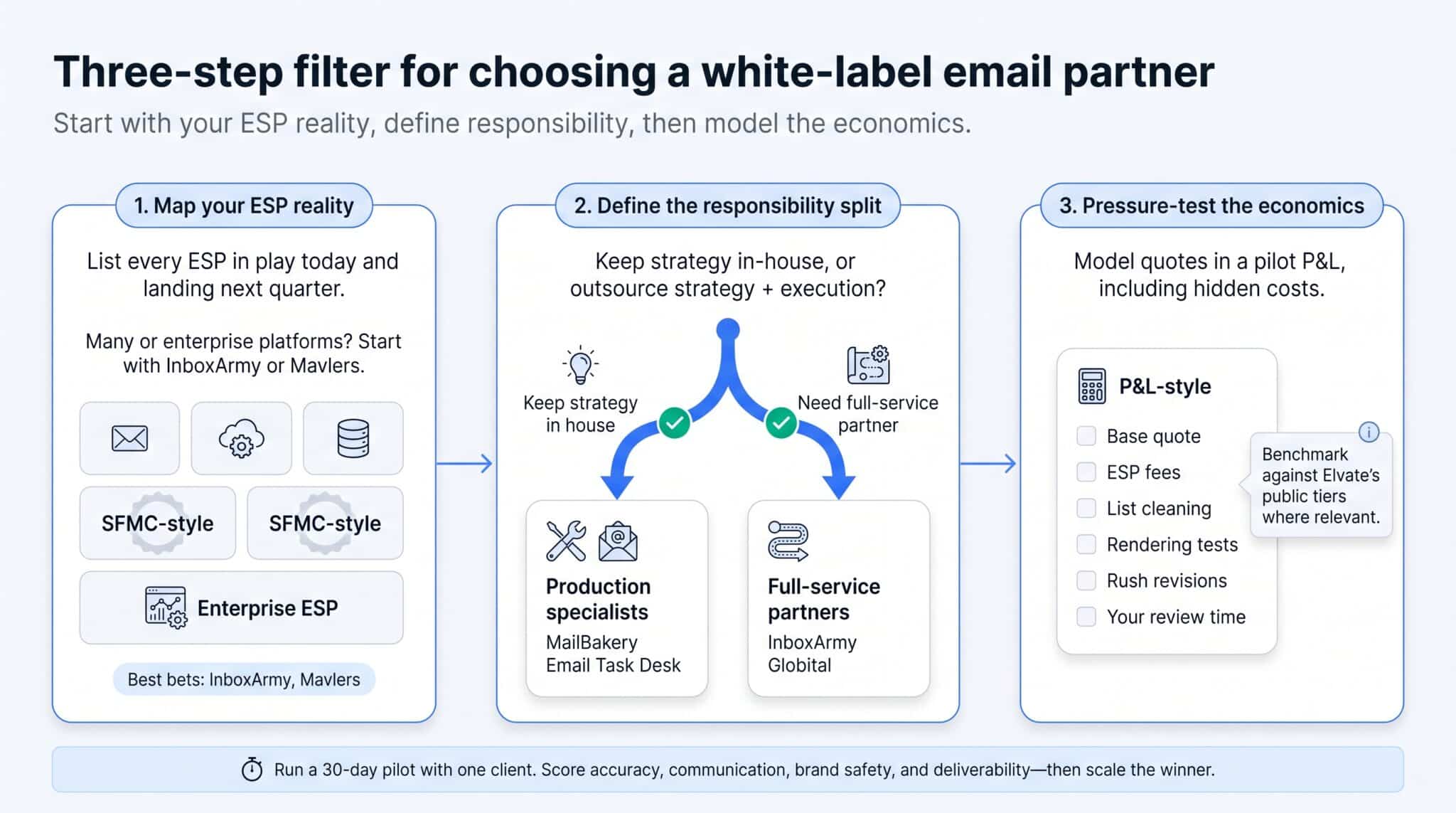
- Map your ESP reality. List every platform in play today as well as the ones landing next quarter. If that roster tops 10 logos, including at least one enterprise heavyweight like Salesforce Marketing Cloud or Braze, start with InboxArmy or Mavlers. They are the two teams in this roundup with published client work across dozens of platforms.
- Define the responsibility split.
- Keep strategy in house? A production powerhouse such as MailBakery or Email Task Desk will stretch your budget furthest.
- Need a partner to think, build, and optimize the program? Go full service with InboxArmy or Globital.
- Pressure-test the economics. Feed each quote into a pilot P&L. Add the stealth costs: ESP fees, list cleaning, rendering tests, rush revisions, and your own review time. The lowest hourly rate can grow expensive once rework enters the ledger.
Run one client through a 30-day pilot, score accuracy, communication, brand safety, and deliverability, then scale the winner. One clean send beats ten glossy slide decks every time.
Contract, security and hidden-fee checklist
Before you sign, slow down. A white-label deal is only as strong as the paperwork and processes behind it.
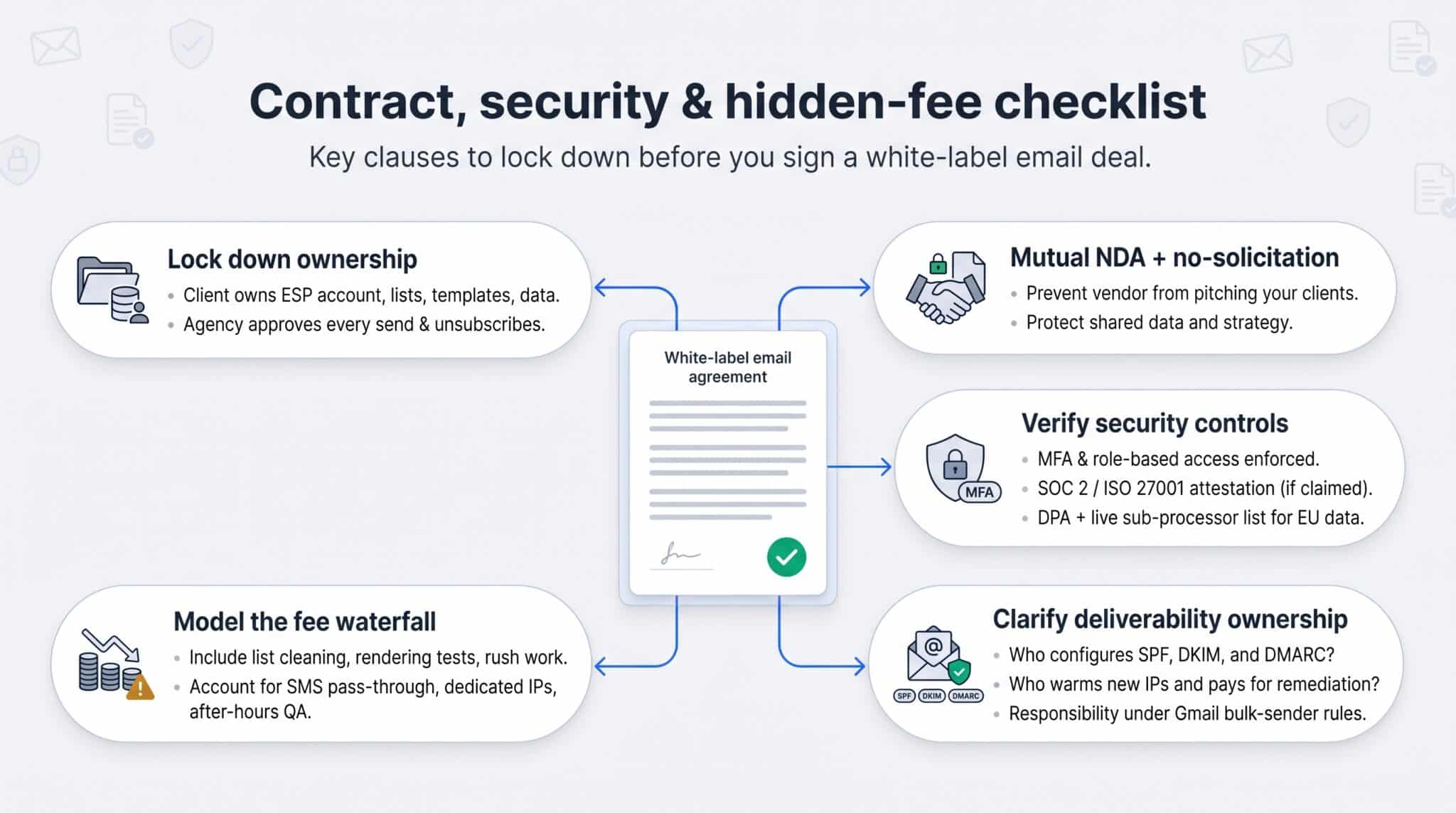
- Lock down ownership. The contract should state the client keeps the ESP account, lists, templates, and data. Your agency approves every send and controls unsubscribes. Anything less risks lock-in or fines.
- Demand a mutual NDA with a no-solicitation clause. No project manager should pitch your client six months later.
- Verify security. Ask for MFA enforcement, role-based access, and a written credential policy. If the provider touts SOC 2 or ISO 27001, request the current attestation, not just a footer badge. EU lists? Require a Data Processing Agreement and a live sub-processor register.
- Clarify deliverability ownership. Who configures SPF, DKIM, and DMARC? Who warms new IPs? Who pays for remediation if Gmail blocks the domain under its bulk-sender rules?
- Model the fee waterfall. List-cleaning credits, rendering tests, rush revisions, SMS pass-through, dedicated IPs, and after-hours QA can double the headline rate. Pull them into your pilot P&L before you celebrate “low” pricing.
Conclusion
If a vendor dodges any of these questions, keep shopping. Transparency now beats crisis management at send time.
Frequently asked questions
What is white-label email marketing?
It’s the practice of outsourcing email strategy, production, or deployment to a specialist team that works invisibly inside your client’s existing ESP, so every deliverable appears to come from your agency.
How does a white-label service differ from white-label software?
Software hands you a rebranded dashboard but still expects your team to plan, write, and send. A white-label service supplies both people and processes, letting you offload labor and infrastructure.
Can a provider really work in any ESP?
Not quite. Ask for named experience in your exact platform, run a paid pilot, and inspect campaign logs before you promise clients universal coverage.
How much does white-label email cost?
Most providers quote custom retainers based on hours or full-time pods rather than published per-client tiers. Remember to factor in hidden costs such as ESP fees, list cleaning, rendering tests, and rush revisions before you compare quotes.
Will clients know the work is outsourced?
They shouldn’t. A solid provider uses your email aliases, places your logo in reports, and removes its own tags from HTML. Test for “leakage” by checking template metadata and unsubscribe pages during the pilot.
Who holds legal responsibility for CAN-SPAM compliance?
You do. The FTC says senders cannot “contract away” liability, so make sure the provider’s workflow covers consent, suppression, and prompt opt-out handling.
What should a white-label SLA include?
Response times, campaign turnaround, QA steps, error remediation, escalation contacts, data-breach notification, and exit support.
Is outsourcing cheaper than hiring?
Often, but only after you add fully loaded salaries, management time, peak-season overtime, and software subscriptions to the provider’s all-in rate plus hidden fees.
Should I choose a full-service partner or a production specialist?
Keep strategy in house if that’s your value prop and outsource execution. If you need lifecycle ownership and deliverability oversight, pay for a full-service crew.
How do I get started?
Pick one client with a clear brief, run a 30-day pilot with two finalists, score them on accuracy, communication, and margin, then scale the winner. One clean test beats ten reference calls.