































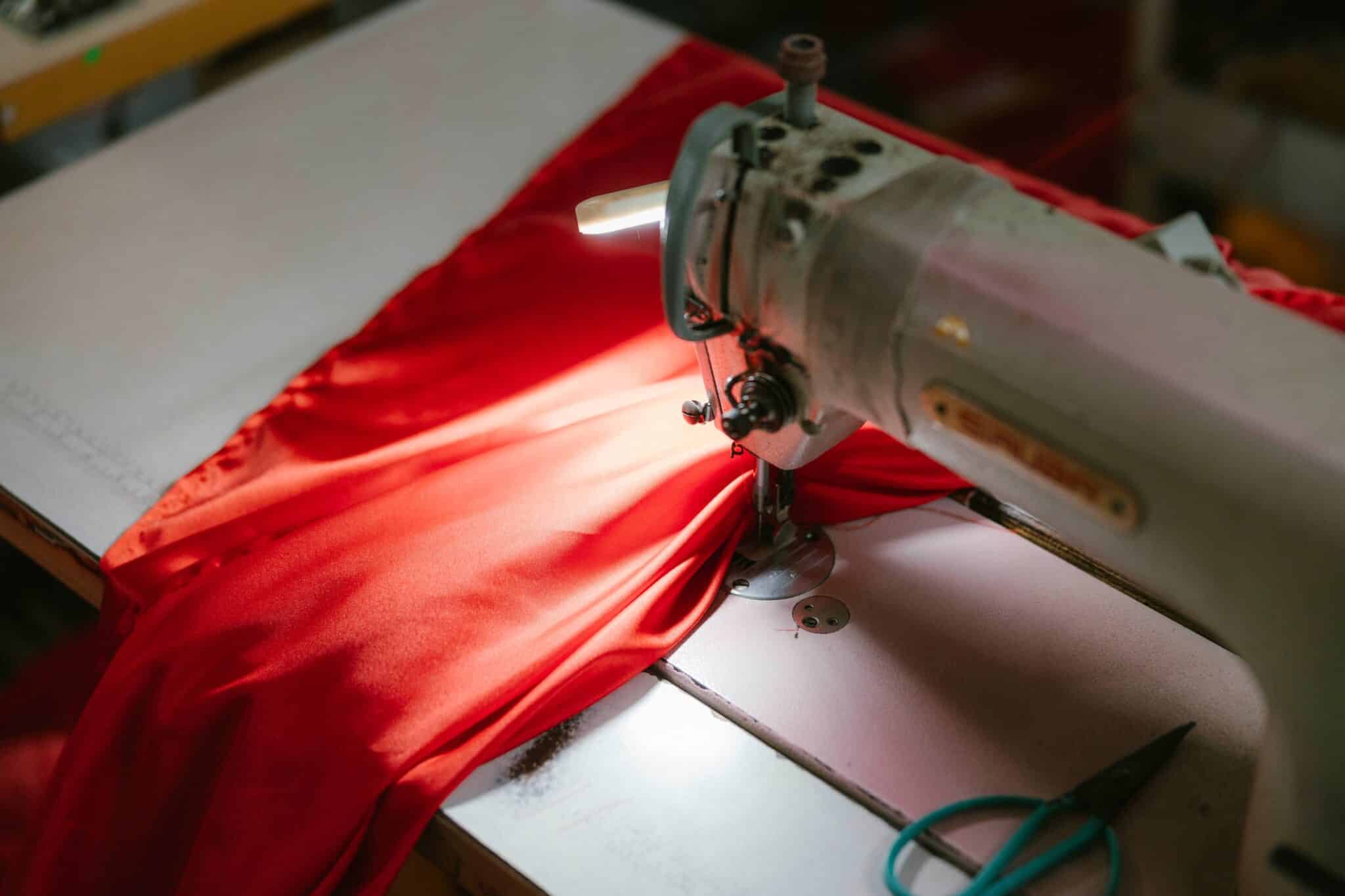
Choose a clothing manufacturer in China by checking its production setup, sample process, quality controls, and terms for repeat orders. For a private label program, confirm garment quantities, label and packaging minimums, and who handles each stage. These details help you assess a supplier before committing to a larger order.
Choosing a clothing manufacturer in China affects your margins, product quality, and launch schedule. This guide looks at the decision from the brand owner’s side: what to verify, how to structure the relationship, and where the risks tend to hide.
Quick Answer: How Should a Brand Choose a Manufacturer in China?
Start by confirming which production stages the supplier owns and which it assigns to partners. Compare MOQ per style and color, sampling by process, bulk timing, inspection steps, and written defect-handling terms. For private label orders, check labels, packaging, and reorder records separately. Approve a physical sample and use a manageable first order to test the working relationship.
Join The European Business Briefing
New subscribers this quarter are entered into a draw to win a Rolex Submariner. Join 40,000+ founders, investors and executives who read EBM every day.
SubscribeWhy China Still Matters for Apparel Brands
China’s garment industry offers depth that is hard to replicate: fabric mills, trim suppliers, dye houses, and decoration specialists often sit within the same industrial regions. That density shortens sampling cycles and widens the range of materials a brand can access, from basic cotton jersey to heavyweight fleece and specialty washes.
It also supports flexibility in volume. Many factories can accommodate smaller opening orders and scale up as a brand grows, which suits labels still testing demand. The trade-off is variation in quality between factories, which is why vetting matters so much more than the country label.
Understanding Private Label Before You Source
A private label clothing manufacturer produces garments sold under your brand. The product can be an existing style with your labels and decoration, or a garment developed from your specifications. Confirm the fabric, fit, labels, packaging, and artwork included in the quoted scope.
This differs from buying plain blanks. A private label program requires the factory to manage details like label placement, packaging standards, size labeling, and consistency from batch to batch. A factory that treats these as routine is usually easier to work with than one that treats each as a special request.
Stock-Based Private Label vs. Fully Custom
Private label can use stock garments or full custom development. At UNIT-100, stock blanks with printing or embroidery start at 50 pieces per style, with colors and sizes mixed. Full custom starts at 100 pieces per style, per color, with sizes mixed within that quantity. Choosing stock does not mean a buyer can change its fabric or pattern; those changes need a separate development brief and quote.
What to Verify Before You Commit
In-House Capabilities
v
Experience and Stability
Years in operation say something about how a factory has handled changing demand, material costs, and customer expectations. A long-running manufacturer has usually seen the problems that newer operations are still learning about.
Sampling Discipline
How a factory handles samples predicts how it will handle production. Look for clear measurement records, honest feedback on design feasibility, and reasonable turnaround. A factory that agrees to everything without comment may be hiding concerns.
Quality Control Process
Ask for the inspection stages, acceptance criteria, and action taken when goods fail a check. UNIT-100 describes checks before production, during production, at completion, and before shipment, including pre-shipment sampling to AQL 2.5. Ask the factory to explain its sampling plan and the measurement tolerances agreed for your order.
In a 300-piece tie-dye order described by UNIT-100, pre-shipment colorfastness testing found color bleeding in blue-and-black and green-and-black combinations. The goods went back for color fixing and were shipped only after meeting the required standard. The example shows why a buyer should ask what happens after a failed check, as well as whether inspection takes place.
Communication
Slow, vague, or inconsistent replies during the quoting stage tend to continue during production. Clear communication, with specific answers and written confirmation, is one of the strongest early signals.
Key Benefits of a Long-Term Manufacturing Partner
A reference for reorders. Retained patterns, measurements, and approved samples give both sides a starting point. They do not remove the need to confirm fabric availability, shade, and finishing on the next batch.
Faster development. A factory that knows your standards needs fewer rounds of revision on new styles.
Clearer reorder planning. Ask for a fresh quote based on quantity and current materials. UNIT-100 does not offer a standard reorder discount or annual price lock, and a smaller repeat order can have a higher unit price.
Easier problem solving. A relationship built on repeated orders makes it simpler to resolve issues quickly.
Support for private label details. Labels, packaging, and file retention become routine rather than one-off requests.
Buying Guide: What to Compare Between Factories
| Factor | What to Confirm |
| Production setup | Owned facilities, partner processes, and the contact responsible for the order |
| MOQ | Minimum per style and color, plus separate label and packaging minimums |
| Sampling | Timing for plain, decorated, and washed samples; revision arrangements |
| Bulk timing | Start point, material and trim readiness, and shipping time separately |
| Fabric | GSM, fiber composition, hand feel, shrinkage, and availability for reorders |
| Private label services | Label placement, packaging format, and what is included in the quote |
| Quality control | Inspection stages, agreed tolerances, and action after a failed check |
| Reorder records | Which patterns, measurements, artwork, and print screens are retained, and for how long |
| Payment terms | Deposit, balance, production evidence, and any pre-shipment inspection |
Ask for all of this in writing. A comparison table built from written answers is far more useful than impressions from calls.
Common Mistakes to Avoid
Starting with the largest order. A smaller first run lets you assess communication, quality, and delivery before committing more capital. UNIT-100 describes one customer who began with 100 pieces and later ordered 1,000 pieces per style, after receiving design help and fabric recommendations. This is one customer’s progression, not a promised growth result.
Relying on a supplier’s label alone. A business can own factories and also handle sales, export, and partner production. Ask which facilities it owns, who will make your order, and who is responsible for follow-up.
Skipping the physical sample. Photos and spec sheets don’t show fabric hand, fit, or print quality.
Underestimating lead times. Sample approval, bulk production, and shipping run on separate clocks, and combining them leads to missed launch dates.
Choosing on unit price alone. A cheap quote can hide defect rates, slow communication, and inconsistent reorders.
Leaving specifications vague. Unclear tech packs lead to interpretation, and interpretation leads to disputes.
Neglecting reorder planning. Not asking how specs are stored makes later batches harder to match.
Expert Tips
Build a one-page specification sheet for every style covering fabric, GSM, measurements, trims, label placement, decoration, and packaging. Use the same template for each factory so comparisons stay fair.
Ask for GSM options matched to your product, then compare the actual fabric and a washed sample. UNIT-100 reports 210–230 GSM as its most-ordered T-shirt weights and about 380 GSM for hoodies. As of November 2026, it defines heavyweight T-shirts as starting at 240 GSM and heavyweight hoodies and sweatshirts at 380 GSM. These are its own reference points, not a universal weight recommendation.
Treat the first order as a pilot. Define success in advance, such as measurement tolerance, color accuracy, on-time delivery, and defect rate, then review results with the factory.
Keep your own photos, measurements, and approved specifications. UNIT-100 says it retains patterns and cutting markers permanently but generally does not release patterns to customers; print screens are kept for six months. Confirm what the factory stores, what you receive, and what may need to be prepared again for a reorder.
Negotiate timelines as carefully as price. A realistic schedule protects your launch more than a small discount does.
Managing Risk Across the Process
Risk in apparel sourcing usually shows up in four places: quality, timing, communication, and payment. Address each early.
For quality, agree on measurements, tolerances, and how deviations will be handled before production starts. For timing, request milestones that include material and trim readiness. For communication, assign one point of contact on each side and confirm decisions in writing. For payment, confirm the deposit, balance, and inspection arrangements before paying.
UNIT-100’s stated terms are a 30–50% deposit with the balance due before shipment. It sends bulk photos or video before the balance payment and welcomes buyer-appointed inspectors. Its stated defect-handling options include rework, remaking goods, or compensation, depending on the issue. Ask for the terms that apply to your order in writing rather than treating these options as an unconditional refund promise.
None of this requires an adversarial approach. Factories generally prefer clear specifications, because clarity reduces rework for them as well.
UNIT-100: Private Label MOQ, Packaging and Lead Times
UNIT-100 is the brand of Guangzhou Vision Clothing Co., Ltd., a family business founded in 2001. It owns a sewing factory and a print shop in Zhongshan, China, and handles sales and shipping. Embroidery, washing, and garment dyeing are handled by partners; sewing may also be assigned to partner factories when its own lines are full. Kenneth, the second-generation owner, had eight years of experience in the business as of November 2026.
Garment, label, and packaging minimums need to be checked separately. The following are UNIT-100’s stated quantities as of November 2026; confirm the selected materials and services in the quote.
| Item | Minimum and planning detail |
| Stock blanks with printing or embroidery | 50 pieces per style; colors and sizes can be mixed |
| Full custom garments | 100 pieces per style, per color; sizes can be mixed |
| Custom neck labels and care labels | 500 of each; allow about 8–10 additional days |
| Hangtags, stickers, and tissue paper | 500 pieces; about 10 days |
| Custom-printed polybags | 5,000 pieces; about 10–15 days |
For a small garment order, a buyer can purchase 500 woven labels and leave the unused labels with UNIT-100 for a later order, or have them sent separately. Confirm the arrangement in the quote. Barcode labeling and individual packaging can also be arranged; UNIT-100 does not provide single-piece dropshipping.
Sampling and production estimates also depend on the process. The following timings are as of November 2026 and exclude shipping.
| Process | Estimated timing |
| Plain sample | 3–7 days, including pattern development |
| Sample with one print or embroidery | About 10 days |
| Sample with both printing and embroidery | About 12–13 days |
| Washed sample | 14–18 days or longer |
| Standard bulk production | 7–20 working days after sample approval |
| Tie-dye, acid-wash or snow-wash bulk production | About 20–30 days |
| Repeat order of the same style with trims available | About 15–20 days |
Confirm whether label and packaging work can run alongside other preparation or will delay production. A production estimate is not an arrival date; shipping is a separate part of the schedule.
FAQs
What is the difference between a clothing manufacturer and a private label manufacturer?
A clothing manufacturer produces garments. A private label manufacturer produces them under your brand, including labels, packaging, and branding details, often starting from existing styles that you adapt.
What is a typical MOQ when sourcing from a clothing manufacturer in China?
It varies by factory and product. At UNIT-100, stock blanks with printing or embroidery start at 50 pieces per style, with colors and sizes mixed. Full custom starts at 100 pieces per style, per color, with sizes mixed. Label and packaging minimums are separate; confirm the chosen fabric’s minimum in the quote.
How long does sampling take?
UNIT-100’s November 2026 estimates are 3–7 days for a plain sample, including pattern development; about 10 days with one print or embroidery; about 12–13 days with both; and 14–18 days or longer for washed samples. Revisions and shipping need separate time allowances.
How long does bulk production take?
At UNIT-100, standard bulk production takes about 7–20 working days after sample approval. Tie-dye, acid-wash, and snow-wash orders take about 20–30 days. These are November 2026 estimates; confirm fabric and trim readiness, and allow separately for shipping.
How do I know whether a supplier is a factory or a trading company?
Ask which facilities the business owns and where your order will be made. Request production evidence and discuss a visit or inspection. Ownership and trading activity can coexist: UNIT-100 owns sewing and printing facilities, handles sales and shipping, and uses partner factories for some processes.
Can a manufacturer handle labels and packaging?
Yes, but confirm each item’s minimum, timing, and quoted scope. At UNIT-100, custom neck and care labels start at 500 of each, while custom-printed polybags start at 5,000. A 100-piece garment order does not mean every packaging item can also be ordered in quantities of 100.
What GSM should I choose?
Choose by product, climate, and intended feel, then review a washed sample. UNIT-100’s most-ordered weights are 210–230 GSM for T-shirts and about 380 GSM for hoodies. Its heavyweight definitions start at 240 GSM for T-shirts and 380 GSM for hoodies and sweatshirts, as of November 2026.
Conclusion
Choosing a clothing manufacturer in China comes down to verifiable details: who makes the goods, how samples and inspection are handled, and what happens on a reorder. Before contacting a private label clothing manufacturer, prepare your reference images or garments, fabric requirements, artwork, measurements, quantities by style and color, and label and packaging needs. Start with a manageable order, record approvals, and assess the result before increasing volume.