






























A cubic yard of soil weighs roughly 3,000 pounds. When a trench wall collapses, that weight drops on a worker in seconds. There’s no outrunning it and almost no surviving it without immediate rescue.
That’s why trench shoring isn’t optional. It’s regulated, enforced, and the single most important safety measure on any underground utility job. Yet OSHA continues to cite contractors for the same violations year after year. In late 2024, a Texas utility contractor received over $107,000 in penalties for sending workers into unprotected trenches. That came two years after a fatal collapse on a similar job.
Trench collapses are also among the highest-severity insurance claims in construction. Coverage should extend to subcontracted and right-of-way work, which is where shoring failures typically happen. Having the right utility contractor insurance means your policy accounts for these exposures before a claim forces the conversation.
Join The European Business Briefing
New subscribers this quarter are entered into a draw to win a Rolex Submariner. Join 40,000+ founders, investors and executives who read EBM every day.
SubscribeHere’s what you need to know about the standards that govern trench shoring.
What OSHA Requires Under Subpart P
OSHA’s excavation standard lives in 29 CFR 1926, Subpart P. It applies to every trench on every job site, regardless of project size.
The rules are built around depth thresholds:
- Under 5 feet. No protective system is required unless a competent person identifies a cave-in hazard. If the soil looks unstable, protection is still mandatory.
- 5 feet or deeper. A protective system is required. No exceptions. This is where trench shoring, sloping, benching, or shielding becomes non-negotiable.
- 20 feet or deeper. The protective system must be designed or approved by a registered professional engineer.
Most utility work falls in the 5-to-15-foot range. That means every water main, sewer line, and storm drain job needs protection before anyone enters the trench.
Quick summary: OSHA requires protective systems for trenches 5 feet or deeper. At 20 feet, an engineer must design the system. Violations carry serious penalties and can result in criminal charges after fatalities.
The Four Approved Protective Systems
OSHA recognizes four methods for protecting workers in trenches. Each has specific applications depending on soil type, trench depth, and site conditions.
Sloping
Cut the trench walls back at an angle steep enough to prevent collapse. The required angle depends on soil type. Type C soil requires a slope of 1.5:1.
Benching
Create step-like formations in the trench walls. Benching is only allowed in Type A and Type B soils. It’s prohibited in Type C.
Shoring
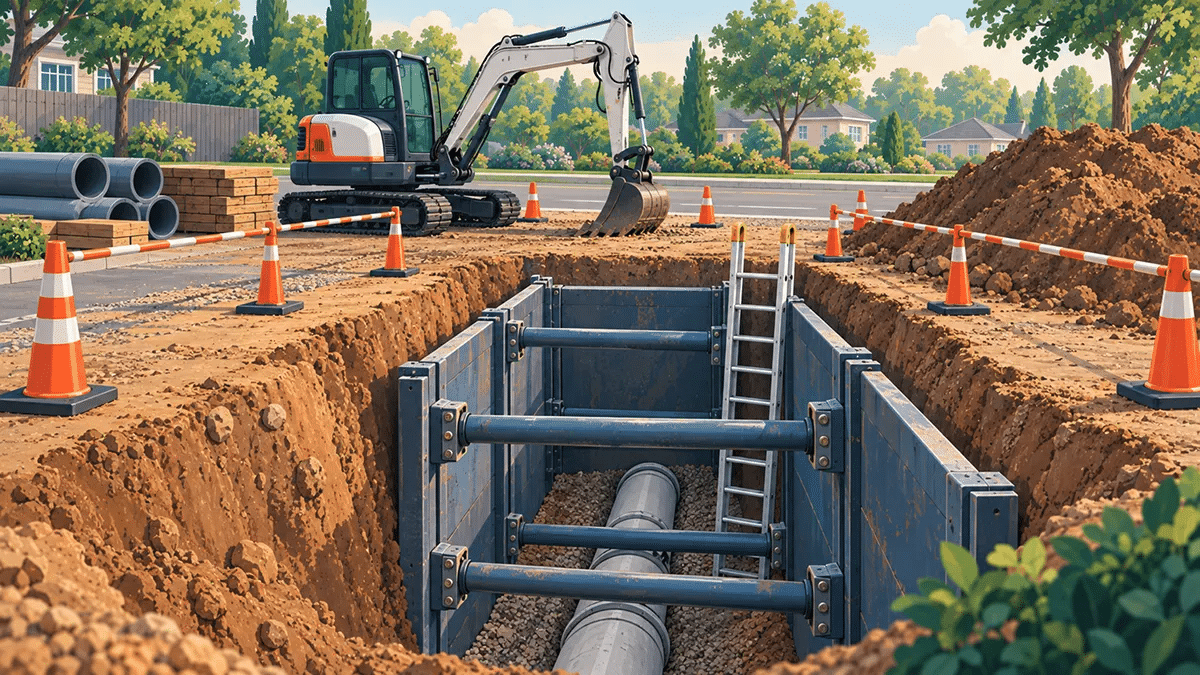
Install hydraulic, mechanical, or timber supports against the trench walls. Trench shoring is the most common protection method for utility work. It allows a narrower excavation footprint, which matters on roads and in right-of-way corridors.
Shielding
Place a trench box or shield inside the excavation. Shields protect workers from collapse but don’t prevent the walls from caving in. They create a safe zone, not structural support.
For most utility contractors, trench shoring and shielding are the go-to methods. Sloping requires too much space on tight urban job sites.
Soil Classification Determines Your Trench Shoring Method
You can’t select the right trench shoring system without classifying the soil first. OSHA defines three types:
- Type A. The most stable. Clay, silty clay, hardpan. Unconfined compressive strength of 1.5 tsf or greater.
- Type B. Moderately stable. Silt, sandy loam, medium clay. Strength between 0.5 and 1.5 tsf.
- Type C. The least stable. Gravel, sand, submerged soil, soil from which water is seeping. Strength below 0.5 tsf.
Your competent person must classify the soil before work begins and reclassify it when conditions change. Rain, vibration from nearby traffic, and adjacent excavation activity all downgrade soil stability.
Note: Soil that was Type B in the morning can become Type C by afternoon if water accumulates or heavy equipment operates nearby. Classification is not a one-time task.
The Competent Person Requirement
Every trench job site needs a designated competent person. This isn’t a title you hand to someone for paperwork purposes.
Under OSHA, the competent person must identify existing and predictable hazards related to soil conditions and protective systems. They must also have authority to take immediate corrective action, including shutting down the job.
If your competent person can’t stop work when conditions are unsafe, they don’t meet the standard. OSHA inspectors look for this specifically. A name on a form means nothing if that person can’t actually make the call.
Daily inspections are mandatory. The competent person checks the trench before each shift, after rain, and after any condition change. They document soil type, trench dimensions, protective systems, and weather.
How Trench Shoring Connects to Your Insurance
Here’s where safety compliance and coverage intersect.
An OSHA citation during an active claim gives your insurer grounds to dispute coverage. If an investigation reveals missing shoring, an unqualified competent person, or undocumented inspections, the claim gets harder to defend.
Workers’ comp for utility contractors sits under classification code 6325. Your Experience Modification Rate reflects your claims history. A trench collapse claim elevates your EMR for three years, raising premiums on every renewal.
Providers like NIP Group build coverage specifically for underground utility work. That matters because right-of-way jobs, subcontracted crew exposure, and multi-trade trenching operations create liability layers that generic commercial policies miss.
Important: Make sure your policy explicitly covers the type of trench work you perform. Utility line installation, storm drainage, and directional boring each carry different risk profiles. Your coverage should match your actual scope.
FAQs
- At what depth does OSHA require trench shoring?
OSHA requires a protective system for any trench 5 feet or deeper. Trench shoring is one of four approved methods alongside sloping, benching, and shielding. For trenches 20 feet or deeper, the system must be designed by a registered professional engineer.
- What does a competent person do on a trench job site?
The competent person classifies the soil, inspects the trench before each shift, monitors protective systems throughout the day, and has the authority to stop work immediately if conditions become unsafe. They document all inspections and must be present whenever workers enter the excavation.
- How often should trench inspections happen?
OSHA requires inspections before each work shift, after every rain event, and after any change in site conditions like heavy equipment vibration or nearby excavation. The competent person performs and documents each inspection before allowing workers to re-enter the trench.
- Does trench shoring compliance affect insurance premiums?
Yes. A strong safety record with documented shoring compliance lowers your Experience Modification Rate over time, which directly reduces workers’ comp premiums. OSHA violations discovered during a claim investigation can also give insurers grounds to dispute coverage or limit payouts significantly.






