






























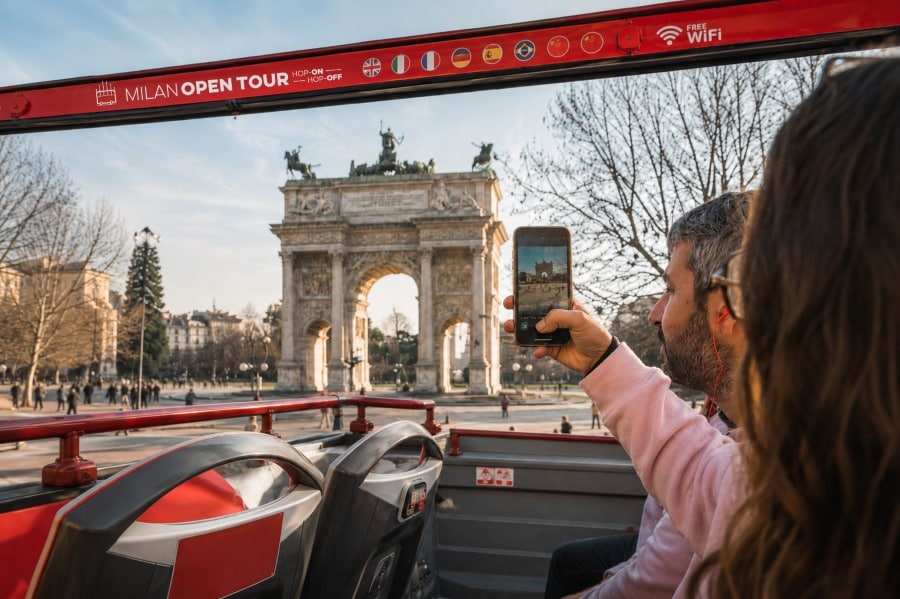
The map of central Milan is quietly misleading. On a phone screen the Duomo, the Sforza Castle and Brera sit within a couple of centimetres of each other, which is why most first-time visitors write an itinerary that assumes everything is five minutes from everything else. Then the morning starts, the queue for the Cathedral is longer than the photos suggested, a coffee turns into forty minutes, and by early afternoon the plan has quietly collapsed. It is usually at that point that the question of whether a Milan hop on hop off bus is worth the ticket stops being theoretical and becomes practical.
Nobody arrives in a city already knowing its rhythm. You learn how long Milan takes by spending a day getting it wrong, and the first visit is precisely the one where a fixed schedule has the least chance of surviving contact with reality. What follows is less a recommendation than a description of what the format actually solves, and where it does not help at all.
What first-time visitors get wrong about timing in Milan
Walking from Piazza del Duomo to the Sforza Castle takes around twenty minutes at a steady pace. That figure is accurate and almost useless, because nobody walks it at a steady pace. You stop under the Galleria’s glass dome, you photograph the Madonnina from three angles, you get pulled into a shop on Via Dante. The twenty minutes become fifty, and the museum you had pencilled in for eleven now starts at noon.
Join The European Business Briefing
New subscribers this quarter are entered into a draw to win a Rolex Submariner. Join 40,000+ founders, investors and executives who read EBM every day.
SubscribeAdd the crowds. Italian tourism has been setting records for several years running, and according to this release from Istat, the national statistics institute, 2024 closed with 458.4 million nights spent in tourist accommodation, another increase over the previous record. Those numbers translate, on the ground, into queues that behave unpredictably from one hour to the next. A first-timer has no way of anticipating them, which makes any plan built on precise timings fragile from the start.
Deciding at the stop, not the night before
The practical response is not a better schedule. It is a looser one. Buying a Milan hop on hop off bus tour takes you to the operator’s site, where the three panoramic lines, the departure window from Piazza Duomo and the 24, 48 and 72 hour ticket prices are laid out together, along with a Real Time Bus tool that shows where each vehicle currently is rather than where a printed timetable says it should be. That last detail matters more than it sounds: you stop guessing and start seeing.
The Highlights line gives a sense of the scale involved. It runs a loop of eighteen stops through the historic centre in roughly an hour and ten minutes, starting and finishing in Cathedral Square, with service from 9:15 to 18:30. Get off at the Castle because the light is good and the courtyard is empty, spend an extra hour there, then rejoin when you are ready. The ticket stays valid on all the lines for its full duration, so nothing about that decision costs you anything except the time you chose to spend.
Families move at a different pace than solo travellers
A parent with two children under ten operates on a completely different clock. Meals happen earlier, energy runs out sooner, and the number of times you have to fold a pushchair to board a crowded tram becomes the real measure of how hard a day was. Staying seated for twenty minutes, in the open air, with the Castle passing on one side, is worth more to that family than any saving in transit time.
The audio commentary runs in eleven languages for adults, and there is a separate version in three languages written for children, which does more for a restless eight-year-old than a guidebook read aloud by a tired parent. The reduced ticket for ages five to fifteen costs €10 regardless of whether you take the 24, 48 or 72 hour option, a pricing structure that quietly rewards families who stay longer. Small thing, but it changes how you plan the second day.
Milan’s weather has a say in your itinerary
Spring and autumn in Milan bring rain that arrives without much warning, and there is no good improvised answer to a downpour when you are halfway between two stops with a museum booking in forty minutes. The city’s arcades help. They do not cover much ground.
Being able to climb back aboard, out of the rain, with air conditioning and Wi-Fi on board, is one of those advantages that sounds trivial in a brochure and feels significant at four in the afternoon in November. The lower deck is enclosed, so a wet hour does not have to be a lost one. Rain is the variable that ruins the tightest itinerary, and a Milan hop on hop off bus at least keeps the next move available while you work out what to do with the rest of the afternoon.
What a Milan hop on hop off bus really saves you
The instinct is to compare the ticket price against a single public transport fare, which is the wrong comparison. A day pass on the metro gets you between two points; it does not get you a route that connects the Duomo, Brera, the Castle, the Last Supper area, the Triennale and CityLife in one continuous loop with a commentary explaining what you are looking at.
The honest comparison is against hours. Two or three walking transfers of twenty-five minutes each, plus the time spent standing at a crossing working out which direction is north, is most of a morning. Twenty-five euros for twenty-four hours of unlimited hopping looks different once you price that morning at what it is actually worth on a two-day trip. This is the same arithmetic that business travellers run when they get half a day free in an unfamiliar city, whether that is Milan or somewhere they have never landed before, as in this piece on things to do in Lisbon for the business traveller. Three or four planned stops and the ticket pays for itself. One stop and it does not.
What you actually take away
There is a detail most people notice only after boarding: fifty cents from every ticket sold goes to Dynamo Camp, which runs recreational therapy programmes for children with serious or chronic conditions. It is not why anyone chooses the bus, and it should not be. It is the kind of thing you find out on the day and remember afterwards.
The larger point about a first visit is that flexibility is not laziness. It is an accurate assessment of how little you know about a city you landed in yesterday. Come back a second time, with a sense of which neighbourhoods you actually want, and you will probably walk more and ride less. That is how it should go. The first trip is for building the map in your head, and it is easier to build from the top deck of something that keeps coming back for you.