






























Why Ionic App Developers Need a Scalable Backend Like Cassandra
Mobile applications built with Ionic have become a common choice for teams that want one codebase to run across iOS, Android, and the web. This approach saves development time and keeps maintenance simpler, but it also raises a question that many teams overlook until it becomes a problem: what happens to the backend when the app gains thousands, or millions, of active users? A frontend framework can only carry an app so far. Once user numbers climb, the database layer often becomes the point where performance drops, response times slow, and outages start to appear during peak traffic. This is the moment when a scalable, distributed database like Apache Cassandra enters the conversation, and understanding how it fits into an Ionic project can save a development team from painful rewrites later on.
What Is Apache Cassandra and Why It Fits Mobile App Architecture
Apache Cassandra is a NoSQL database built to handle large volumes of data across many servers without a single point of failure. Unlike traditional relational databases that rely on one central server (or a primary-replica setup), Cassandra uses a peer-to-peer architecture where every node in the cluster carries equal responsibility. Data gets distributed and replicated across nodes automatically, which means the system keeps running even if one or several machines go offline.
For mobile applications, this structure lines up well with real-world usage patterns. Mobile users log in from different regions, at different times, on inconsistent networks, and often in large bursts (think of a flash sale or a live-streamed event). A database that can write and read data across multiple geographic locations, while tolerating node failures, gives an Ionic app the kind of backend stability that relational systems struggle to match at scale.
Join The European Business Briefing
New subscribers this quarter are entered into a draw to win a Rolex Submariner. Join 40,000+ founders, investors and executives who read EBM every day.
SubscribeKey Benefits of Using Cassandra for Scalable Mobile Backends
Cassandra offers several advantages that directly address the pain points mobile teams run into as their user base grows. Traditional databases often buckle under sudden spikes in traffic, but Cassandra was built to handle exactly that kind of pressure. It scales horizontally, so adding capacity means adding servers rather than rebuilding the system. It also keeps running even when individual machines fail. For mobile teams, this translates into fewer outages and steadier performance during high-demand moments. The sections below break down these benefits in more detail.
High Availability and Fault Tolerance for Ionic Apps
Because Cassandra replicates data across multiple nodes and data centers, there is no single machine that can bring the whole system down. If one node fails, the cluster keeps serving read and write requests from the remaining nodes. For an Ionic app that depends on constant connectivity for features like chat, notifications, or location tracking, this kind of uptime matters directly to the user experience. Downtime in a mobile app often leads to uninstalls, so a database designed to stay online through hardware failures gives the product a real advantage.
Handling High-Velocity Data from Mobile Users
Mobile apps frequently generate data quickly: location pings, sensor readings, chat messages, in-app events, and analytics logs. Cassandra was designed from the start to accept high write throughput, which makes it a practical fit for these kinds of continuous data streams. Rather than slowing down as traffic increases, the system scales horizontally, meaning more nodes can be added to the cluster to absorb additional load. This gives an Ionic app room to grow its user base without requiring a full backend redesign every time traffic increases.
A few concrete scenarios where this matters:
- Ride-sharing or delivery apps that need to log GPS coordinates every few seconds from thousands of active drivers.
- Social or messaging apps that must handle bursts of activity when a post goes viral or a notification triggers mass engagement.
- IoT-connected mobile apps that collect sensor data continuously from wearables or smart devices.
How to Integrate Cassandra with an Ionic App Backend
Ionic apps do not talk to Cassandra directly. Instead, the typical setup involves a middle layer, usually a REST API or GraphQL service, that sits between the Ionic frontend and the Cassandra cluster. Node.js is a common choice for this middleware layer because of its non-blocking I/O model, which pairs naturally with Cassandra’s asynchronous read and write operations. Drivers such as the DataStax Node.js driver allow the backend service to execute CQL (Cassandra Query Language) statements, manage connections to the cluster, and handle retries when a node is temporarily unreachable.
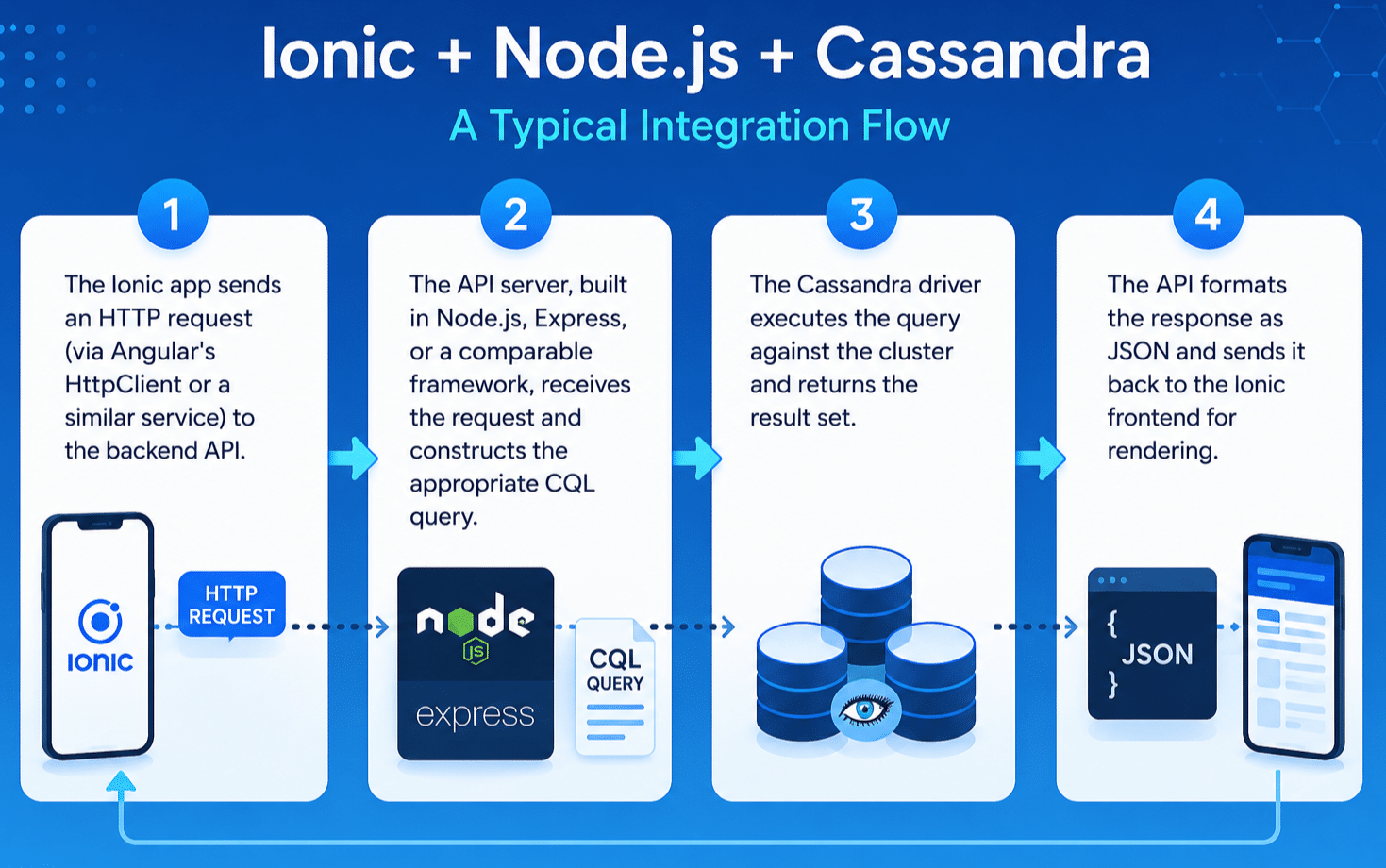
Setting up this pipeline correctly requires backend expertise that goes beyond general web development, since Cassandra’s query patterns and consistency settings differ meaningfully from relational databases. Many product teams choose to hire Ionic app developer alongside backend specialists so the frontend and data layer are designed together rather than bolted on after the fact.
Best Practices for Ionic Developers When Designing Cassandra Data Models
Cassandra data modeling works differently from relational database design, and this difference trips up teams that are new to the system. In a relational database, developers typically design tables first and write queries later. In Cassandra, the process runs in reverse: queries come first, and the table structure is built around them. This is often called query-first design.
Because Cassandra does not support joins in the way SQL databases do, data is frequently denormalized, meaning the same piece of information may be stored in multiple tables to match different query patterns. This trades storage space for read speed, which is a reasonable exchange for mobile apps that prioritize fast response times.
Partition key selection is another area that deserves attention. The partition key determines how data spreads across nodes, and a poorly chosen key can create “hot spots” where one node handles a disproportionate share of traffic. The table below outlines a few common mobile use cases and how partition keys might be approached:
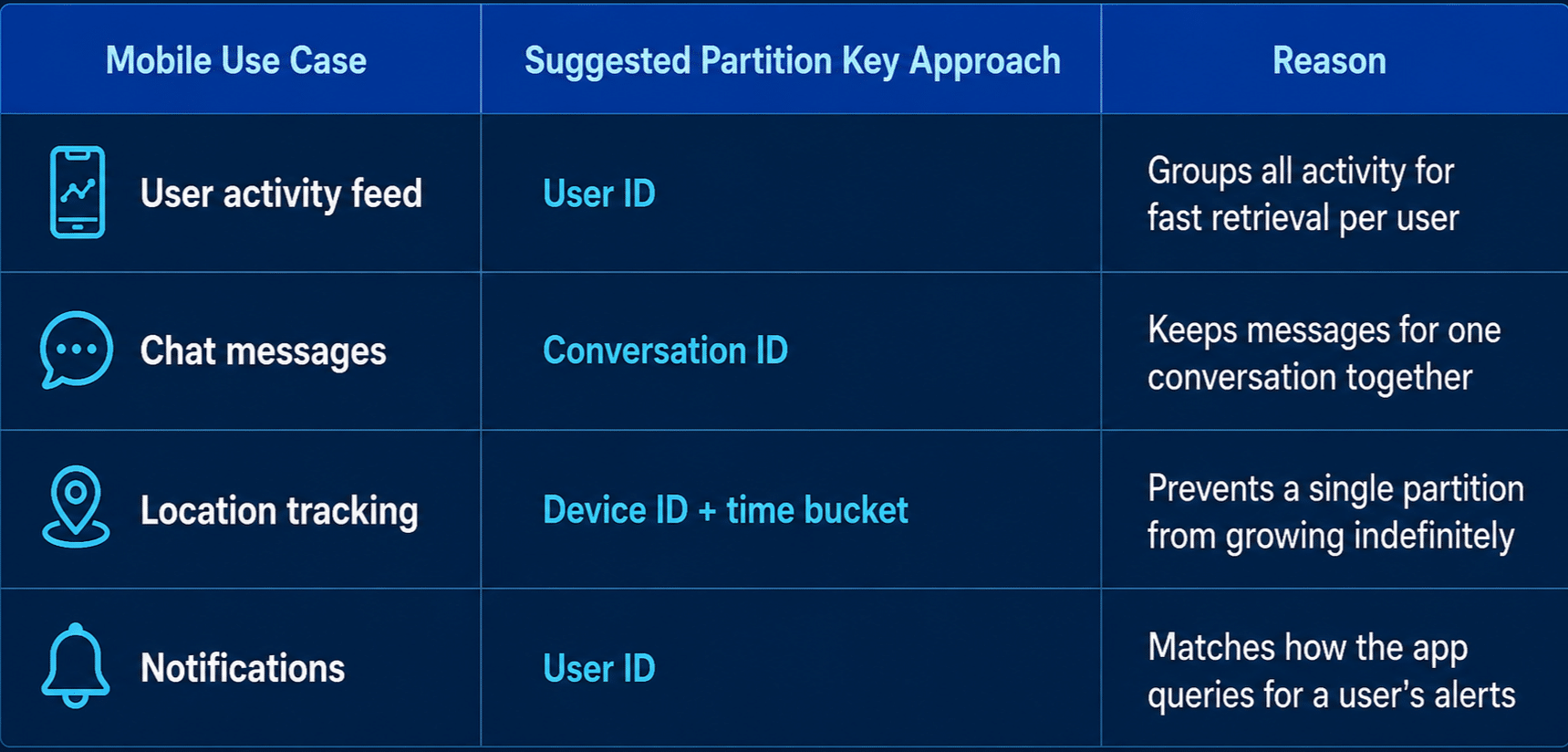
Because these design decisions affect performance long after launch, many companies choose to hire Cassandra engineer specialists early in the project rather than after scaling issues appear. Getting the schema right from the start avoids costly migrations down the line.
Common Challenges and How to Solve Them
Cassandra brings real advantages, but it also introduces trade-offs that teams should plan for rather than discover mid-project.
- Latency in multi-region setups: Replicating data across distant data centers can introduce delay. Choosing appropriate consistency levels (such as LOCAL_QUORUM instead of a stricter global setting) often reduces latency while keeping acceptable data accuracy for mobile use cases.
- Eventual consistency trade-offs: Cassandra favors availability over strict consistency by default, meaning a read immediately after a write might not reflect the latest value across all nodes. For features like financial transactions, tuning consistency levels or applying application-level checks becomes necessary.
- Learning curve for teams new to NoSQL: Developers coming from SQL backgrounds often need time to adjust to query-first modeling and the absence of joins. Investing in training, documentation, and pairing junior developers with someone experienced in distributed databases shortens this adjustment period considerably.
Addressing these challenges early, through proper consistency configuration and schema planning, prevents most of the issues that give Cassandra a reputation for being difficult to work with.
Conclusion: Is Cassandra the Right Choice for Your Ionic App’s Backend?
Cassandra is not the right fit for every mobile project, particularly smaller apps with modest, predictable traffic where a simpler relational database will do the job without added complexity. But for Ionic apps expecting rapid growth, global user bases, or high-velocity data from sources like location tracking, messaging, or IoT devices, Cassandra offers a level of availability and horizontal scalability that few alternatives can match. The key to success lies in planning the data model around actual query patterns from day one and building the integration layer with a clear understanding of how Cassandra behaves under load. Teams that take this approach early tend to avoid the painful backend rewrites that come from choosing the wrong database at the start.