





























1 September 2026 | 11:30 BST— EBM Newsdesk Analysis. By Nick Staunton
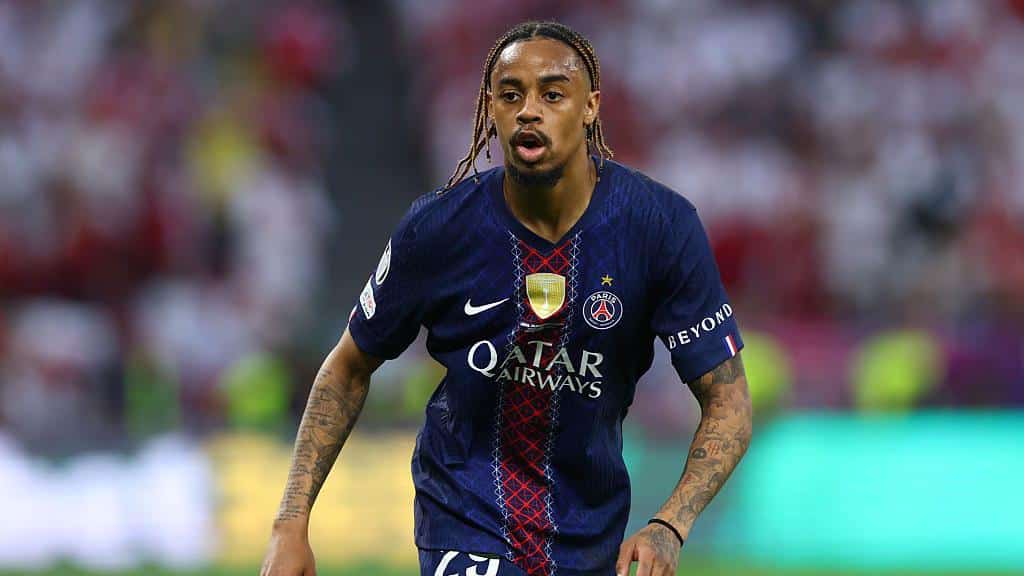
Paris Saint-Germain spent more than a decade trying to buy football’s biggest stars. Bradley Barcola’s departure to Liverpool for an initial £106m, potentially rising to £123m, shows how dramatically the club’s economic model has changed. The most interesting thing about this transfer is not that Liverpool have spent another enormous sum on a young forward. It is that PSG has discovered something potentially more valuable than another superstar: how to create an asset and sell it at a premium.
Barcola joined PSG from Lyon in 2023 for a reported €45m. Three years later, Liverpool have agreed a deal that makes him their second-most expensive signing, behind Alexander Isak, with £106m guaranteed and another £17m available through add-ons. Barcola leaves Paris after 152 appearances, 39 goals and 35 assists, having helped PSG win consecutive Champions League titles and three successive Ligue 1 championships.
Join The European Business Briefing
New subscribers this quarter are entered into a draw to win a Rolex Submariner. Join 40,000+ founders, investors and executives who read EBM every day.
SubscribeOn the surface, it looks like another example of the Premier League’s extraordinary purchasing power. But the better way to understand it is through the economics of the player market. As EBM explored recently in The £100m Question: What Is an Elite Footballer Actually Worth?, the headline transfer fee tells only part of the story. A player’s salary, amortisation, bonuses, agent fees and the commercial value created by Champions League qualification all form part of the investment equation.
PSG’s calculation is therefore surprisingly corporate. The club bought Barcola when he was 20, developed him within one of Europe’s strongest squads and benefited from the increase in his sporting and commercial value. It is now selling him while he is still only 23. In conventional business language, PSG has bought an asset, increased its value and crystallised the gain.
That is a very different proposition from the PSG of the Neymar, Lionel Messi and Kylian Mbappé era.
The old strategy was essentially to buy finished global products. Neymar arrived for a world-record fee. Messi arrived as arguably the most recognisable footballer on earth. Mbappé became the centrepiece of a squad designed around individual brilliance. The strategy generated enormous attention and domestic dominance, but it did not initially deliver the Champions League trophy PSG’s owners wanted.
The post-superstar PSG looks increasingly disciplined. As EBM examined in How Qatar Turned PSG Into a $5.8bn Football Empire, the club’s transformation has involved moving away from celebrity recruitment and towards a younger, more coherent squad. PSG subsequently won back-to-back Champions League titles. That makes Barcola’s sale particularly revealing: the club is no longer dependent on keeping every good player simply because it can afford to.
Indeed, PSG did not appear desperate to sell. Barcola had become an important member of the squad, but competition for attacking places was intense. Ousmane Dembélé, Khvicha Kvaratskhelia and Désiré Doué offered Luis Enrique alternatives, while Barcola himself wanted the opportunity to play a bigger role elsewhere.
That is where the £123m valuation becomes more interesting. PSG is effectively asking a question familiar to any sophisticated investor: what is this asset worth to us compared with what someone else is prepared to pay for it?
The answer, apparently, is that £106m guaranteed is more valuable than keeping Barcola.
Liverpool are making the opposite calculation. They believe the player’s future contribution is worth more than the money they are spending today. That is not necessarily irrational. Liverpool are buying a 23-year-old France international with elite Champions League experience and several years of peak performance potentially ahead of him.
And the timing matters. Liverpool are rebuilding their attacking options under new manager Andoni Iraola and have already demonstrated a willingness to commit extraordinary sums to players they believe can define the next phase of the club. EBM’s analysis of Liverpool’s financial position and the rise of football as an asset class shows why the biggest clubs can increasingly treat player acquisition as part of a broader capital-allocation strategy rather than simply a footballing expense.
There is another reason the Barcola deal matters. Football clubs are discovering that player development itself can become a business model. A teenager recruited for €20m or €30m can, with the right coaching, exposure and Champions League football, become worth €100m or more. That means scouting and development departments are beginning to resemble investment teams: they are trying to identify undervalued assets before the wider market catches up.
It is why PSG’s model has echoes elsewhere in European football. EBM’s examination of private equity’s growing influence in European football showed how clubs are increasingly being managed around asset creation, revenue growth and capital appreciation. The player is only one part of that broader financialisation, but increasingly he is the most valuable one.
There is also an entire ecosystem taking a share of the economics. As explored in EBM’s analysis of Jorge Mendes and the football agent economy, blockbuster transfers now involve agents, lawyers, performance clauses, intermediaries, image rights and complex contractual structures. The £123m headline number is therefore only the beginning of the financial story.
For PSG, however, the logic is straightforward. Sell Barcola at a huge valuation, recycle the capital and continue developing the next generation. If that process works repeatedly, the club creates something far more powerful than a single profitable transfer: a self-replenishing talent economy.
That is the real shift.
PSG no longer needs every expensive player to stay until the end of his career. It can develop a player, win trophies with him, increase his value and then decide whether his next phase is more valuable inside the club or on somebody else’s balance sheet.
Liverpool, meanwhile, are effectively betting that Barcola’s best years are still ahead.
That is why this transfer is more than a £123m football story. It is a transaction between two different theories of value. PSG is monetising the value it has created. Liverpool is paying a premium for the value it believes it can still unlock.
And football is increasingly full of these calculations. As EBM’s analysis of the Champions League’s multibillion-euro business model makes clear, the financial rewards at the top of European football are now sufficiently large to justify extraordinary investment in talent. A player who can help a club win or qualify for Europe’s elite competition can generate value far beyond his transfer fee.
The Bigger Picture
The old PSG believed that financial power meant being able to buy whoever it wanted. The new PSG is discovering that financial power can mean something more sophisticated: knowing when to buy, how to develop and, crucially, when to sell.
That makes Barcola potentially more valuable to PSG as a £123m transaction than as another star in an already crowded attack. There is a certain irony in that. A club once defined by its appetite for football’s most expensive superstars may ultimately prove more successful as a business because it has learned to treat players not simply as celebrities, but as assets whose value can be created, managed and realised.
And if PSG can repeat the trick, Barcola will not be the end of the story. He may be the proof of concept.