






























Key Takeaways
|
Most teams understand the general roadmap from MVP to scaling custom enterprise software. The real challenge often comes to timing. Teams often invest in architecture, infrastructure, or governance before the business is ready, which can create unnecessary complexity and hidden debt. A stronger MVP development roadmap ensures that every growth stage is supported by the right readiness checks, whether that’s customer validation, architectural improvements, infrastructure scaling, or governance.
Most companies build an MVP to test whether the idea can solve a real problem before investing time and money in full-scale custom software development. They launch an early version, collect feedback, improve the product, and gradually strengthen architecture, infrastructure, and governance as adoption grows.
That path sounds good on paper, but problems arise when teams move too early or too late. Some spend months building a scalable architecture before there are enough users to justify it. Others delay governance until enterprise customers begin requesting security reviews, access controls, audit logs, or compliance documentation.
Join The European Business Briefing
New subscribers this quarter are entered into a draw to win a Rolex Submariner. Join 40,000+ founders, investors and executives who read EBM every day.
SubscribeEven a successful MVP doesn’t prove the product is ready for enterprise workloads, integrations, reporting needs, or procurement checks. Timing is the real challenge, and hidden debt tends to surface right where the gap is widest.
Why a Successful MVP Does Not Automatically Mean Enterprise Readiness
A successful MVP proves how the core workflow solves a real problem for an early set of users. But it says nothing about architecture stability, data governance, integration depth, or security posture under enterprise load. Many teams find out the difference during a customer’s security review, not before.
The shift from MVP to enterprise software changes the bar across the stack:
- Demand validation becomes workflow reliability across teams, departments, and customer environments.
- Fast, frequent software releases become part of a release discipline alongside product scaling strategy, test coverage, and change management.
- Raw feedback collection becomes signal filtering, separating real patterns from one-off requests.
- Basic hosting becomes cloud resilience through observability, load testing, backups, and cost visibility.
- Standalone features become connected systems, including identity providers, CRMs, ERPs, and data warehouses.
- Basic login security becomes enterprise-grade security with RBAC, SSO, MFA, audit logs, and encryption.
- Informal ownership becomes governed delivery, with named owners for access, releases, and incidents.
- AI experiments become controlled automation with clean data, human oversight, and workflow governance.
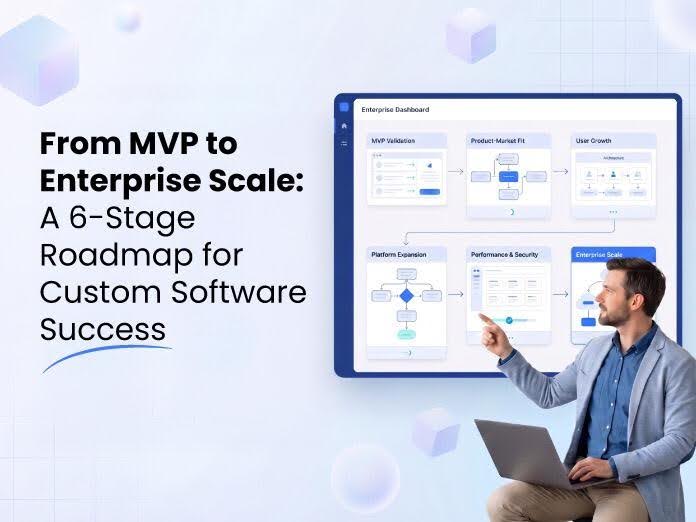
6 Enterprise Software Development Stages for Scaling an MVP
Stage 1: Validate the Core Problem with MVP
Building a successful MVP proves that the business problem is real and worth testing further. It does not prove that the architecture, data model, deployment process, or operational setup can support enterprise scale. Those are separate readiness questions because an MVP is deliberately built to quickly validate demand, not to solve every future scaling requirement.
A team building an MVP usually focuses on one user group, one workflow, and one success metric. For example, an AI agent-assist MVP may help customer support agents find policy answers faster during conversations. But that does not prove the system is ready for enterprise use. As the product scales, the team needs access controls, approved knowledge sources, output review, monitoring, audit trails, and integration with the actual support platform. Usability and reliability are not the same test.
If your team is developing an MVP that uses AI or RAG, they also need approved knowledge sources, retrieval governance, output monitoring, and human review before scaling. Because an MVP is built to validate the idea quickly, some shortcuts are inevitable. A shared debt log in Notion or Linear can help teams track those decisions early, so they don’t become bigger problems as the product scales.
Stage 2: Check Customer Fit Before You Scale Demand
An MVP can be successful in usage and still send the wrong business signal. Users may sign up, test the product, and even depend on parts of it, but that does not always mean the product is serving the right market or solving a problem worth scaling. The risk appears when teams treat all usage as proof of product-market fit.
For example, a workflow automation MVP may attract users with simple approval reminders and task tracking. But if they never adopt the paid reporting or integration features, the product may be solving a convenience problem rather than a high-value business need.
That is how hidden debt starts forming:
- Product debt appears when the roadmap shifts toward features that increase usage but do not support the core business model.
- Sales debt arises when the team closes low-fit customers who require heavy customization, lengthy onboarding, or one-off integrations.
- Technical debt arises when engineers implement quick fixes for use cases that may not matter in the long term.
- Data debt appears when different customer workflows create inconsistent data models and weak reporting.
- Governance debt appears when access rules, ownership, and audit trails are ignored until enterprise buyers ask for them.
Before scaling demand, the question is not only whether people are using the MVP. The better question is whether the demand is repeatable, profitable, and aligned with the product the company actually wants to build.
Stage 3: Turn Feedback Into a Product-Market Fit Map
After an MVP launches, the challenge is not simply gathering feedback. Most teams already have more feedback than they can act on. The real work is identifying which signals indicate repeatable demand, which requests reveal enterprise readiness gaps, and which one-off ideas should stay off the roadmap.
- Usage data, showing what users actually value
- Support tickets, showing where workflows break
- Sales objections, showing what blocks adoption
- Churn signals, showing where value is weak
- Enterprise requests, showing which trust or integration gaps matter
Businesses need to identify the pattern. For instance, an enterprise prospect asking for SAML support is a data point, but multiple prospects across different industries asking for it is a pattern. Building around isolated requests instead of recurring demand often leaves teams maintaining features that very few customers use.
Pro tip: Teams need to track feature requests by account, industry, and deal size before they reach the backlog. Patterns across multiple customers are a stronger signal for prioritization than requests from a single account.
Stage 4: Run a Scale Debt Audit Before Scaling Custom Software Architecture
A scale debt audit helps teams identify what to keep, refactor, or replace before adding more users, features, and integrations. This matters because many scaling problems stay hidden until customers feel them. Once performance, security, or release issues affect production, fixing them becomes slower, riskier, and more expensive.
Microservices, for instance, are often adopted too early. For many teams, a modular monolith provides a simpler path to scale while improving API boundaries, testing, observability, and deployment practices. While they can solve scaling problems, they also add complexity, operational overhead, and data consistency challenges.
| Factors | Modular Monolith | Microservices |
| Right time | Before real-scale pressure exists | After service boundaries are clear and pressure is real |
| Operational cost | Lower, with one deployment, one runtime | Higher, includes distributed tracing, network reliability, service mesh |
| Common failure mode | Tight coupling if boundaries are sloppy | Data consistency issues, debugging across services |
| Good fit for | Teams under ~20 engineers, single product line | Teams with independent scaling needs per service |
What to Audit Before Scaling the Architecture
- Codebase: duplicated logic, fragile modules, low test coverage.
- Architecture: tight coupling, unclear service boundaries.
- Database: weak schema design, no indexing strategy.
- APIs: inconsistent contracts, poor versioning.
- Security: missing RBAC, audit logs, and secrets management.
- DevOps: manual deployments, no rollback plan.
- Observability: weak logs, metrics, traces, alerts.
- Documentation: tribal knowledge, outdated diagrams.
- Supply chain: dependency scanning, secrets scanning, package vulnerability checks.
Tools like SonarQube for code quality and OpenTelemetry for tracing make this audit concrete instead of a gut check. Waiting until a customer’s procurement team asks for a SOC 2 report is too late to start.
Stage 5: Scale Cloud Infrastructure Based on Real Usage
Businesses should scale cloud infrastructure when usage, performance pressure, or reliability needs actually justify it. Scaling too early adds unnecessary cost, while scaling too late can cause outages and performance problems that undermine customer trust. The goal is to protect uptime, release confidence, customer trust, and cloud spend simultaneously.
- A single environment becomes separate development, staging, QA, and production environments.
- Manual deployments become CI/CD pipelines with rollback capabilities.
- Basic hosting becomes cloud architecture with autoscaling.
- Reactive bug fixing becomes monitoring, alerts, and incident response.
- Limited QA becomes automated regression and performance testing.
- Limited cost visibility becomes a challenge for cloud cost management and FinOps practices.
- Basic backups become disaster recovery and recovery testing.
Teams should address load testing, caching, and queue management before scaling. Otherwise, systems that perform well at low usage levels may slow down and cause delays as demand grows.
Stage 6: Build Enterprise Software Governance and Trust
Enterprise software governance demonstrates that the product meets security, compliance, integration, data handling, and operational requirements without creating business risk. It gives buyers confidence that access, approvals, incidents, audit evidence, and customer data are managed through clear systems rather than informal processes.
McKinsey’s 2025 Global GRC Benchmarking Survey found that 42% of respondents said their use of IT and GRC systems needs improvement, while 15% reported such systems are absent or lagging. For enterprise software companies, this reinforces the need for governance systems that track access, approvals, incidents, controls, and audit evidence.
The governance controls usually fall into three areas:
Access and data control
- User access should be managed through defined processes and controls such as RBAC, MFA, and SSO using SAML or OIDC.
- Customer data should have clear ownership, with policies for access, handling, and review.
- Audit logs should track key actions and support investigations when needed.
- Sensitive data and credentials should be protected through encryption and secrets management practices.
Integration and platform control
- New integrations should be reviewed before deployment to ensure they meet security and operational requirements.
- API gateways with rate limiting can help enforce security policies and manage usage.
Operational and compliance readiness
- Incident response procedures should define who is responsible for handling and communicating issues.
- Where required, frameworks such as SOC 2 or ISO 27001 can help document, validate, and continuously improve governance controls.
- Governance responsibilities should have clear owners and regular reviews rather than being treated as a one-time compliance exercise.
Final Thoughts
Premature scaling can increase costs and lock businesses into the wrong direction. Organizations should scale only when demand, risk, and product maturity justify it. Before expanding teams, infrastructure, integrations, or AI initiatives, they should validate demand, establish a clear ICP, and ensure data quality, governance, and operational readiness are in place.
A simple test is ownership. Teams should know who is responsible for access, data, releases, and incident response, and how those issues will be handled when problems occur. Strong ownership and operating processes are often a better indicator of scaling readiness than architecture alone.
A codebase often looks more ready than the operating model running underneath it. Many enterprise reviews stall not because the technology is impossible to scale, but because governance, accountability, and operational practices are not yet mature enough.