































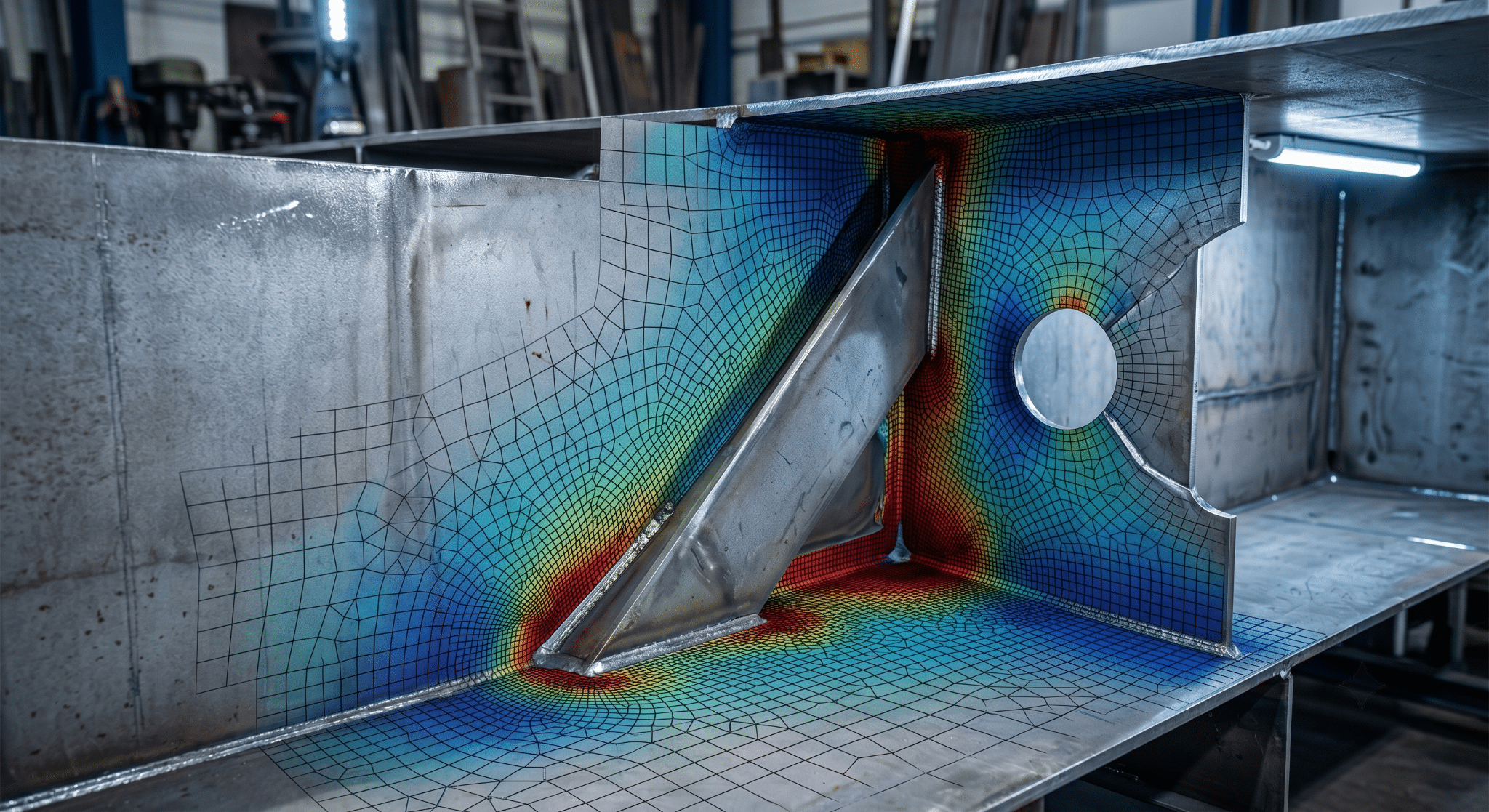
Bending is the first check that decides which section makes it into the structure. If a section is clearly inadequate in bending resistance, further checks are usually unnecessary until the section is revised. But “evaluate bending stress” hides two different problems. In a beam, it comes down to one moment and one formula. In a plate, it means two bending moments, a twisting moment, and a stress state where the critical direction is not known in advance. What follows is how the stress is computed in each case, and why a plate takes more steps.
Why Bending Comes First
The bending moment sets the required section directly. For a given load, the moment is fixed, and the only way to lower the stress is to raise the section modulus: a larger section, or a different shape. That is why bending leads the queue of checks.
The cost of an error runs both ways. An overstated capacity means the section fails in the steel. An understated one adds weight across the structure. Hand calculation makes it worse: stress gets checked only at selected sections, and the most loaded point can slip out of view, especially near stress raisers and geometry changes.
Join The European Business Briefing
New subscribers this quarter are entered into a draw to win a Rolex Submariner. Join 40,000+ founders, investors and executives who read EBM every day.
SubscribeA Beam: One Moment, One Formula
Euler-Bernoulli theory has described beam bending since the 1750s: plane sections stay plane, and stress grows linearly from the neutral axis to the extreme fiber. From it comes the classic formula σ = My/I, or σ = M/S through the section modulus S.
Any safety margin starts from one definition, what is bending stress at a point in the section: a normal stress proportional to the distance from the neutral axis and to the moment. For a fixed moment, geometry alone sets that stress through the section modulus. A larger S means a lower σ, and that drives the choice of profile.
Two geometric quantities should not be confused. The moment of inertia I governs stiffness: deflection, stability, and natural frequencies. The section modulus S governs bending strength, the stress at the extreme fiber. Different properties, and one cannot replace each other.
Behind the Formula Sits Section Classification
The formula looks simple, but the choice of section modulus rests on classification. Eurocode 3 splits cross-sections into four classes by whether local buckling arrives before the plastic hinge. Classes 1 and 2 use the plastic section modulus Wpl, Class 3 the elastic Wel, Class 4 a reduced value. The difference is not cosmetic: for a rectangular bar Wpl exceeds Wel by half, for a rolled I-section by 10 to 17 percent. An HEA 280 in S355 steel, Class 1, gives Wpl,y near 1307 cm³ against Wel,y near 1160 cm³. That 13 percent decides whether the section passes in bending. On thin-walled sections, a wrong class becomes a capacity error of up to 50 percent.
The second trap is lateral-torsional buckling. An open profile with an unrestrained compression flange moves sideways and twists before it reaches the design moment. A beam without intermediate restraints loses up to a quarter of its capacity to span length alone. Closed sections such as tubes and boxes are nearly immune. Open I-beams are the most exposed.
Bending strength is not the only limit. On long beams, deflection sets the section depth more often than stress: a typical floor limit is 1/360 of the span under live load. A beam can pass in bending and still need a deeper section for stiffness.
Plate Bending Works on Two Axes at Once
A plate changes the picture. It resists bending about two axes at once, and a twisting moment Mxy joins the bending moments Mx and My at every point. Bending stress is computed per unit width through σ = 6M/t², where M is the moment per unit length and t the thickness. With thickness squared in the denominator, a thin plate builds stress fast.
Plate stiffness is set by the flexural rigidity D = Et³/12(1−ν²), the plate counterpart of EI. The (1−ν²) comes from biaxial restraint: bending in one direction induces stress in the perpendicular one through Poisson’s ratio. A beam has no such term, a plate always does. Small deflections of a thin plate follow the Germain-Lagrange equation ∇⁴w = p/D, derived by Lagrange in 1811.
The consequence is direct: the critical direction in a plate is not known in advance. An engineer collects σx, σy, and the shear component, then computes principal stresses or equivalent stresses depending on the governing failure criterion. Where a beam yields one number, a plate yields a stress state.
Thickness decides which theory applies. While it stays within 1/20 to 1/100 of the span, classical Kirchhoff-Love theory holds, with no transverse shear. For thick plates, where the span-to-thickness ratio drops below 10 to 20, Mindlin-Reissner theory is needed, shear included. In steel work, plates of 10–30 mm thickness over meter-scale spans behave as thin plates.
How Plate Bending Stress Comes Out of FEA
In a model, a plate is represented by shell elements, and they do not return a single bending stress. An element gives stress on its top and bottom surfaces. The membrane component is the half-sum, the bending component the half-difference: σ_membrane = (σ_top + σ_bottom)/2, σ_bending = (σ_top − σ_bottom)/2. The same σ = 6M/t², through surface stresses.
For a code check, the stress is linearized along a classification line through the thickness, split into membrane, bending, and peak components. The allowables differ: under ASME VIII-2, membrane stress is capped at Sm, the sum of membrane and bending at 1.5·Sm. Bending is allowed to be higher because it redistributes once local yielding starts, while membrane stress carries the load through the full thickness.
This is where errors appear that a beam never produces. One is checking only the larger moment, while the second goes unchecked. The twisting moment Mxy gets dropped, though it raises the principal stress in an asymmetrically loaded plate. A numerical peak at a support gets read as a real stress, taken as von Mises without linearization. And membrane and bending get mixed, though they answer to different allowables.
Stability is a separate check. When a flange or web is compressed by the bending of the whole beam, the plate is checked for local buckling under EN 1993-1-5, which covers flat elements under in-plane stress. Bending of the plate itself under transverse load, a bottom panel under pressure, for instance, falls under EN 1993-1-7. In offshore and ship structures the same checks run under DNV, API, and other industry codes, but the order holds: bending stress first, local stability after.
From a Stress Field to a Line in the Report
Lining up the steps makes the difference plain. A beam: one moment, one section modulus, one code check. A plate: two moments and a twist, membrane and bending components, principal stresses in two directions, two separate allowables, and a possible buckling check on top. Every extra step is one more place to go wrong.
The scale is not small. The FEA software market is projected at $7.82 billion for 2026, and structural analysis remains its largest segment, around 56 percent. A large share of those models is dense with plates: platform decks, ship hulls, crane box girders, pressure vessel walls. Processing that volume by hand is slow and error-prone, as peer-reviewed work on FEA post-processing automation notes.
This is the gap structural design and analysis software fills: recognizing the element type, pulling moment components from the results, computing principal stresses, and applying the right allowable from the code. It removes the most error-prone manual steps: section classification, modulus choice, and the membrane-bending split. Documentation prep, by industry estimates, drops by 50 to 70 percent under automated code checking.
The point is not speed for its own sake. It is less oversized steel where hand calculation plays safe, and less risk of missing the peak, where it eats into the margin.