































EBM Newsdesk Analysis
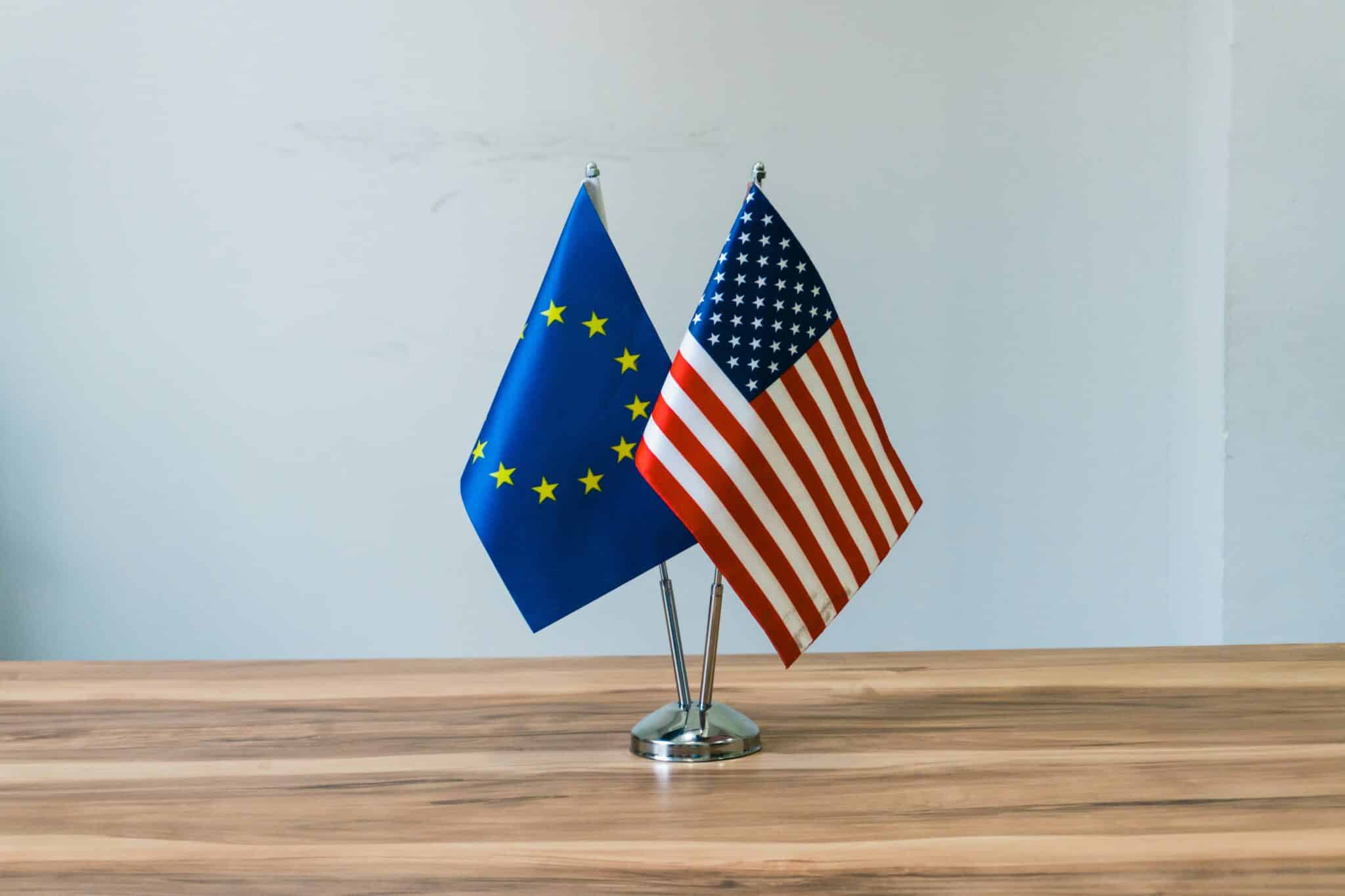
20 May 2026. After months of freezes, threats, Supreme Court rulings, and last-minute collapses in trilogue negotiations, MEPs and EU member state diplomats reached a provisional agreement late on Tuesday to implement the EU-US Turnberry trade deal. The regulations will now proceed to formal adoption. European duties on most US industrial goods will be scrapped. American tariffs on most European exports will be capped at 15%. The deal that Trump and von der Leyen struck at his golf resort in Turnberry, Scotland last July will finally take legal effect.
The Commission described it as delivering on commitments and enhancing a stable transatlantic trade relationship. Critics described it as handing Washington zero-duty access to the European market while locking European exporters into a 15% tariff for the foreseeable future. Both descriptions are accurate. The question is whether the alternative — continued uncertainty, the threat of 25% tariffs on European cars, and a deteriorating transatlantic relationship in the middle of an energy crisis — was worse.
How We Got Here
Join The European Business Briefing
New subscribers this quarter are entered into a draw to win a Rolex Submariner. Join 40,000+ founders, investors and executives who read EBM every day.
SubscribeThe path to Tuesday’s agreement was significantly more turbulent than the Commission’s official language suggests. The deal was originally concluded at Turnberry in July 2025. It should have been a straightforward ratification. It was not.
MEPs froze implementation twice. First, after Trump threatened to impose tariffs on EU countries that refused to support his Greenland acquisition. Second, after a US Supreme Court ruling declared the tariffs the White House had imposed since Trump’s return to power legally invalid — prompting Washington to simply raise the tariffs again under different statutory authority, triggering a further European parliamentary response.
After six hours of failed negotiations in early May, talks between MEPs on the Parliament’s trade committee and Cypriot officials representing member states under the Cyprus presidency broke down entirely. A week later, they resumed. On Tuesday night, after further pressure from the Commission, a provisional agreement was reached — including safeguard mechanisms that MEPs had fought hard to preserve but which some view as having been substantially weakened in the final text.
What the Deal Actually Says
The core terms are straightforward. The EU removes tariffs on most US industrial goods. The US caps tariffs on most European goods at 15%. The EU simultaneously committed under the Turnberry framework to investing $600 billion across strategic sectors in the United States through 2028 and to purchasing $750 billion worth of US energy.
The asymmetry is significant and was always the deal’s most contested element. European exporters face a 15% tariff. American exporters face zero. The European Economic and Social Committee noted in March that the deal should not be assessed only from the perspective of exports but as part of value chains — European manufacturers benefit from cheaper imported US components. That argument has merit for some sectors and considerably less for others.
The safeguard mechanisms MEPs fought to include provide some protection. The Commission can suspend the agreement if the US fails to lift tariffs on European steel and aluminium products above 15% by the end of 2026. It can also suspend if the US undermines the deal’s objectives or discriminates against EU economic operators. A sunset clause means the regulations cease to apply at the end of 2029 — aligning with the next US presidential election cycle. The deal is fragile by design.
Why Brussels Said Yes
The alternative to accepting an asymmetric deal was a 25% tariff on European cars — Trump’s explicit threat if the EU failed to ratify. For German automotive manufacturers, French luxury exporters, and the European industrial sector broadly, a 25% tariff would have been significantly more damaging than a 15% cap. Brussels chose the lesser damage.
There is also a broader strategic dimension. The Iran conflict and Hormuz closure have pushed European energy costs to levels that are already slowing industrial output. Adding a trade war with the United States on top of an energy shock was a risk European policymakers judged unacceptable. The Turnberry deal — asymmetric, contested, and fragile — provides at least a floor of predictability that businesses can plan around. As the European Economic and Social Committee noted, stable tariff levels, even if higher, are often more manageable than permanent uncertainty.
What Remains Unresolved
The deal’s ratification does not resolve the underlying tension in the transatlantic relationship. The US has launched investigations into EU goods over alleged unfair trade practices despite signing the Turnberry Agreement — a signal that Washington views trade leverage as a permanent tool rather than a temporary negotiating position. The steel and aluminium exemption remains contested, with the 2026 deadline for US compliance a genuinely open question given the Trump administration’s track record on honouring trade commitments.
The EU’s broader confrontation with China on trade means Brussels is now managing simultaneous trade complexity with both of its largest non-European partners. The Turnberry deal reduces one source of uncertainty. It does not resolve Europe’s fundamental strategic problem: navigating a world in which both Washington and Beijing treat trade as an instrument of geopolitical pressure rather than mutual economic benefit.
Tuesday’s agreement is a relief. It is not a resolution.
Related Analysis