





























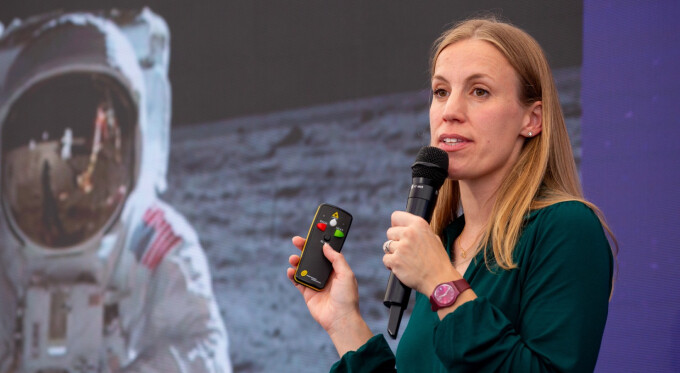
 Susan Charlesworth is also a TEDx Brighton
speaker, adding a local point of interest to a career shaped by some of the most demanding performance environments in the world. From space missions to extreme isolation settings, her work has centred on how people think, communicate and perform when the pressure is highest.
Now recognised among leading psychology & neuroscience speakers, Susan combines academic depth with rare operational experience. A psychologist, astronaut trainer and expert in human performance, leadership and communication, she spent more than 15 years at the European Space Agency training astronauts and ground teams to operate effectively in extreme and unpredictable conditions.
Join The European Business Briefing
New subscribers this quarter are entered into a draw to win a Rolex Submariner. Join 40,000+ founders, investors and executives who read EBM every day.
SubscribeHer career has taken her from mission control rooms to Antarctic research stations, with a specialist focus on teamwork, decision-making and resilience under pressure. She is also the co-author of Handbook of Mental Performance: Lessons from High Performance Domains, and the founder of Charlesworth Human Performance Ltd, where she supports technically brilliant professionals navigating high-stakes careers.
In this exclusive interview with the Mental Health Speakers Agency, Susan reflects on what organisations can learn from space about communication, trust and high performance. She also shares why team cohesion, psychological safety and an explorer’s mindset matter so much when people are expected to deliver in uncertain environments.
Question 1. When you look at the teams that perform best under pressure, what separates a high-performance team from the rest?
Susan Charlesworth: “I think high-performance teams definitely stay calm. They’re really well coordinated, hopefully had a good leader, but they also show those leadership traits themselves as well. And I really believe anyone can perform well if they’ve got a script or a procedure, but really great teams, really high-performance teams can perform well even in uncertain situations.
“So yes, uncertain situations in space and Antarctica, but also uncertain situations in organizations as well. Things are rapidly changing in any organization down here on Earth. And it’s, can those teams still perform well even if they’re coming across problems they’ve never seen before, or the environment’s changing, the landscape, political landscape, organizational landscape is changing?
“But it’s having a really good culture in that team. They know they can speak up if there’s issues, that it’s got great trust and psychological safety. They’ve got really high standards. They’re not blaming each other if they make mistakes. They’re learning from them.
“So, it’s all that kind of stuff that can really help them perform well.”
Question 2. In high-stakes environments, communication can be the difference between control and crisis. What role does it really play?
Susan Charlesworth: “I think communication is key. We quite often call things like communication and teamwork a soft skill, which I don’t agree is a soft, it’s certainly not an easy skill. It’s a really safety-critical skill.
“I talk about in my training about speaking up. So that’s really, really important, that people communicate early and clearly. So, if they think that something’s going on, they talk up, they talk about it. They don’t wait for someone else to say something. They don’t assume just because everyone else is getting on and hasn’t noticed that there’s no problem.
“We’ve seen quite a lot of quite serious accidents that have happened in space, in aviation, in nuclear, where people have noticed a problem and haven’t spoken up about it. So, communicating, as I said, early and clearly, and then in the space environment we also have certain procedures and protocols, and same with aviation as well, closed-loop communication.
“So, I say something, you repeat it back, I confirm what you’ve said. So again, we’re not assuming anything here. So, its really good communication, reduce ambiguity and speak up.”
Question 3. You’ve worked in one of the most demanding performance environments there is. Which lessons from space do you think organisations on Earth should be applying far more seriously?
Susan Charlesworth: “So don’t leave performance to chance. Astronauts are trained literally for years before they ever fly to space. They have all their technical training. As said, they have also all the non-technical human behaviour performance training that I provide. So, yeah, they are trained and they are overtrained as well.
“So, they’re trained in all the routine stuff that they’re going to have to do, but they are also trained in all the emergency-like situations and scenarios as well. So again, if something happens, they are really, really prepared. And if something unexpected happens, like the situation we talked about with Luca on the space walk, he’s also had all the non-technical skills training as well that will help him deal with that situation.
“So, I think that’s really, really important. I think it’s also important, one of the other kind of lessons from space to organizations is to reduce the cognitive load. So, astronauts, everyone likes to think that they’re superhumans and they probably are a little bit, but they are also human.
“So as much, we don’t expect them to learn procedures and checklists off by heart. I’m sure they could, but it’s not necessary. So, reduce the cognitive load, make sure they’ve got checklists and things. They also rely a lot on ground.
“So, coming back to the teamwork thing, they are not expected to be up in space for 6 months performing, operating by themselves. They rely on each other on the space station, and they rely on the teams on Earth as well. So, that reduces the cognitive load, reduces stress and is a great team dynamic going on there.
“And I’d say that’s the last lesson as well, that team cohesion and great leadership is far more important than the individuals and their performance.”
This exclusive interview with Susan Charlesworth was conducted by Tabish Ali of the Motivational Speakers Agency.