
































For European enterprise leaders and digital growth directors steering international expansion, organic search visibility remains one of the highest-leverage acquisition channels in B2B commerce. However, as search engines refine their algorithmic scrutiny around backlink provenance, marketing organizations face a pivotal strategic choice in how they source authoritative editorial citations. The default path for many teams has historically been self-serve inventory marketplaces that offer vast catalogs of publisher websites. Yet, after several quarters of deployment, forward-looking marketing leaders are discovering that an end-to-end managed guest post service offers substantially superior risk-adjusted returns by eliminating hidden administrative overhead and enforcing strict editorial quality control.
The strategic debate between self-serve purchasing and managed procurement is fundamentally an inquiry into unit economics and labor allocation. While open marketplaces boast lower entry prices on individual listings, they quietly shift the burden of domain auditing, bespoke content creation, publisher negotiation, and link maintenance onto internal staff. When fully loaded personnel costs are factored into campaign accounting, the apparent savings of self-serve link buying rapidly evaporate, prompting executives to reconsider their procurement models.
Join The European Business Briefing
New subscribers this quarter are entered into a draw to win a Rolex Submariner. Join 40,000+ founders, investors and executives who read EBM every day.
SubscribeThe Illusion Of Low Cost In Open Link Marketplaces
On the surface, self-serve link platforms present a compelling value proposition: thousands of verified publishers categorized by Domain Rating, organic traffic metrics, and flat placement fees. In operational practice, however, these marketplaces present serious operational frictions that drain marketing productivity.
Unseen Labor Costs In Screening Low-Quality Domains
Commercial link databases are heavily populated with domains whose public metrics conceal severe underlying vulnerabilities. Marketing analysts must spend dozens of hours every month cross-referencing prospective sites against Ahrefs analytics, evaluating organic keyword trajectories, checking outbound link ratios, and filtering out synthetic private blog networks. When growth teams bypass this exhaustive protocol due to project deadlines, companies frequently pay for placements on decaying sites that fail to convey authority or, worse, trigger algorithmic link spam penalties.
Editorial Rejection Rates And Content Rework Cycles
The second major operational bottleneck involves content fulfillment. The low-cost copywriting options bundled with self-serve marketplaces typically produce generic, automated prose that sophisticated industry editors reject immediately. When submitted articles cannot pass editorial muster, internal teams are forced into cycles of extensive rework and protracted email correspondence. This administrative friction delays campaign velocity and distracts skilled marketing professionals from high-priority strategic initiatives.
The Operational Architecture Of Managed Acquisition
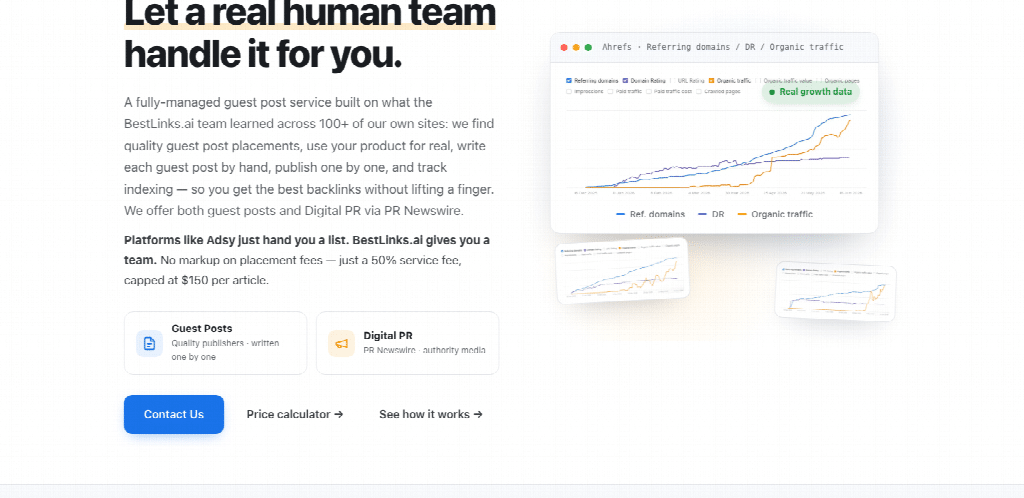
In contrast to catalog-driven marketplaces, managed acquisition frameworks deliver completed business outcomes rather than raw publisher lists. Emerging solutions like BestLinks exemplify this evolution, providing an integrated workflow built directly upon the operational lessons learned across more than one hundred proprietary websites before opening the service to commercial clients.
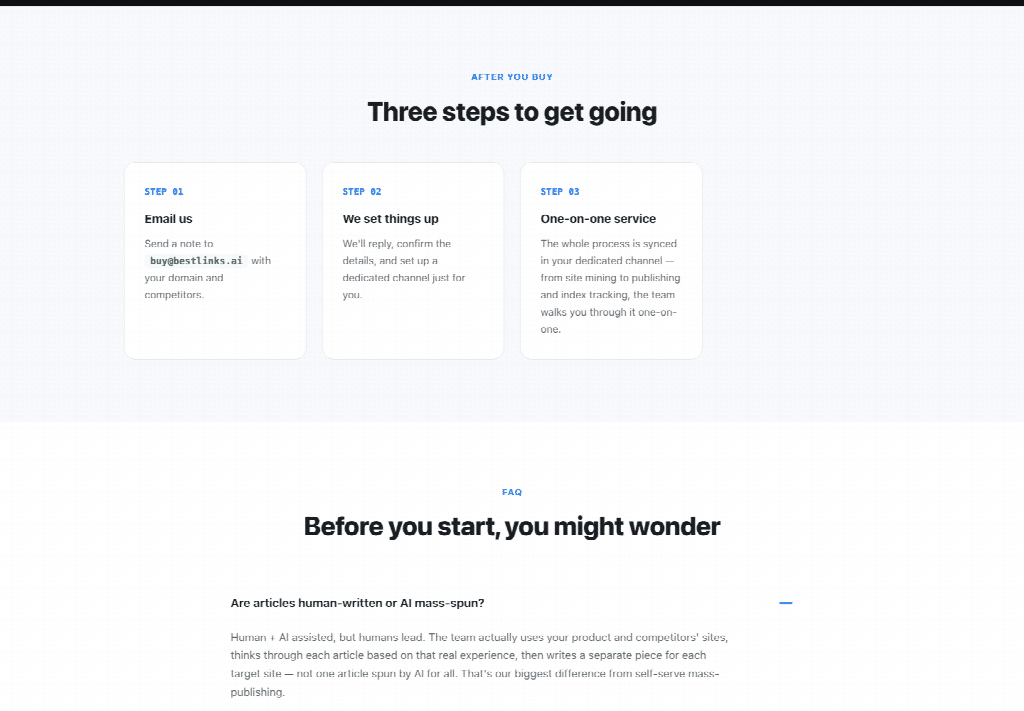
Under the BestLinks managed framework, prospecting does not rely on an arbitrary database. Instead, analysts perform competitive gap analyses against a client primary competitors in Ahrefs, identifying authoritative publications that have demonstrated real ranking impact in the specific industry niche. Once target sites are mutually confirmed, experienced writers examine the client actual product workflows, drafting dedicated long-form articles tailored specifically to each individual host publication. This hands-on editorial immersion ensures exceptionally high acceptance rates and seamless contextual relevance.
Comparative Analysis Of Procurement Models And Operational Friction
To quantify the organizational difference between these two operational methodologies, enterprise leaders must evaluate performance across every phase of the link acquisition lifecycle.
| Evaluation Dimension | Self-Serve Link Marketplaces | BestLinks Managed Acquisition |
| Publisher Discovery | Client manually filters thousands of catalog entries | Team mines high-relevance targets from competitor Ahrefs data |
| Content Production | Automated spinning or unvetted freelance copy | Human writers test the product and draft bespoke articles |
| Pricing Transparency | Opaque markup embedded within placement fees | Placement costs passed through at publisher cost |
| Management Overhead | Bundled or hidden within premium subscription tiers | Flat 50% service fee, minimum $15, capped at $150 |
| Post-Publish Support | Client handles tracking, verification, and link loss | Ongoing health monitoring and broken link replacement |
| Internal Time Investment | High (15–20 hours per month of internal labor) | Minimal (executive approval of curated target lists) |
As illustrated in the comparative matrix, the managed model transforms link acquisition from a fragmented administrative chore into a predictable, transparent procurement process. Internal marketing resources remain focused on core value drivers while specialized external teams execute the tactical mechanics.
Unit Economics And The Logic Of Capped Management Fees
A critical consideration for enterprise decision-makers is the fee architecture governing managed procurement. Traditional link-building agencies frequently apply markups of one hundred percent or higher on publisher placement fees, obscuring the true cost of media acquisition. BestLinks introduces a radically transparent pricing structure: publisher placement fees are passed through with little to no markup, matching what self-serve platforms charge directly.
The Structural Math Behind The Fifty Percent Fee Cap
Compensation for the service is derived entirely from an explicit management fee: 50 percent of the placement price, subject to a minimum fee of $15 and a strict upper cap of $150 per article. For high-tier enterprise placements—such as a $400 publication slot—the standard percentage calculation would yield $200, but the hard cap confines the fee to exactly $150. This structure aligns the provider incentives with campaign efficiency and ensures predictable budgeting across high-volume campaigns, providing enterprise finance departments with absolute cost certainty.
Establishing Clear Baseline Revenue Criteria For Clients
Furthermore, the service operates with disciplined client selection criteria. Fully managed link acquisition is explicitly designed for established web properties that already possess proven monetization baselines and active revenue streams. For pre-revenue ventures, the team openly advises founders to build initial links manually and validate product fundamentals before deploying capital into premium guest posting. In early beta testing, 10 of 13 participating enterprises successfully completed comprehensive placement campaigns with flawless indexation tracking, confirming the viability of this transparent partnership framework.
Post-Publication Link Health And Verification Standards
A backlink acquisition campaign does not terminate upon editorial publication. In an unstable web environment, links can suffer from inadvertent editor deletion, URL restructuring, or delayed indexation by search engines. In self-serve environments, tracking these technical failures falls entirely upon the buyer, creating an ongoing maintenance drag.
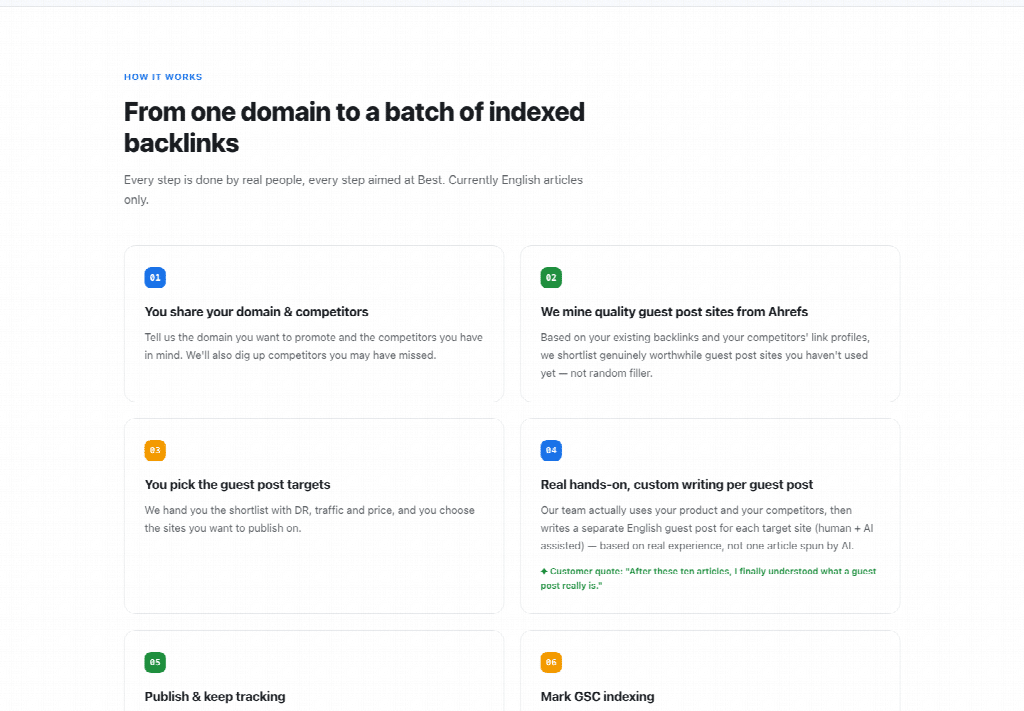
The BestLinks operating model integrates systematic post-publication monitoring into its core service. The team actively tracks live links, repairs broken placements at any time without surcharge, and shares a transparent tracking framework where clients log confirmed indexation in Google Search Console. This shared accountability ensures that corporate investments translate into permanent digital assets that compound authority over extended multi-year horizons.
Moreover, having a dedicated operational team oversee the entire lifecycle of each citation provides enterprise marketing departments with audited records for quarterly governance reviews. Rather than maintaining disparate spreadsheets scattered across multiple media agencies, growth leaders obtain an immutable audit trail showing exact anchor text distributions, live destination URLs, and verified indexing timestamps. This rigorous operational discipline transforms off-page optimization from an opaque marketing expense into a verifiable enterprise asset.
Strategic Capital Allocation For Sustainable Search Leadership
In modern B2B marketing, executive leadership is defined by the intelligent allocation of internal talent toward high-impact strategic priorities. Tasking senior growth managers with manual domain filtering and publisher negotiation represents an inefficient deployment of organizational capital.
By partnering with a dedicated managed service that pairs competitor-based intelligence with human-crafted editorial integrity and capped fee transparency, European enterprises can build durable search moats across competitive global markets. In an increasingly algorithmic search landscape, high-context authority building remains the most reliable foundation for sustained organic growth.






