





























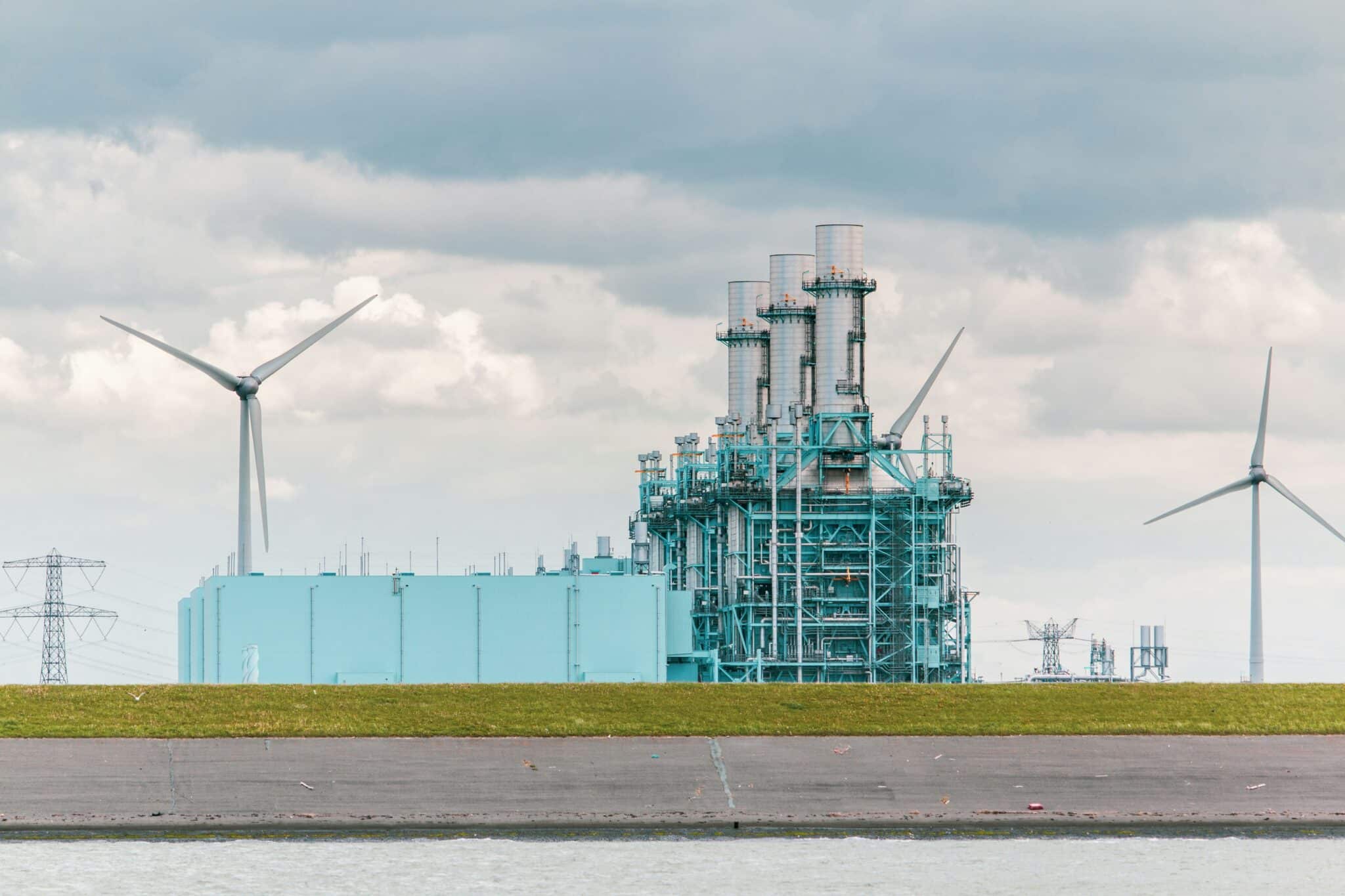
Hydrogen is becoming an important part of the clean-energy conversation, but producing green hydrogen is only one part of the value chain. That hydrogen still needs to be stored, distributed, and converted into usable power. Fuel cells perform that conversion, and their performance depends on a stack of carefully engineered components. For selected thin metal parts with complex channels and repeated features, chemical etching provides one manufacturing option during fuel-cell development and production.
The clean-energy transition therefore depends not only on energy generation, but also on the manufacturing systems behind it.
Join The European Business Briefing
New subscribers this quarter are entered into a draw to win a Rolex Submariner. Join 40,000+ founders, investors and executives who read EBM every day.
SubscribeFrom Hydrogen to Electricity
A fuel cell converts chemical energy into electrical energy through an electrochemical reaction.
In a simplified hydrogen fuel-cell system:
Hydrogen + Oxygen → Electricity + Heat + Water
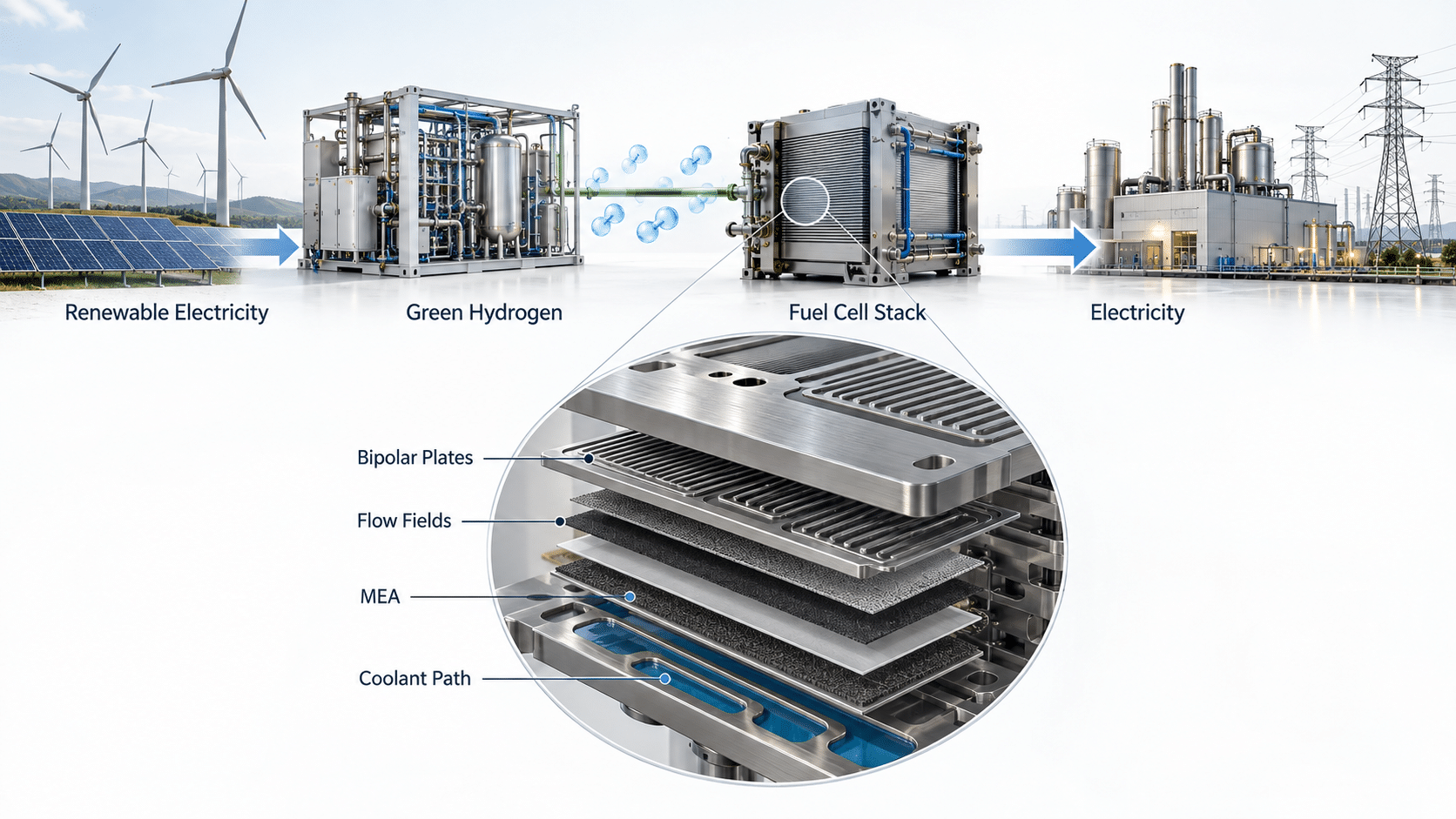
A single cell produces limited voltage, so multiple cells are combined into a fuel-cell stack.
That stack may include:
- Membrane electrode assemblies.
- Gas diffusion layers.
- Seals and gaskets.
- Bipolar plates.
- End plates.
- Cooling structures.
- Electrical connections.
Each component has a different function.
The complete system only works when gas flow, electrical conduction, sealing, thermal management, and mechanical compression work together.
Why Bipolar Plates Matter
Bipolar plates are one of the key physical components inside many fuel-cell stacks.
They can perform several functions at the same time.
Depending on the stack design, they may:
- Separate adjacent cells.
- Conduct electrical current.
- Distribute hydrogen and air.
- Support gas-flow channels.
- Provide mechanical structure.
- Help route coolant.
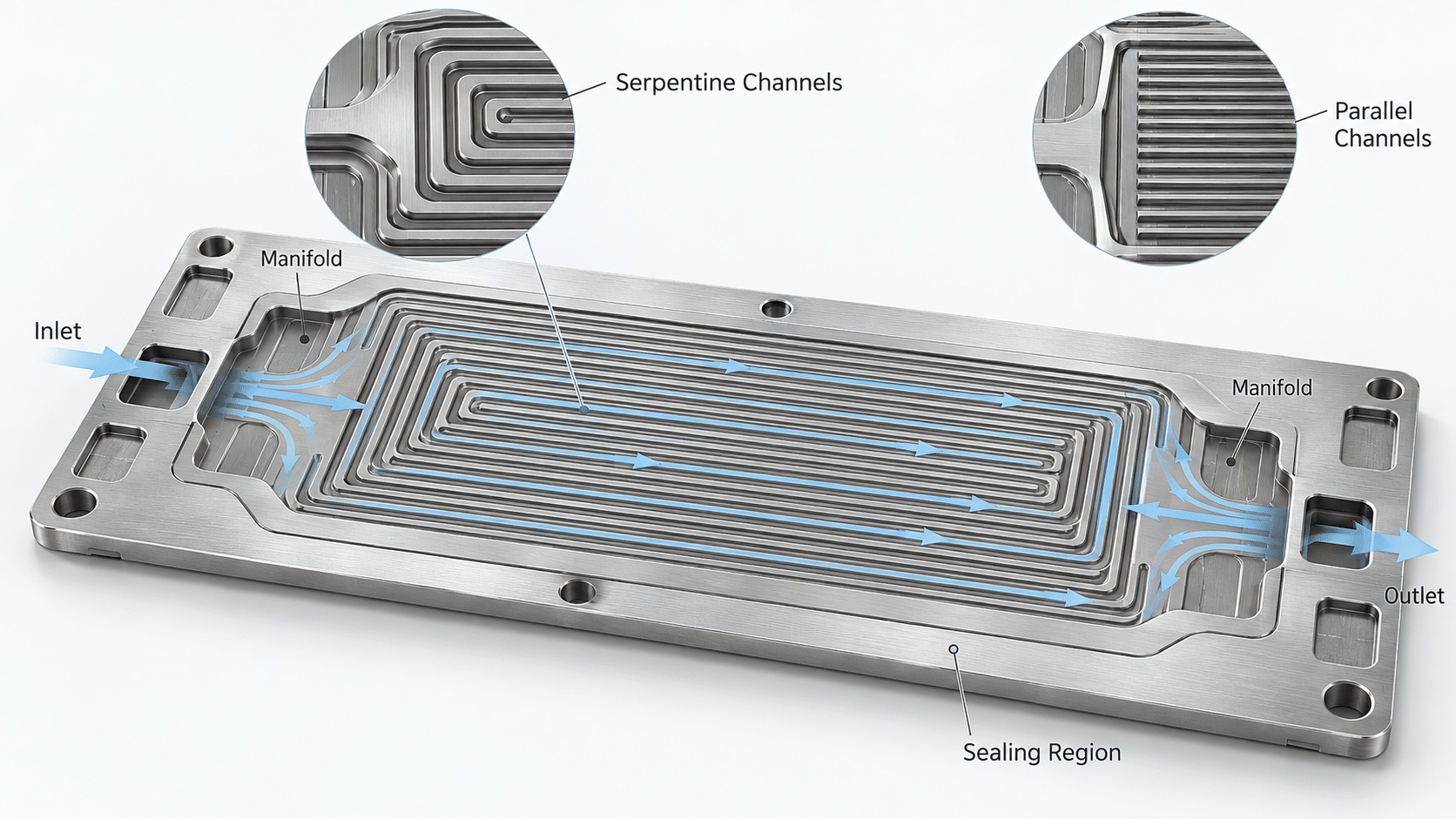
Precision bipolar plates can include complex channel patterns, ports, manifolds, sealing areas, and different geometries on opposite sides.
This makes their manufacturing method an important design decision.
A bipolar plate is not simply a flat sheet of metal. It is also a flow-management and electrical component within the stack.
Flow Fields Control What Happens Inside the Cell
The channels formed on a bipolar plate are known as flow fields.
Their job is to distribute reactant gases across the active area of the fuel cell.
Common layouts may include:
- Serpentine channels.
- Parallel channels.
- Interdigitated patterns.
- Branching structures.
- Custom flow-field designs.
The correct layout depends on the fuel-cell architecture and operating conditions.
Engineers may need to balance several factors, including gas distribution, pressure drop, water management, active-area coverage, and manufacturing feasibility.
A channel pattern that performs well in simulation may still need several design revisions before the final geometry is selected.
That creates a manufacturing challenge.
Why Design Flexibility Matters During Development
Fuel-cell development is rarely a one-version process.
Engineers may change:
- Channel width.
- Channel depth.
- Rib geometry.
- Port location.
- Manifold shape.
- Sealing areas.
- Coolant paths.
If every geometry change requires a new hard production tool, development can become slower and more expensive.
Chemical etching uses digital phototooling.
For suitable flat metal components, engineers can modify the digital artwork when the channel geometry changes rather than creating a completely new hard cutting die for every version.
A development path may look like:
Design → Prototype → Testing → Flow-Field Revision → Validation → Pilot Production
This flexibility can be valuable while the design is still evolving.
Scaling Fuel Cells Is Also a Manufacturing Challenge
The hydrogen economy is often discussed through production capacity, infrastructure, and investment.
But fuel-cell scale-up also depends on manufacturing economics.
As production increases, manufacturers need to consider:
- Material cost.
- Tooling investment.
- Cycle time.
- Inspection.
- Secondary processing.
- Joining methods.
- Surface treatment.
- Supplier capacity.
- Repeatability.
A process that works well for prototypes may not always be the most economical choice at very high volumes.
This is why manufacturing strategy should evolve with the product.
Early development may prioritize design flexibility. Mature production may place greater weight on throughput and unit cost.
The best manufacturing route depends on both the geometry and the expected production scale.
Thermal Management Cannot Be Ignored
Fuel cells produce heat as well as electricity.
That heat must be managed to keep the system operating within its intended temperature range.
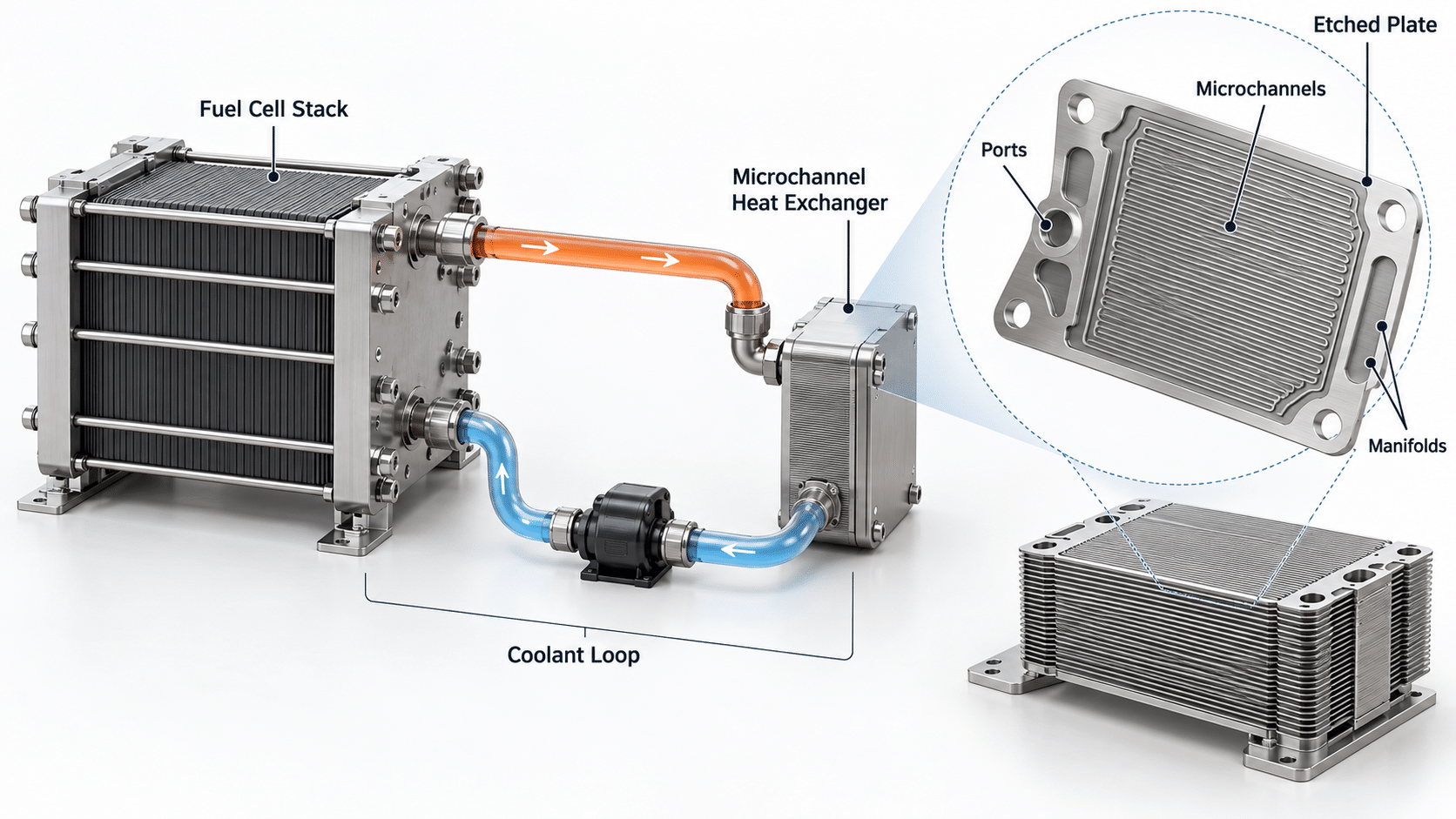
Thermal-management systems may include:
- Coolant channels.
- Cooling plates.
- Pumps.
- Heat exchangers.
- Microchannel structures.
Microchannel heat-exchanger plates are another example of thin metal components that can contain complex channels, ports, and manifolds.
Chemical etching can form these channel structures into flat metal layers.
However, an etched plate is only one stage of the complete heat-exchanger manufacturing route.
The layers may still require alignment, joining, pressure validation, leak testing, and other processes before they become part of a finished heat exchanger.
Chemical Etching Is One Manufacturing Option
Fuel-cell components can be produced using several different processes.
Stamping can be attractive when a bipolar-plate design is stable and production volume is very high.
Hydroforming can create formed three-dimensional channel structures.
CNC machining can be useful for prototypes, thicker plates, and low-volume development work.
Chemical etching is more relevant when the component combines:
- Thin metal.
- Complex flat channels.
- Detailed repeated features.
- Multiple design revisions.
- Double-sided geometry.
No single process is best for every fuel-cell program.
The right choice depends on material, thickness, channel design, tolerance, production volume, surface requirements, and total manufacturing cost.
Precision Manufacturing Supports the Energy Transition
Green hydrogen requires more than renewable electricity and electrolyzers.
It also requires the downstream systems that convert hydrogen into usable energy.
Fuel-cell stacks depend on bipolar plates, flow fields, seals, electrical interfaces, and thermal-management hardware working together.
Many of these components are small compared with the complete energy system, but they influence how efficiently the stack can be manufactured and integrated.
Chemical etching is one option for producing selected thin metal components with complex flat geometry and digitally defined channels.
As hydrogen technologies move from prototype programs toward wider commercial deployment, precision manufacturing will become an increasingly important part of turning clean-energy concepts into scalable physical systems.






