






























By Simmy Lin, Managing Director, Bk-bags
A certificate can say a bag’s fabric is 100% recycled while the bag itself is 59% recycled. Both numbers are correct. They measure different things, and only one of them belongs on the bag.
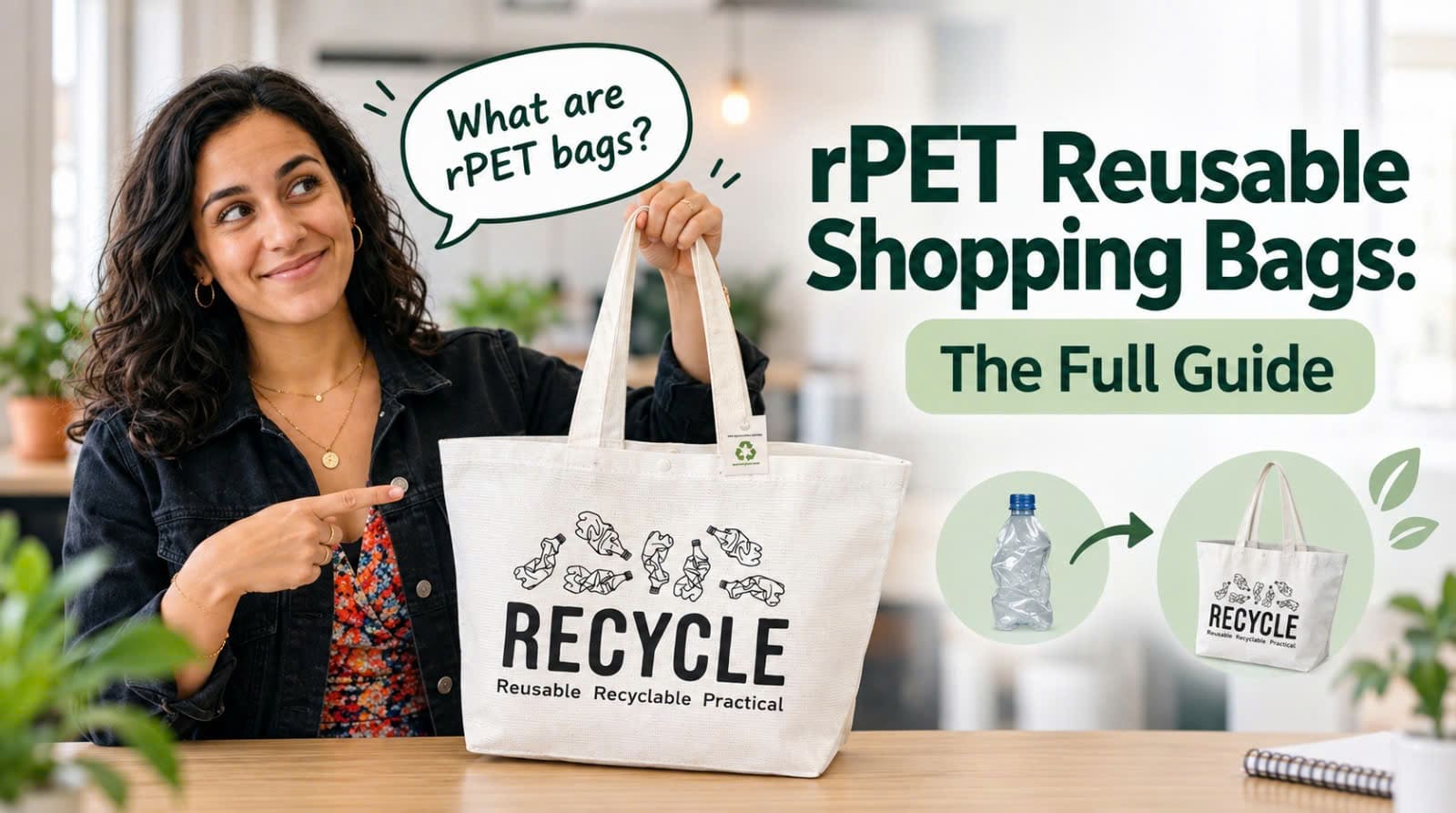
rPET shopping bags are reusable bags made from recycled polyethylene terephthalate, the same polymer as polyester. According to Textile Exchange’s Materials Market Report 2025, 98% of recycled polyester is made from PET bottles. The rPET shopping bags this article covers are made from two non-woven fabrics, spunbond and stitchbond, used either uncoated or laminated with a polypropylene film. The recycled content of a specific order is evidenced by a GRS transaction certificate, not by a lab test and not by the supplier’s product sheet.
Join The European Business Briefing
New subscribers this quarter are entered into a draw to win a Rolex Submariner. Join 40,000+ founders, investors and executives who read EBM every day.
SubscribeAt Bk-bags we have supplied reusable shopping bags to retailers since 2006. A question we hear often from European buyers of rPET bags is whether they can prove what they print on the bag.
Why a Lab Test Cannot Prove Recycled Content
Recycled PET and virgin PET are the same polymer. A 2022 study in the journal Polymers tested 20 commercial rPET flake and granule samples and found that their thermal and mechanical properties could not separate them from virgin material. Every recycled sample fell inside the published range for virgin PET.
Tracer programmes can add a marker to a fibre and confirm later that a fabric contains it. That proves the fibre passed through the point where it was tagged. It says nothing about what went in before.
So proof of recycled content is documentary. It is a chain of custody, and for a certified rPET bag the document at the end of that chain is a Global Recycled Standard (GRS) transaction certificate, issued by a certification body for certified goods shipped from one certified seller to one buyer.
“rPET Non-Woven” Is Not a Specification
Before the paperwork, the fabric. A quotation that says “rPET non-woven” has not told you what you are buying.
Spunbond is made from continuous filaments, bonded by heat and pressure. You can recognise it by a small dot or diamond emboss. It feels crisp and slightly papery, and it can be spun directly from bottle flake.
Stitchbond is a web of recycled staple fibre held together by a separate yarn stitched through it. You can recognise it by parallel stitch lines. It feels soft, like fabric. Ask what the stitching yarn is made of, because it is a second yarn and it counts in the weight.
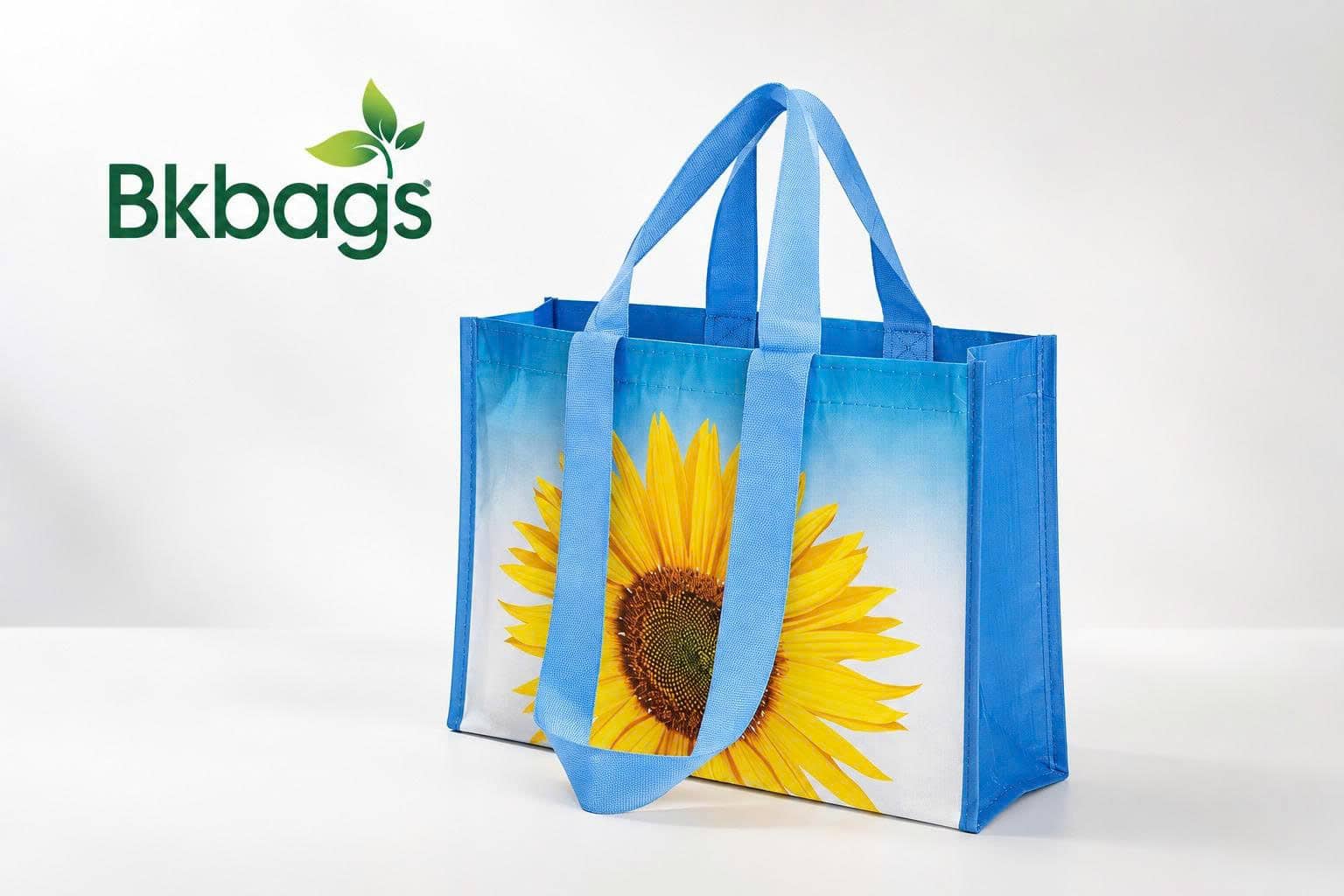
Either fabric can be laminated: a film, usually oriented polypropylene, bonded to the face with a second plastic layer. Lamination gives a sharper print, water resistance and a stiffer bag. It also changes every number that follows.
The Fabric Is 100% Recycled. The Bag Is 59%.
This is Bk-bags’ component calculation for a custom laminated rPET shopping bag supplied to a client. The body is 140 g/m² laminated fabric. The calculation is simple: the area of each panel multiplied by the weight of each layer.
| Component | Weight | Recycled |
|---|---|---|
| rPET fabric (body, bottom, handles, pocket) | 55.05 g | 100% |
| Polypropylene film (18 g/m²) | 12.07 g | 0% |
| Lamination layer bonding film to fabric | 23.84 g | 0% |
| Thread and label | 2.00 g | 0% |
| Finished bag | 92.96 g | 59.2% |
The quoted weight is a total. Of that 140 g/m², only 85 g/m² is rPET fabric. The other 55 g/m² is film and lamination. Two quotations that both say “140 g/m² laminated rPET” can carry very different amounts of recycled material. Ask whether the weight is the base fabric or the laminated total.
The 59% depends on the fabric being 100% recycled. On a fabric that was 70% recycled, the same construction would come to about 41%.
Any supplier can produce this calculation. Ask for it with the quotation, then check that it matches the certified weight divided by the net weight on the transaction certificate when the goods ship.
“Every rPET bag has two recycled numbers: the fabric and the finished bag. On a laminated bag they are never the same, and only the second one belongs on the bag.” — Simmy Lin, Bk-bags
What the Transaction Certificate Says
A GRS transaction certificate has three fields to read. Bk-bags has published a worked certificate, read box by box, in its full rPET bags guide.
The material code tells you post-consumer or pre-consumer. RM0189 is Textile Exchange’s code for recycled post-consumer polyester. RM0188 is pre-consumer. Neither code says “bottles”.
The certified weight tells you how much of the shipment is certified. Divide it by the net shipping weight. The composition line may say “100% recycled post-consumer polyester” about the fabric, while the certified weight is well below the net weight, because non-certified parts such as the film, thread and polypropylene handles are not counted as certified. That is normal for a laminated bag. Printing “100% recycled” on it is not.
The declared origin is where the waste was collected. It is not where the fibre, the fabric or the bag was made. A bag sewn in Vietnam can carry recycled polyester collected in China, and a certificate that shows exactly that is correct.
Two more points catch buyers out.
Bottles appear in only one certified field. The first certified company in the chain, usually the recycler, declares the feedstock, and “reclaimed bottles” has its own code, PD0094. Since December 2025, Textile Exchange has allowed that code on the recycler’s certificate. From 1 April 2027 it is required there. It reaches your certificate only if every certificate in the chain carries it forward. On most certificates issued in 2026 it will be missing, and its absence proves nothing either way. A recycler that buys washed flakes will normally record “flakes”, even when the flakes came from bottles. If “made from plastic bottles” matters to your campaign, ask your supplier before the order what upstream evidence they can give you.
The certificate comes after the goods. The seller applies for it after shipment. Under Textile Exchange’s older policy, which can be used until 1 April 2027, a certificate must be issued if a complete application arrives within 90 days of shipment, and may be issued up to 180 days. Under the new policy, which certification bodies may use from 1 October 2026, the “must” window is 180 days. Under both, a certificate for finished products such as bags may be issued up to 365 days after shipment in some cases. Your bags can be on the shelf before the certificate exists. Make the certificate a condition in the purchase order, not a follow-up email.
Is an rPET Bag Recyclable? Is It Eco-Friendly?
Neither word holds up.
Laminated rPET is two polymers fused together. PET recyclers separate polypropylene from PET by density: polypropylene floats and PET sinks. That works for a bottle cap. It does not work when polypropylene film is bonded to PET fibre, because every flake carries both. We found no commercial process that separates them.
Uncoated rPET is one polymer, but that is not the same as recyclable. PET recycling systems are built for bottles and packaging, not textile bags. According to Textile Exchange’s Materials Market Report 2025, under 1% of fibre produced worldwide is made from recycled textiles, so a used textile bag rarely becomes new fibre.
Read more: EU Packaging Rules: Sellers Must Register in Each Market
The rules on both words are tightening. In the US, the FTC Green Guides (16 CFR 260.12) allow an unqualified “recyclable” claim only where recycling facilities are available to at least 60% of the consumers where the product is sold. In California, SB 343 was due to restrict recyclability claims on products manufactured from 4 October 2026, but a federal court blocked its enforcement in July 2026 while a legal challenge continues. In the EU, Directive (EU) 2024/825 applies from 27 September 2026 and blacklists generic claims such as “eco-friendly” unless the trader can demonstrate recognised excellent environmental performance relevant to the claim.
Three claims do hold up on an rPET bag:
- Reusable. The Danish Environmental Protection Agency’s 2018 life-cycle study found a recycled PET bag had to be reused 8 times to match the study’s average LDPE carrier bag, itself reused once as a bin bag, on climate impact. The study assumed the rPET bag was recycled at the end of its life, and it did not model a laminated bag. Keep a load test for your finished bag on file.
- Made with a stated percentage of recycled material, by weight. “Made with 59% recycled material by weight”, not “59% recycled polyester”, which hides the polypropylene.
- Hard to recycle, with the reason, and harder still when it is laminated.
One Textile Exchange rule applies to your brand, not to your supplier. Under Textile Exchange’s claims policy, a GRS claim on a finished consumer product requires certification up to the brand. If the bag carries your brand and uses the GRS name or logo, on the bag or in marketing about it, your company needs its own GRS certification. Without it, make a specific recycled-content claim of your own and keep the certificate as evidence.
What to Put in the Purchase Order
- Name the fabric: spunbond or stitchbond, uncoated or laminated, and the base fabric weight as well as the total.
- Ask for the component calculation with the quotation, including handles, thread and film.
- Make the GRS transaction certificate a condition of the order, with the seller’s scope certificate valid on the shipment date.
- Ask whether the feedstock code can be carried through, if you want to say “bottles”.
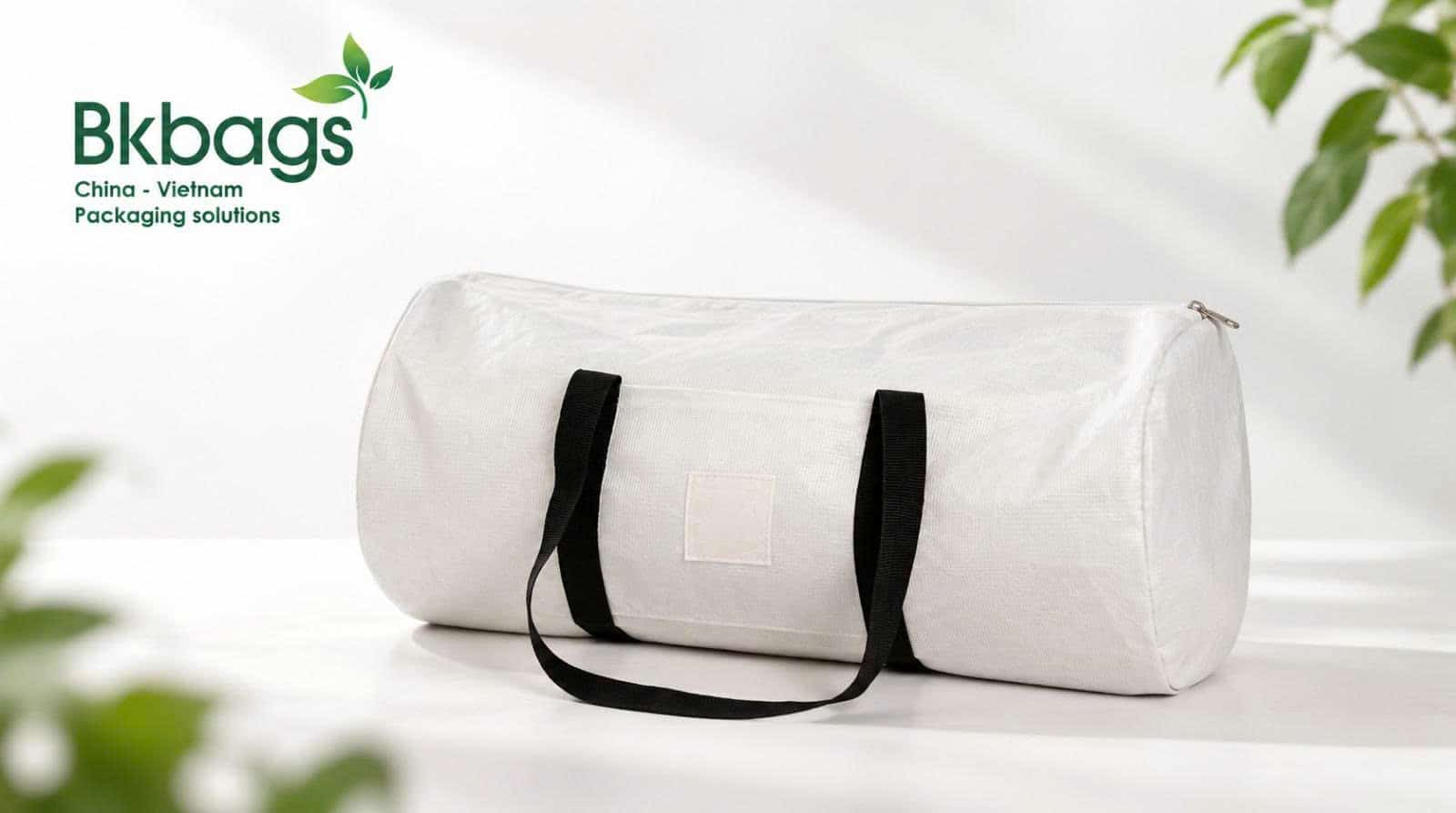
- Specify PET thread and PET webbing handles if recycled content leads your programme. Polypropylene handles turn a single-polymer bag into a mixed one.
- Agree the wording on the bag before artwork, not after the certificate arrives.
About the author
Simmy Lin is Managing Director of Bk-bags, a Ho Chi Minh City based supplier of reusable shopping bags and e-commerce packaging to retailers and brands since 2006. Bk-bags supplies custom rPET bags in spunbond and stitchbond, with production in Vietnam and China and a minimum order of 10,000 pieces.
Sources
- Textile Exchange, Materials Market Report 2025 (98% of recycled polyester from PET bottles; under 1% of fibre from recycled textiles)
- Polymers (MDPI), 2022, thermal and mechanical characterisation of 20 commercial rPET samples
- Textile Exchange, Content Claim Standard and GRS 4.2 Implementation Manual; Reference Data (RM0188, RM0189, PD0094); Calibration of December 2025 (feedstock code); certification policy POL-203 V4.0 (effective 1 October 2026, mandatory 1 April 2027)
- Textile Exchange, Standards Claims Policy TE-301 V1.4, B3.1.2 (certification up to the brand)
- US FTC Green Guides, 16 CFR 260.12
- California SB 343 (2021); preliminary injunction, US District Court, Southern District of California, 14 July 2026
- Directive (EU) 2024/825, Annex I
- Danish Environmental Protection Agency, Life Cycle Assessment of grocery carrier bags, Environmental Project No. 1985, 2018
- Bk-bags component calculation for a client’s laminated rPET bag (supplier calculation, 2026)






