































Two sites with identical traffic can earn wildly different revenue. The difference almost always comes down to fill rate, demand quality, and how the monetization stack is configured – not how many visitors show up.
|
The Metric Most Publishers Get Wrong
Ask a publisher how their monetization is performing and most will quote a CPM number. It’s the metric everyone talks about, the one that shows up in sales pitches, the one that feels like the obvious scorecard.
It’s also incomplete on its own in a way that costs real money.
Join The European Business Briefing
New subscribers this quarter are entered into a draw to win a Rolex Submariner. Join 40,000+ founders, investors and executives who read EBM every day.
SubscribeFill rate is the percentage of ad requests that actually serve an ad.
A 100% fill rate at $1.00 eCPM outperforms an 80% fill rate at $1.50 eCPM. Run the math: 1,000 requests at 100% fill and $1.00 eCPM produce $1.00 in revenue.
The same 1,000 requests at 80% fill and $1.50 eCPM produce only $1.20 – wait, let’s be precise here, because this is exactly where publishers get confused.
The actual formula: revenue = (impressions served ÷ 1,000) × eCPM.
At 80% fill, only 800 of your 1,000 requests become revenue-generating impressions. So $1.50 eCPM × 800/1,000 = $1.20.
Meanwhile, 100% fill at $1.00 eCPM gives you the full $1.00 per 1,000 requests – meaning the higher headline rate actually produced more total revenue in this example, but the gap is far narrower than the eCPM difference suggests. Many publishers chase eCPM alone and bleed revenue through the fill gap.
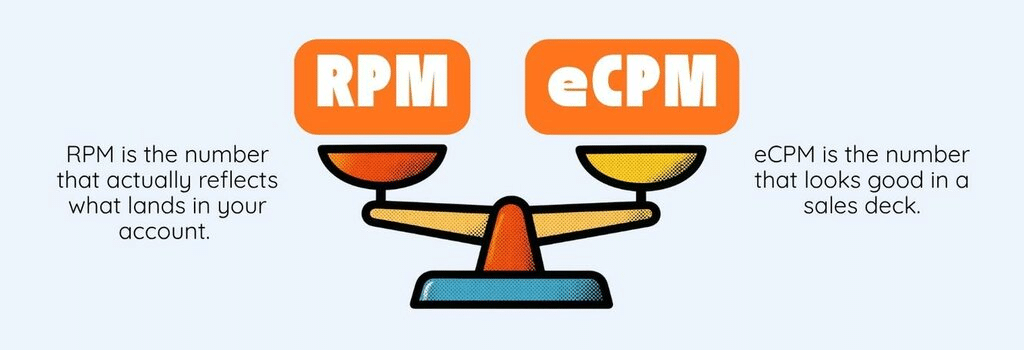
This is the heart of the problem: RPM (revenue per mille) accounts for your fill rate, while eCPM doesn’t – that’s the whole difference, and it’s a meaningful one at any real scale. RPM is the number that actually reflects what lands in your account. eCPM is the number that looks good in a sales deck.
The publishers consistently growing their ad revenue aren’t necessarily the ones with the most page views – they’re the ones who fixed their fill rate before chasing eCPM, who know their RPM by placement, and who stopped guessing when they could be measuring.
Why Fill Rate Quietly Destroys Revenue
Low fill rate is one of the most common – and most invisible – revenue killers in publisher monetization. Sit below 85% fill rate and you’re leaving money on the table every single session, because unsold inventory is dead inventory: it generates zero income while consuming the same page load weight as filled placements.
Here’s why fill rate gaps happen, and what they actually cost:
- Demand mismatch. If your ad network’s advertiser base doesn’t have strong coverage in your traffic’s GEO mix, device mix, or vertical, requests go unfilled because there’s no buyer ready to bid. A network with deep advertiser density across Tier-1, Tier-2, and Tier-3 markets will fill more of your inventory than one concentrated in a narrow GEO set.
- Latency and timeouts. Every ad request has a window to receive a bid before the page moves on. Slow-responding demand sources lose that window, and the request goes unfilled even if a willing buyer existed. This is a technical, not a demand, problem – and it’s invisible unless you’re specifically measuring it.
- Eligibility constraints. Format mismatches, ad size mismatches, and category exclusions all reduce the pool of advertisers eligible to fill a given request. The more granular and restrictive your setup, the more requests fall through with no eligible bidder.
- Floor prices set too high. If you’ve set a minimum acceptable price above what the available demand is willing to pay, requests simply won’t fill. This is sometimes intentional – protecting premium pricing – but it’s frequently a default setting nobody revisited.
The fix starts with monitoring fill rate alongside RPM. Extremely high fill rates can sometimes signal floors set too low, while extremely low fill rates signal floors set too high – the goal isn’t maximum fill at any cost, it’s the fill rate that produces the highest total RPM for your specific traffic.
Lever 1: Demand Diversification – Don’t Rely on One Buyer Pool
The single biggest structural fix available to most publishers is demand diversification. Many publishers use multiple ad networks simultaneously specifically to increase fill rates and reduce dependency on a single platform.
The logic is straightforward: every ad network has a finite pool of advertisers actively bidding at any given moment. If your only demand source has thin coverage for your specific traffic profile – a particular GEO, a particular device type, a particular time of day – your fill rate suffers regardless of how good your inventory actually is.
A layered approach where multiple demand sources compete for the same impression consistently outperforms any single-network setup, because it widens the pool of advertisers who get a chance to bid on your traffic. More eligible bidders means more filled requests, and more competition among those bidders means higher prices for the requests that do fill.
This doesn’t mean publishers need a dozen integrations to see the benefit. It means choosing a primary network with genuinely broad, global advertiser demand – covering multiple GEO tiers, multiple verticals, and multiple device types – rather than one with narrow or shallow coverage.
What to look for in a primary demand partner:
- Does the network serve advertisers across Tier-1, Tier-2, and Tier-3 GEOs, or is coverage concentrated in a narrow set of markets?
- Is there sufficient demand density for both desktop and mobile traffic?
- Does the network support multiple verticals, so your content category isn’t competing against a thin advertiser pool?
- Can the network sustain consistent fill rates during your traffic’s peak hours, not just average ones?
Lever 2: Format Mix – Match Ad Type to How Your Audience Actually Behaves
Format and placement choices shape both buyer demand and user attention – and they’re one of the few yield levers publishers control directly. The right format mix does two things simultaneously: it increases the pool of advertisers willing to bid (because different formats appeal to different advertiser objectives), and it improves user engagement (because the format fits naturally into how visitors interact with your content).
Formats that earn higher eCPM often do so because they capture more attention. Formats that preserve user experience often do so because they respect the natural flow of content and don’t interrupt it. The publishers who maximize RPM are the ones who find the formats that do both – rather than defaulting to whatever the first network they signed up with happened to offer.
Format-by-format breakdown for publisher monetization
- Push notifications monetize the moment a user opts in, independent of page views – meaning revenue continues even after the user leaves your site. This format works well for content sites with a meaningfully engaged returning audience, because the value comes from repeat reach rather than single-session impressions.
- In-page push solves the coverage gap that classic push leaves behind: it works across all devices, including iOS, where traditional push notifications can’t be served. For publishers with significant Apple device traffic, this is often the difference between monetizing or leaving a major audience segment unfilled.
- Native ads match the look and feel of your site’s content, which means higher engagement and typically less impact on bounce rate than display formats. For content-driven sites – finance, lifestyle, news, blogs – native consistently produces a better balance of RPM and user experience than disruptive formats.
- Banner ads remain a reliable baseline format with broad advertiser demand across standard sizes – useful for filling above-the-fold and sidebar placements where native or push formats don’t fit naturally.
- Interstitial ads capture maximum attention at natural content transitions – between articles, between app screens – and tend to produce some of the highest per-impression rates because of the guaranteed visibility, though they should be used selectively to avoid disrupting the user journey.
- Video ads command the highest CPMs of any standard format, since advertisers pay a premium for the engagement and brand recall that motion and sound deliver. They work particularly well as pre-roll on content pages or rewarded placements in apps, though load times and placement need care so they don’t undermine page speed or user experience.
- Pop ads (pop-unders) generate revenue through sheer volume and broad advertiser demand, opening in a separate window or tab without interrupting the user’s current session. This format performs best on high-traffic sites with less brand-sensitive content, since it trades a lighter touch on the immediate user experience for reach and fill rates that are hard to match with more targeted formats.
The diversification principle
Focus on fewer, higher-quality, better-positioned units rather than maximizing unit count. Adding more ad slots doesn’t reliably increase revenue – past a certain density, it degrades user experience, increases page weight, and can actually reduce RPM as bounce rates rise and session length falls. The goal is the right mix of formats in the right positions, not the maximum number of placements.
Lever 3: Site Speed and Viewability – The Infrastructure Layer Behind RPM
It’s easy to think of monetization purely in terms of demand and pricing. But the technical performance of your site directly gates how much of your inventory is even monetizable in the first place.
Page speed directly impacts RPM through several connected mechanisms: it affects ad viewability, since faster pages show more ads to more users before they navigate away; it influences traffic quality and retention, since slow pages increase bounce rates before ads have a chance to load and register as viewable; and it affects how demand sources evaluate your inventory, since publishers with poor site performance are increasingly deprioritized by quality-conscious advertisers.
Viewability standards require ads to be visible to users for a minimum duration to count as a valid, billable impression.
A banner that loads but is never actually seen – because the user scrolled past before it rendered, or because the page itself loaded too slowly for the ad to appear in time – doesn’t just fail to earn revenue. It also drags down your overall viewability metrics, which can affect how favorably demand sources evaluate your inventory going forward.
Practical fixes that move the needle:
- Prioritize ad units in above-the-fold and high-viewability positions, rather than spreading inventory evenly down the page
- Avoid stacking multiple heavy ad scripts that compete for the same load resources
- Test load order – sometimes deferring lower-priority ad units until after primary content renders improves both speed and revenue
- Monitor Core Web Vitals regularly, since publishers with poor scores are increasingly excluded from premium demand sources
Lever 4: Payout Reliability – The Yield Metric Nobody Talks About
There’s a category of “yield” that doesn’t show up in any RPM calculation but matters just as much to a publisher’s actual financial health: how reliably and quickly that revenue actually reaches your account.
A network offering a marginally higher eCPM is worth less to your business if it pays on a 45-day cycle with a high minimum withdrawal threshold than a network offering a slightly lower eCPM with daily payouts and a low minimum.
Cash flow is not a footnote in publisher monetization – for sites running on ad revenue as a primary income source, payment terms determine whether the business is actually sustainable month to month.
The payout checklist:
- What is the minimum withdrawal threshold, and is it accessible for sites of your size?
- How frequently are payments processed – daily, weekly, monthly?
- What payment methods are supported? Sites operating internationally often need crypto or multi-currency options that traditional bank transfers don’t cover well.
- Are there hidden deductions or processing fees that reduce the amount actually received?
- Is there a clear, published payment schedule, or is timing left ambiguous?
Lever 5: Platform Transparency and Support – Trust as a Yield Driver
The final lever is the hardest to quantify but arguably the most important over time: whether the network you’re working with operates transparently, and whether support is responsive when something goes wrong.
Opaque setups – where intermediaries take undisclosed margins and publishers can’t see exactly what advertisers paid versus what they received – create what the industry sometimes calls a “black box tax” on publisher revenue. Without clear, log-level reporting, you cannot verify your true yield, and you have no leverage to identify or fix underperforming placements.
Transparency shows up practically in a few ways: real-time reporting that shows performance by zone, by format, by GEO, and by device, rather than aggregated numbers that obscure where revenue is actually coming from; clear payment terms with no surprise deductions; and support that responds with real answers, not scripted templates, when a payment is delayed or a placement underperforms unexpectedly.
This matters because monetization isn’t a “set it and forget it” relationship. Publishers who actively manage their stack – reviewing performance regularly, testing format and placement changes, and adjusting based on real data – consistently outperform those who configure once and never revisit it. That kind of active management is only possible with a platform that gives you the visibility and support to act on what you see.
What the Best Ad Network for Publishers Actually Looks Like
Pulling all five levers together, here’s the practical checklist for evaluating any ad network as a publisher:
| Yield Lever | What to Check |
| Fill Rate | Broad advertiser demand across GEOs, devices, and verticals; low latency; flexible floor pricing |
| Ad Format Mix | Multiple formats available (push, in-page push, native, banner, sticky, interstitial) without needing multiple integrations |
| Site Performance | Lightweight ad delivery that doesn’t degrade page speed or viewability |
| Payout Reliability | Low minimum withdrawal, frequent payment cycles, multiple payment methods, no hidden fees |
| Transparency & Support | Real-time, granular reporting; responsive 7/7 support; clear terms |
Run any network you’re considering – or already using – through this list. The answers will tell you more about your actual revenue potential than any single eCPM figure on a sales page.
How Mondiad Approaches Publisher Yield
Mondiad was built by a team that spent over a decade learning these lessons firsthand through PopCash – one of the internet’s longest-running ad platforms, founded in 2012. That experience shapes how the publisher side of Mondiad’s platform works today.

Demand diversification: Mondiad connects publisher inventory to a global base of advertisers spanning mainstream and adult verticals, with coverage across Tier-1, Tier-2, and Tier-3 GEOs. This breadth of demand directly supports stronger fill rates across diverse traffic profiles.
Format mix: Publishers can monetize through 8+ ad formats from a single integration – Classic Push, In-Page Push, Native, Banners, Dynamic, Interstitial, and Popunder ads.
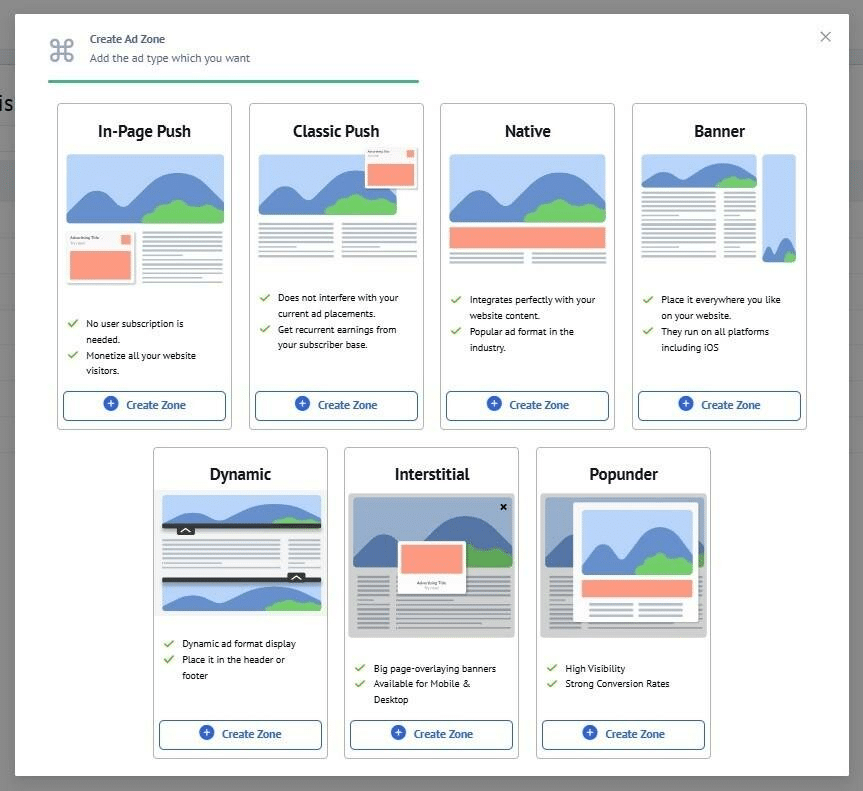
Ad zones are fully customizable, letting publishers match format and placement to their specific site layout and audience behavior rather than forcing a one-size-fits-all setup.
Fast, transparent approvals: Site approvals move quickly, within 1 hour during working time, and the self-serve dashboard can be configured in minutes – no lengthy onboarding process standing between signup and first impression served.
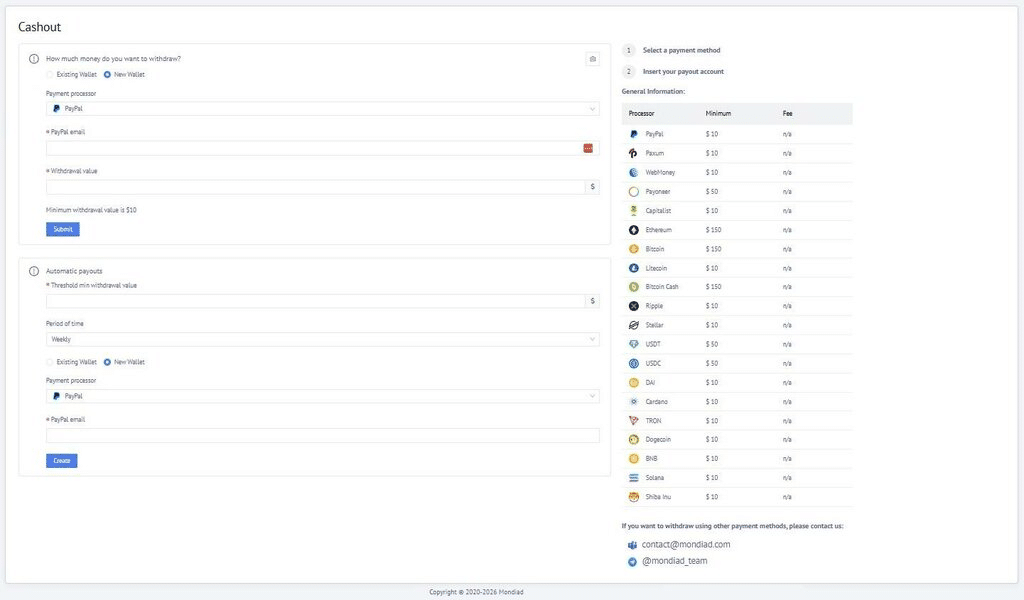
Payout reliability: Publishers receive daily payments available on request, with a $10 minimum withdrawal – one of the lowest thresholds in the industry. Payment methods include PayPal, Paxum, Payoneer, Capitalist, wire transfer, and multiple cryptocurrencies, covering the range of options international publishers actually need.
Transparency and support: Real-time reporting gives publishers visibility into performance by zone, format, and GEO. Support is available 7/7 through Live Chat, WhatsApp, Telegram, Skype, and Email – not a ticket queue with a multi-day response time.
A referral program rewards publishers who bring other publishers or advertisers into the ecosystem with 5% of referred spend or earnings – an additional yield stream layered on top of core ad monetization.
None of this replaces the fundamentals covered above: publishers still need to think critically about format mix, site performance, and demand diversification regardless of which network anchors their stack. But a platform like Mondiad, built around fill rate, payout speed, and transparency, gives publishers a stronger foundation to build that strategy on.
Stop letting fill rate gaps and slow payouts quietly erode your ad revenue. Choose an advertising network that treats your monetization like a partnership.






