































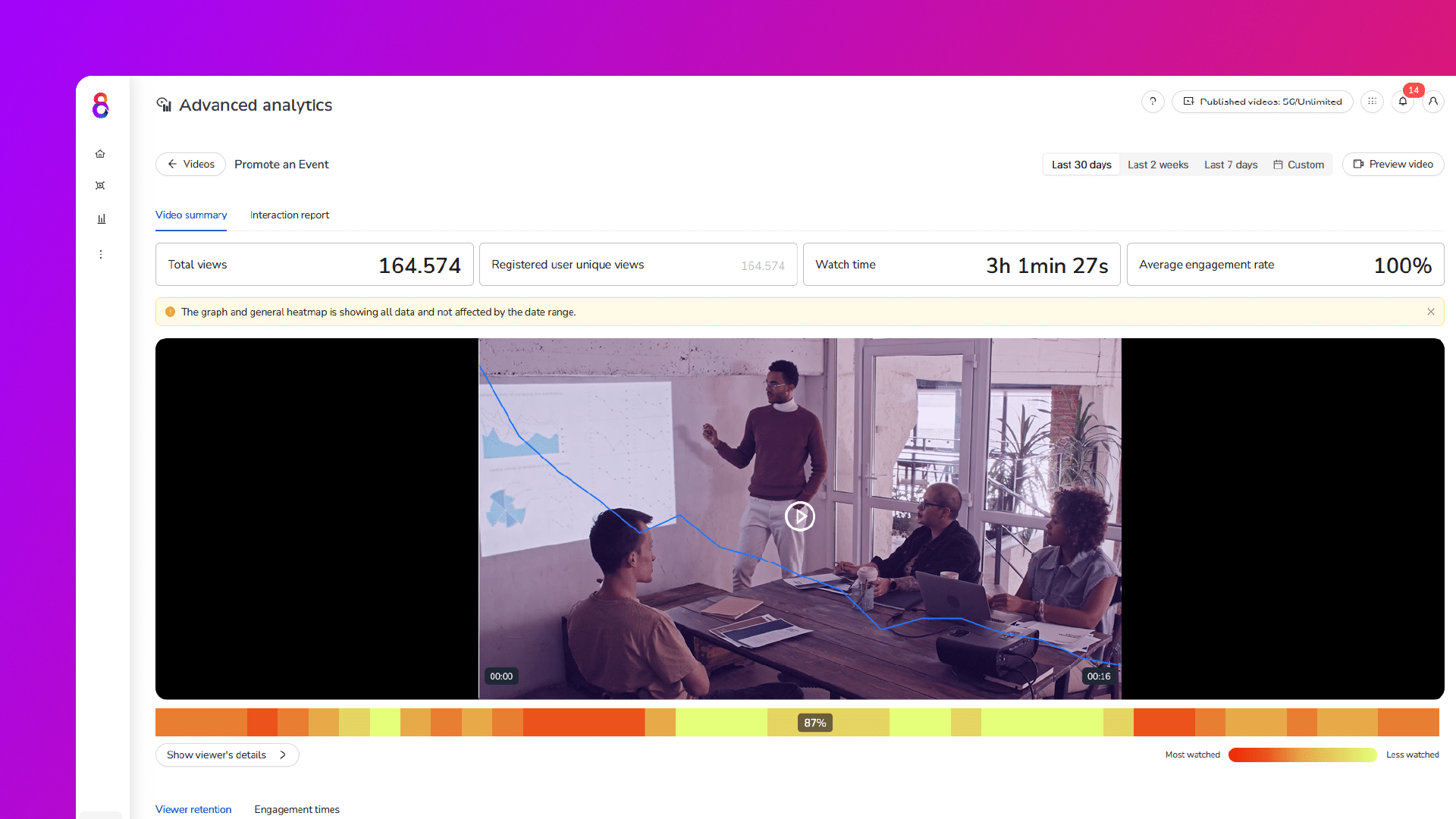
Video engagement analytics measure what viewers do inside a video, not just whether they pressed play. They reveal which moments push a viewer toward a purchase and which lose the sale. Businesses use this data to decide what video to commission next. This guide covers which signals matter, why view counts mislead, and how viewing behaviour drives buying decisions.
What do video engagement analytics measure?
Video engagement analytics measure viewer behaviour during playback: how long people watch, where they stop, and what they click. The useful version of this data is recorded per viewer, not as a crowd average, which is where most public channels fall short. When that per-viewer data flows into tools like GA4 and HubSpot, a business can tie a single viewer’s watch behaviour to a known contact. This is the level of detail behind a secure video hosting platform built for businesses rather than a consumer channel.
The human problem behind weak video data is simple. A team publishes a product explainer video, sees a high view count, and assumes the message landed. The number hides whether anyone reached the part that mattered. Engagement data closes that gap by showing the second attention dropped, which is usually the second the message failed.
Join The European Business Briefing
New subscribers this quarter are entered into a draw to win a Rolex Submariner. Join 40,000+ founders, investors and executives who read EBM every day.
SubscribeView counts answer one question: did someone start the video? Engagement analytics answer the questions that change a campaign. They show the second where viewers leave in a cluster. They show which call-to-action button viewers clicked and which they ignored. For a growth marketing team reporting video return on investment (ROI), that detail decides whether a video budget gets renewed.
Why do view counts mislead marketing teams?
View counts mislead because a view is counted long before a viewer learns anything. Most platforms register a view after a few seconds of playback. A video with thousands of views and a watch time of a few seconds has failed, but the headline number reads like success. This is the most common reporting error in business video. It survives because the vanity metric is the easiest one to find.
The deeper issue is attribution. A view count cannot tell a growth manager whether video influenced a sale. It carries no information about who watched or what they did next. Viewer-level analytics solve this by tying watch behaviour to a known contact record. When that data reaches a CRM, a sales team can see that a prospect watched the full pricing explainer before booking a call.
Public video channels add a second problem. The data belongs to the channel, not the business. A team hosting on a consumer platform gets aggregate numbers, no access controls, and no way to embed a lead form.
YouTube remains the right channel for public brand reach and organic search. For private analytics, controlled access, and in-video lead capture, a dedicated business hosting platform is built for the job. Buyers evaluating business video hosting often compare Vimeo, Wistia, and Cinema8. Each handles hosting and engagement analytics, and the right fit depends on what a team needs inside the player, from chapter navigation to in-video forms.
Which engagement metrics should business teams track?
Business teams should track retention, drop-off points, interaction rate, and conversion events inside the video. These four signals turn a video from a publishing asset into a measurable part of the funnel. Each metric below answers a specific question a growth team needs to act on. Each is reported per viewer on a dedicated business video hosting platform.
- Audience retention shows the percentage of viewers still watching at each second. A sharp drop at 0:33 means the opening promised something the next section did not deliver. Retention is the most useful video metric because it points at the content that needs a rewrite. It removes the guesswork about which part of the video lost people.
- Drop-off clustering identifies the exact timestamps where multiple viewers leave together. A scattered drop-off is normal viewing behaviour. A cliff at one timestamp signals a specific problem: a slow section, a confusing transition, or a claim that lost trust. Fixing one timestamp costs far less than re-recording an entire video.
- Interaction rate measures how many viewers clicked an in-video element such as a button, chapter marker, or lead form. A low interaction rate on a clear call-to-action usually means placement, not lack of interest. Moving the element to the retention peak, rather than the end, often recovers the clicks.
- In-video conversion events track actions completed inside the player, such as a submitted lead form or a booked demo slot. This is the metric that connects video directly to pipeline. When the conversion happens inside the player rather than on a separate landing page, fewer viewers drop out of the journey.
How does engagement data change what you do next?
Engagement data changes the next decision because it grounds the edit in viewer behaviour. A team that knows viewers leave at 0:47 reworks that section instead of debating the whole script. A team that sees high clicks on a mid-video button moves the offer earlier. Every number maps to a specific edit, which is the practical value of viewer-level analytics.
Video A/B testing extends this. Running two versions of a video and comparing retention tells a team which opening or length performs better with real viewers. Cinema8 supports A/B testing on hosted video, and scales from free-plan individuals to enterprise teams with SSO and domain restrictions, so the same testing process works whether a team runs one video or a library. The video then improves with each iteration instead of shipping once and ageing.
For lead generation, the shift is larger. Teams place the form inside the player at the moment of peak attention, instead of pointing viewers to a separate page. Leading video hosting platforms with interactive video tools, such as Cinema8, helps you drag-and-drop lead generation forms in your videos, and integrate them to your CRM.
Who uses video engagement analytics?
Video engagement analytics are used by marketing, sales, product, and training teams that need to prove video performance rather than assume it. Each function reads the same data for a different decision. Marketing and growth teams use retention and conversion data to report video return on investment and justify production spend. Sales teams use per-viewer watch data to see which prospects engaged with which content before a call.
Product and training teams read drop-off data differently. They use it to find the step where users get stuck in an onboarding or tutorial video, then fix that step before it generates support tickets. A dedicated business video hosting platform reports these signals at the level of the individual viewer, which is what lets each team act on the same data for a different end. The shared thread is that engagement data turns video into a source of decisions rather than a number on a dashboard.
What should you do if your video numbers look good but nothing converts?
The first move is to stop reporting on view counts and start reporting on retention and in-video conversion. A video that earns views but no action has a content problem hiding behind a flattering number. Only engagement data shows you where that problem sits. Enterprise video hosting platforms like Cinema8 surfaces this through viewer-level retention curves and in-video lead forms that connect to your CRM, so the point where attention drops and the point where a lead converts both become visible in one place. The next step is to measure where viewers leave your single most important video, then fix that timestamp before producing anything new.
Frequently asked questions about video engagement analytics
These answers cover the questions business teams ask most often when they move from view counts to engagement data. Each one stands on its own, whether you are measuring a single product video or building a reporting process across a content library. They focus on what the numbers mean and what to do once you have them.
What is the difference between video views and video engagement?
A video view records that playback started, while video engagement measures what the viewer did during playback. Engagement covers watch time, retention, drop-off points, and clicks on in-video elements. A high view count with low engagement means people pressed play but did not watch or act. That is why engagement is the more reliable signal for business teams.
How do you measure video engagement accurately?
Accurate video engagement measurement needs viewer-level analytics that track retention, drop-off timestamps, and interaction events per individual rather than in aggregate. A dedicated enterprise video hosting platform like Cinema8 records these signals on hosted video and connects them to GA4 and HubSpot. This lets a team tie watch behaviour to a known contact and to downstream conversion rather than reading anonymous totals.
Why does my video have high views but low conversions?
High views with low conversions usually means viewers leave before reaching the call-to-action, or the call-to-action sits in the wrong place. Retention data reveals the timestamp where attention drops. Interaction data shows whether viewers saw and ignored the offer. Fixing the drop-off point or moving the call-to-action to the retention peak typically recovers lost conversions.
Can you capture leads inside a video?
Capturing leads inside a video is possible on platforms that support forms within the player. Cinema8 lets teams add drag-and-drop lead generation forms inside hosted video and route submissions directly to a CRM. Placing the form at the point of peak attention, rather than after the video ends, reduces the number of viewers who drop out of the journey.
Is YouTube enough for measuring business video performance?
YouTube is built for public reach and organic search, not for the private, viewer-level analytics business teams need. It provides aggregate metrics without access controls, CRM integration, or in-video lead capture. Teams that need per-viewer engagement data and conversion events inside the player use a dedicated business video hosting platform like Vimeo, Wistia or Cinema8, alongside YouTube. Each tool is built for a different job.
What video metrics matter most for growth teams?
The video metrics that matter most for growth teams are audience retention, drop-off clustering, interaction rate, and in-video conversion events. Retention shows where content fails. Drop-off pinpoints the exact second. Interaction rate shows whether calls-to-action work, and conversion events connect video to pipeline. View counts carry no information about viewer behaviour, so they help growth teams least.