






























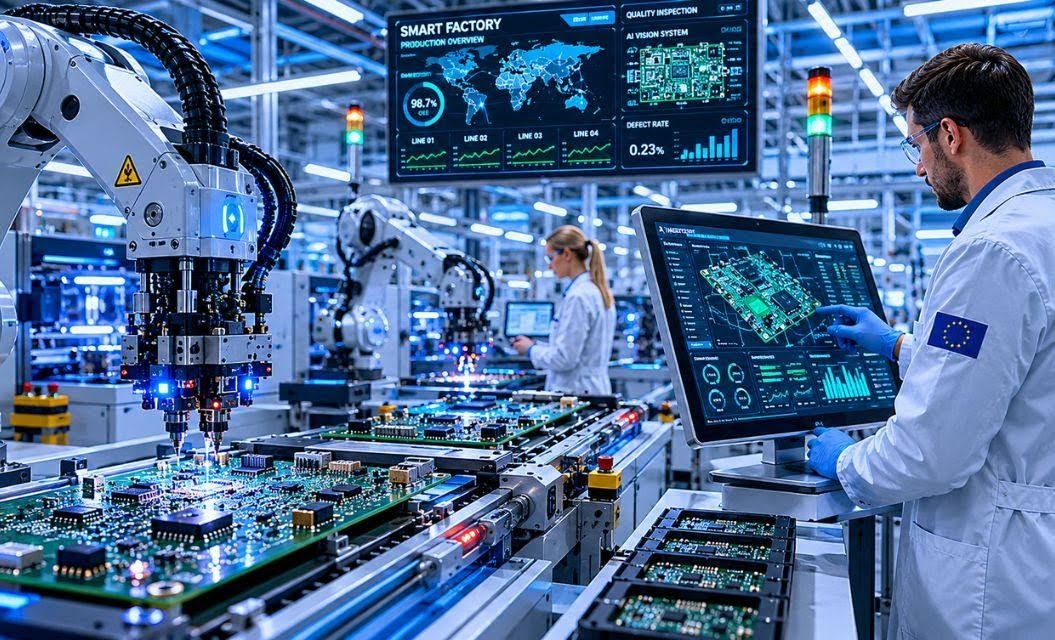
The European electronics manufacturing industry is evolving rapidly as robotics and intelligent automation become central to modern SMT production. Manufacturers across sectors such as automotive electronics, telecommunications, medical devices, industrial automation, and consumer electronics are investing heavily in advanced robotic systems to improve speed, precision, and long-term production efficiency. Traditional SMT assembly lines once relied on a combination of automated machines and manual oversight. Still, growing demand for higher-quality PCB assemblies has accelerated the shift toward fully connected smart factories.
Today, robotics is transforming how printed circuit boards are assembled, inspected, and tested throughout Europe. From AI-powered inspection systems to high-speed pick-and-place robots, automation technologies are helping manufacturers reduce defects, improve scalability, and maintain competitive production standards. As Industry 4.0 adoption continues expanding, robotics is no longer viewed as optional innovation but as a practical requirement for modern electronics manufacturing.
Understanding Modern SMT Assembly Lines
Surface Mount Technology (SMT) is one of the most widely used manufacturing methods in electronics production. It involves mounting electronic components directly onto the surface of printed circuit boards (PCBs) using highly precise automated systems. SMT assembly lines are responsible for producing the compact, high-performance electronics found in nearly every modern industry.
Join The European Business Briefing
New subscribers this quarter are entered into a draw to win a Rolex Submariner. Join 40,000+ founders, investors and executives who read EBM every day.
SubscribeA typical SMT production process includes several key stages:
- Solder paste application
- Component placement
- Reflow soldering
- Optical inspection
- Functional testing
Earlier SMT manufacturing environments depended heavily on manual quality checks and operator intervention. While those systems improved production speed compared to traditional through-hole assembly, manufacturers still faced challenges related to production consistency, labor costs, defect rates, and process scalability.
Modern robotics is changing that landscape by introducing intelligent automation into every stage of electronics production.
Why Europe Is Investing in Robotic SMT Manufacturing
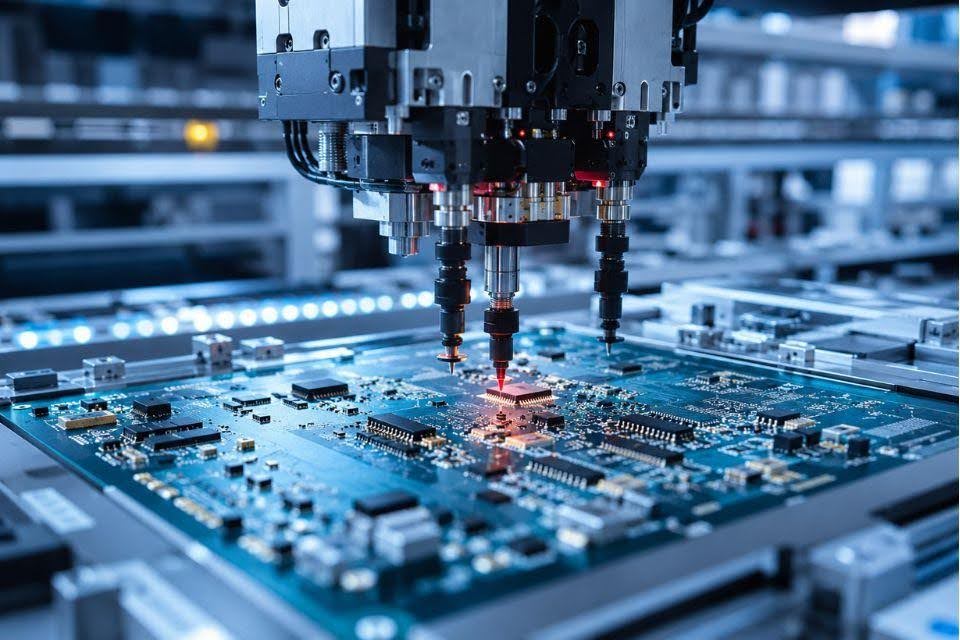
Europe has become a major hub for industrial automation and smart manufacturing innovation. Several factors are driving the rapid growth of robotics in SMT assembly lines across the region.
Increasing Demand for Miniaturized Electronics
Electronic devices continue to become smaller and more complex. High-density PCB designs require precise component placement that leaves very little margin for error. Even microscopic alignment issues can affect electrical performance and product reliability.
Robotic SMT systems provide the placement accuracy needed for advanced PCB assemblies used in:
- Automotive control systems
- Medical devices
- Aerospace electronics
- Telecommunications equipment
- Industrial automation hardware
High-speed robotic systems can place thousands of components every hour with exceptional precision, helping manufacturers maintain strict quality standards.
Labor Challenges in Manufacturing
Many European manufacturing sectors are experiencing shortages of skilled technical workers. SMT production requires specialized knowledge, particularly for quality inspection and machine operation.
Automation helps manufacturers reduce dependency on repetitive manual tasks while allowing skilled workers to focus on higher-level production management and engineering responsibilities.
Rather than eliminating human involvement, robotics is reshaping workforce roles within modern factories.
Growth of Industry 4.0
Industry 4.0 initiatives continue driving digital transformation across European manufacturing. Smart factories rely on interconnected systems that combine:
- Robotics
- Artificial intelligence
- IoT-enabled machinery
- Real-time production analytics
- Predictive maintenance systems
Robotic SMT assembly lines play a central role in these highly connected manufacturing environments.
Pressure for Faster Production Cycles
Electronics manufacturers face increasing pressure to shorten production timelines while maintaining high reliability standards. Markets such as automotive electronics and industrial automation require rapid manufacturing without compromising quality.
Robotic systems improve throughput by operating continuously with minimal interruptions, helping manufacturers respond more efficiently to market demands.
Key Types of Robotics Used in SMT Assembly Lines
Modern SMT production environments use several categories of robotics and intelligent automation technologies.
Pick-and-Place Robotics
Pick-and-place machines are among the most critical robotic systems in SMT manufacturing. These systems use advanced robotic placement heads and machine vision technology to position electronic components accurately on PCBs.
Modern placement systems can handle extremely small components while maintaining high-speed production rates. Advanced sensors and cameras continuously verify alignment and positioning during operation.
Manufacturers producing complex PCB assemblies rely heavily on these systems to maintain consistency across large production volumes.
Automated Optical Inspection Systems
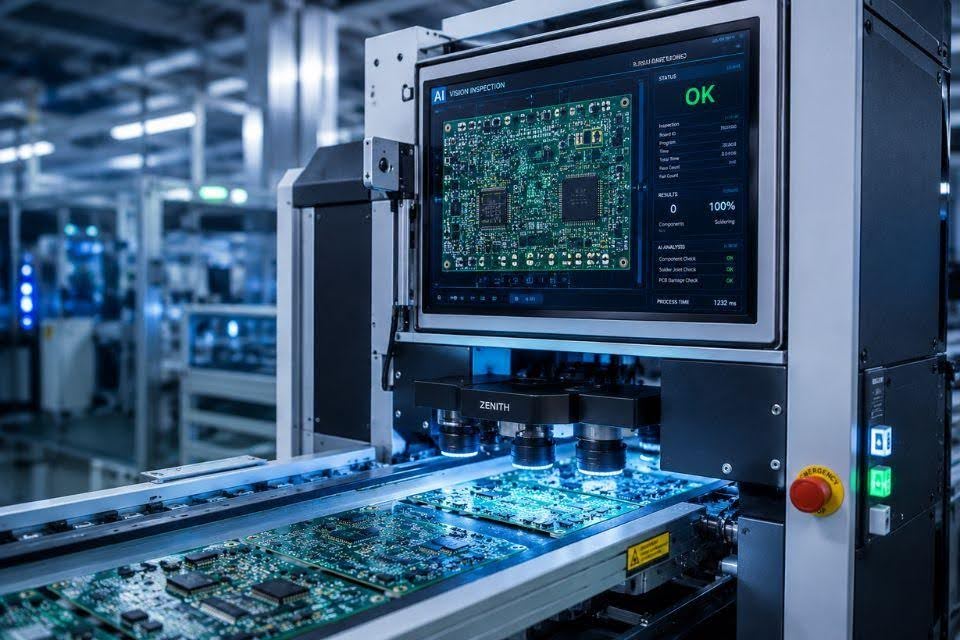
Automated Optical Inspection (AOI) systems use robotics, cameras, and AI-powered software to inspect PCB assemblies during production.
AOI systems can identify:
- Missing components
- Solder defects
- Incorrect polarity
- Alignment problems
- Surface contamination
Unlike manual inspections, robotic inspection systems operate continuously and provide highly consistent quality control.
Many European smart factories now use AI-enhanced AOI platforms capable of learning from production patterns and improving defect detection over time.
Collaborative Robots
Collaborative robots, often called cobots, are designed to work safely alongside human operators.
In SMT manufacturing, cobots are frequently used for:
- Material handling
- PCB loading and unloading
- Packaging operations
- Testing assistance
- Secondary assembly processes
Cobots are particularly valuable for flexible production environments where product configurations change frequently.
Robotic Soldering Systems
Precision soldering is essential in PCB manufacturing because solder quality directly affects electronic reliability.
Robotic soldering systems provide:
- Consistent temperature control
- Repeatable solder application
- Reduced thermal stress
- Improved solder joint quality
These systems are especially useful for high-reliability electronics used in medical, automotive, and industrial applications.
How Robotics Improves SMT Production Efficiency
The growing adoption of robotics in SMT assembly lines is driven by measurable operational improvements.
Higher Production Accuracy
Human error remains one of the most common causes of manufacturing defects. Robotics minimizes variability by maintaining highly repeatable production processes.
Precision robotic systems improve:
- Component placement accuracy
- Solder consistency
- Inspection reliability
- Assembly repeatability
This is particularly important for miniature PCB designs with densely packed electronic components.
Faster Throughput and Reduced Downtime
Robotic SMT systems can operate continuously with minimal interruptions. Automated production lines reduce delays caused by manual handling, fatigue, or inconsistent operator performance.
Manufacturers can increase production capacity while maintaining stable quality levels.
Some advanced SMT factories now use predictive maintenance software that monitors robotic equipment performance in real time, helping prevent unexpected downtime before failures occur.
Lower Defect Rates
PCB defects can result in expensive rework, delayed shipments, and product reliability issues. Robotics significantly improves process control and reduces production inconsistencies.
AI-driven inspection systems can identify quality issues early in the manufacturing process, helping manufacturers reduce waste and improve overall yield performance.
Better Data Collection and Analytics
Modern robotic production lines generate valuable manufacturing data that can be used to improve operational efficiency.
Factories can monitor:
- Machine performance
- Production speed
- Defect patterns
- Material usage
- Equipment health
This data-driven approach allows manufacturers to optimize production decisions more effectively.
Challenges of Robotics Integration in SMT Manufacturing
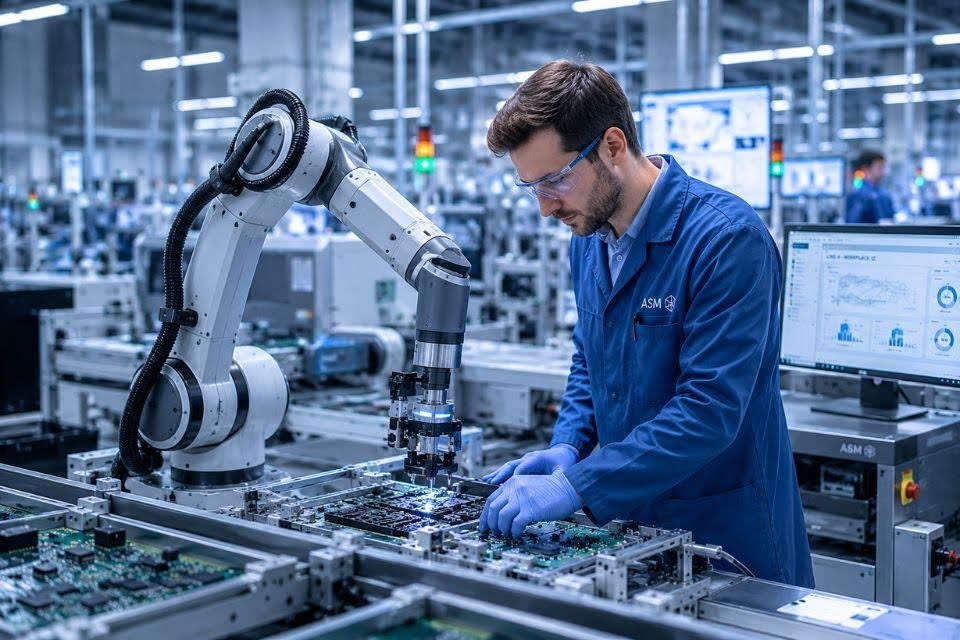
Although robotics provides major advantages, implementation also presents several operational challenges.
High Initial Investment Costs
Advanced SMT robotics systems require significant upfront investment. Costs may include:
- Robotic equipment
- AI software integration
- Smart factory infrastructure
- Workforce training
- Maintenance systems
For smaller manufacturers, automation adoption can represent a major financial commitment.
Complex System Integration
Integrating robotics into existing SMT production lines can be technically demanding. Manufacturers must ensure compatibility between production equipment, software platforms, and inspection systems.
Poor integration planning can lead to temporary production disruptions or operational inefficiencies.
Workforce Training Requirements
As robotics adoption increases, manufacturers require employees with new technical skill sets related to:
- Robotics programming
- Equipment maintenance
- Data analysis
- Automation system monitoring
Many European manufacturers are investing heavily in workforce development to support smart manufacturing transitions.
Cybersecurity Concerns
Connected manufacturing systems create cybersecurity risks because robotic equipment relies heavily on network communication and cloud-connected software.
Manufacturers must protect sensitive production systems from:
- Unauthorized access
- Data breaches
- Malware attacks
- Operational disruptions
Cybersecurity is becoming increasingly important as SMT factories become more digitally connected.
The Rise of Smart Factories in Poland and Europe
Smart factory adoption is accelerating throughout Europe, particularly in countries investing heavily in advanced manufacturing infrastructure.
Germany continues to lead many Industry 4.0 initiatives, but Poland has also emerged as a rapidly growing electronics manufacturing hub. Demand for SMT assembly Poland has increased as manufacturers seek high-quality PCB production capabilities combined with competitive operational efficiency.
Poland’s electronics sector benefits from:
- Skilled engineering talent
- Expanding industrial infrastructure
- Strategic European supply chain positioning
- Increasing automation investment
The market for Electronics assembly Poland is also expanding as European manufacturers look for reliable production partners capable of handling advanced PCB assembly requirements.
Across Europe, manufacturers are increasingly integrating:
- AI-driven analytics
- Robotics
- Real-time monitoring systems
- IoT-connected production equipment
- Predictive maintenance platforms
These technologies are helping create highly efficient smart manufacturing environments capable of adapting quickly to changing production demands.
Future Trends in Robotics and Electronics Manufacturing
Robotics will continue shaping the future of SMT manufacturing throughout Europe and beyond.
AI-Powered Manufacturing Optimization
Artificial intelligence is becoming increasingly important in electronics manufacturing. AI systems can analyze production data in real time to improve:
- Placement accuracy
- Production efficiency
- Quality control
- Maintenance scheduling
This allows factories to optimize operations continuously.
Autonomous Inspection Systems
Future inspection technologies are expected to become even more autonomous. Advanced machine vision systems may soon identify and correct manufacturing issues automatically before defects occur.
This could significantly reduce waste and improve long-term production reliability.
Human and Robot Collaboration
The future of SMT manufacturing will likely involve stronger collaboration between skilled workers and robotic systems rather than fully autonomous factories.
Human expertise remains essential for:
- Engineering analysis
- Process optimization
- Quality strategy
- Production planning
Robotics handles repetitive precision tasks while engineers focus on higher-level operational management.
Sustainable Manufacturing Practices
Sustainability is becoming increasingly important within European manufacturing industries. Robotics supports environmental goals by reducing:
- Material waste
- Energy consumption
- Production inconsistencies
- Defective assemblies
Lower defect rates and optimized production processes contribute to more efficient and environmentally responsible manufacturing operations.
Why Robotics Is Becoming Essential for Competitive SMT Manufacturing
The electronics industry continues evolving toward greater complexity, faster innovation cycles, and stricter quality expectations. Manufacturers that fail to modernize their SMT production capabilities may struggle to remain competitive in global markets.
Robotics provides several long-term advantages:
- Improved scalability
- Better production consistency
- Faster manufacturing cycles
- Reduced operational risk
- Enhanced product reliability
As smart factory technologies continue advancing, robotics is expected to become even more deeply integrated into electronics production strategies across Europe.
Manufacturers across Europe are increasingly investing in advanced SMT production solutions that support automation, scalability, and long-term manufacturing efficiency.
Conclusion
Robotics is transforming SMT assembly lines throughout Europe by improving precision, scalability, efficiency, and manufacturing consistency. From high-speed pick-and-place systems to AI-powered inspection technologies, automation is reshaping how electronic products are produced across industries ranging from automotive electronics to industrial automation.
European manufacturers are adopting robotics not simply to increase production speed but to build smarter, more reliable, and more sustainable manufacturing environments. As Industry 4.0 adoption continues expanding, robotics will remain central to the future of electronics manufacturing.
Manufacturers exploring advanced SMT production capabilities are increasingly prioritizing automation technologies that support long-term operational flexibility and quality improvement. The continued growth of smart manufacturing across Europe demonstrates how robotics is becoming a defining force within the next generation of electronics production.
For businesses seeking reliable and future-focused electronics manufacturing solutions, understanding the role of robotics in SMT production is becoming more important than ever.
Frequently Asked Questions
What is robotics in SMT assembly lines?
Robotics in SMT assembly lines refers to the use of automated machines and intelligent systems to place, inspect, solder, and handle electronic components during PCB manufacturing.
Why are European manufacturers investing in robotic SMT systems?
European manufacturers are investing in robotics to improve manufacturing accuracy, reduce defects, increase production speed, and support Industry 4.0 smart factory initiatives.
How do robotic SMT systems improve PCB quality?
Robotic systems improve PCB quality through precise component placement, consistent soldering, automated inspection, and real-time process monitoring.
What industries benefit most from robotic SMT manufacturing?
Industries such as automotive electronics, aerospace, telecommunications, medical devices, and industrial automation benefit heavily from robotic SMT manufacturing.
Why is Poland becoming an important electronics manufacturing hub?
Poland is growing rapidly as an electronics manufacturing center because of its skilled workforce, expanding industrial infrastructure, competitive production capabilities, and increasing investment in smart factory technologies.