




























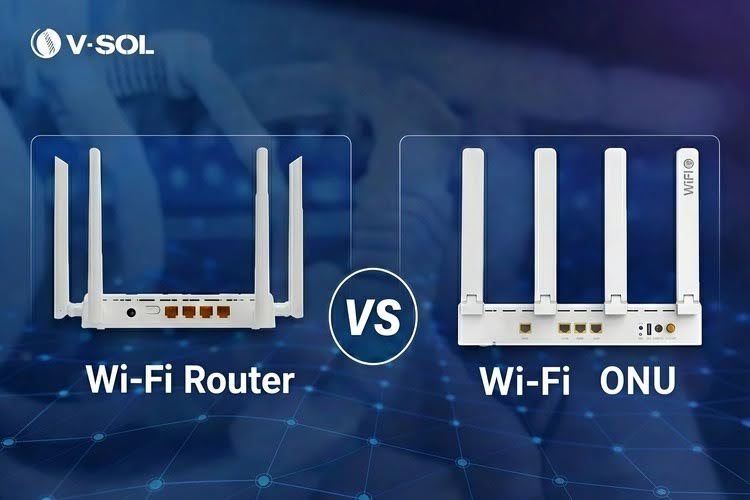
As fiber-to-the-home and fiber-to-the-building deployments continue to accelerate worldwide, end users and network operators are paying increasing attention to what happens at the network edge. While fiber infrastructure often takes center stage, the device that terminates the fiber and delivers connectivity inside homes and offices plays an equally critical role.
In many deployments, users are faced with a practical question: should they rely on a traditional Wi-Fi router, or is a Wi-Fi ONU the better option in a fiber-based access network? Understanding the functional differences between Wi-Fi ONU and Wi-Fi router is essential for making informed decisions in FTTH, FTTB, and small business scenarios.
What an ONU Really Does in a Fiber Network
In a passive optical network, the Optical Network Unit is the endpoint device that connects subscribers to the service provider’s OLT. Unlike generic networking equipment, the ONU is designed to communicate using PON protocols such as GPON or XGS-PON, enabling efficient, centralized bandwidth management.
Join The European Business Briefing
New subscribers this quarter are entered into a draw to win a Rolex Submariner. Join 40,000+ founders, investors and executives who read EBM every day.
SubscribeA clear explanation of what an ONU is helps illustrate why it cannot be treated as a simple modem or router replacement. The ONU performs optical signal conversion, user authentication, traffic prioritization, and service separation under the control of the OLT. These capabilities allow operators to deliver internet, IPTV, VoIP, and enterprise services over a single fiber with predictable performance.
In traditional FTTH architectures, the ONU is paired with a standalone Wi-Fi router. This separation works, but it introduces additional hardware, power consumption, and configuration complexity at the user premises.
The Role of a Traditional Wi-Fi Router
A traditional Wi-Fi router is primarily responsible for local area networking. It distributes internet access via Ethernet and wireless connections, manages NAT, assigns IP addresses, and applies basic security policies. However, it does not understand PON protocols and cannot directly terminate a fiber connection from an ISP.
In fiber deployments, a traditional router typically connects to an ONU through an Ethernet WAN port. While this approach is familiar to many users, it creates a two device setup that increases installation time and potential points of failure. From an operator perspective, troubleshooting also becomes more complex because responsibilities are split across devices from different vendors.
How a Wi-Fi ONU Combines Two Worlds
A Wi-Fi ONU integrates PON termination and wireless routing into a single device. It combines optical access, Ethernet switching, and Wi-Fi distribution within one managed platform. This convergence is particularly attractive in large scale FTTH rollouts, where reducing hardware footprint and simplifying deployment can translate directly into lower operational costs.
The functional differences between a Wi-Fi ONU and a traditional Wi-Fi router become clearer when examined side by side. A detailed comparison of Wi-Fi ONU vs traditional Wi-Fi router highlights how integrated devices are purpose-built for fiber access networks rather than adapted from consumer networking products.
Deployment Efficiency and Installation Simplicity
One of the most immediate advantages of a Wi-Fi ONU is installation efficiency. With a single device, technicians only need to mount, power, and provision one unit. Optical authentication, service profiles, and Wi-Fi settings can be pushed remotely from the OLT or management platform.
In contrast, a traditional router setup requires coordination between the ONU and router. Misconfigurations at either layer can result in connectivity issues, often requiring on-site intervention. For operators managing thousands of subscribers, this difference has a measurable impact on operational expenditure.
Network Management and Operator Control
From an ISP standpoint, centralized control is a critical requirement. Wi-Fi ONUs are typically designed with carrier-grade management features such as TR-069, TR-369, or proprietary OLT-based provisioning. This allows operators to monitor performance, push firmware updates, and apply QoS policies consistently across the network.
Traditional Wi-Fi routers, especially consumer-grade models, often lack deep integration with ISP management systems. Even when remote management is possible, feature sets and reliability vary widely by brand and model. This inconsistency can undermine service quality and complicate support processes.
Manufacturers like VSOL focus on ONU solutions that align closely with operator workflows, ensuring that integrated Wi-Fi ONUs remain manageable at scale without sacrificing user experience.
Performance Considerations in Real-World Scenarios
Performance is not only about headline Wi-Fi speeds. In a fiber access environment, stable throughput, low latency, and predictable behavior under load are equally important. Wi-Fi ONUs are optimized to handle PON traffic scheduling while simultaneously delivering wireless coverage.
Because the PON and Wi-Fi functions are tightly integrated, traffic prioritization can be applied more intelligently. For example, voice and video services can be preserved even during peak usage. Traditional routers operate independently of the PON layer, limiting their ability to coordinate traffic handling with the access network.
Cost Structure and Total Cost of Ownership
While the upfront cost of a Wi-Fi ONU may appear higher than that of a basic router, total cost of ownership often tells a different story. Eliminating a separate router reduces hardware inventory, logistics, power consumption, and failure rates.
For operators, fewer devices per subscriber also mean fewer support tickets and faster deployment cycles. Over the lifespan of a network, these factors frequently outweigh initial hardware price differences, particularly in dense FTTH deployments.
User Experience and Space Efficiency
End users increasingly value simplicity and aesthetics. A single compact device with fiber input, Ethernet ports, and Wi-Fi coverage is easier to accommodate than multiple boxes and cables. Wi-Fi ONUs are typically designed with residential environments in mind, balancing performance with unobtrusive form factors.
Traditional routers can still be suitable for advanced users who require custom firmware or specialized configurations. However, for most residential and small business users, an integrated Wi-Fi ONU provides a cleaner and more user-friendly solution.
Choosing the Right Device for the Right Scenario
The decision between a Wi-Fi ONU and a traditional Wi-Fi router should be guided by deployment context. In operator-managed FTTH networks, Wi-Fi ONUs offer clear advantages in integration, control, and scalability. In contrast, standalone routers may still play a role in scenarios where the access device is fixed or where users demand maximum customization.
Understanding device roles at the network edge helps stakeholders avoid mismatched expectations and suboptimal designs. As fiber networks continue to evolve toward higher speeds and greater service diversity, integrated access devices are likely to become the default choice.
Final Thoughts
Wi-Fi ONUs are not merely routers with an optical port. They are purpose-built access devices designed to bridge carrier-grade fiber networks and user environments efficiently. By consolidating functions that were traditionally separated, they address many of the operational and user experience challenges faced by modern FTTH deployments.
As manufacturers such as VSOL continue to refine Wi-Fi ONU designs to support higher PON speeds and advanced Wi-Fi standards, the distinction between access and in-home networking will become increasingly seamless. For operators and users alike, understanding these differences is the first step toward building more reliable and future-ready fiber networks.