





























EBM Newsdesk Analysis
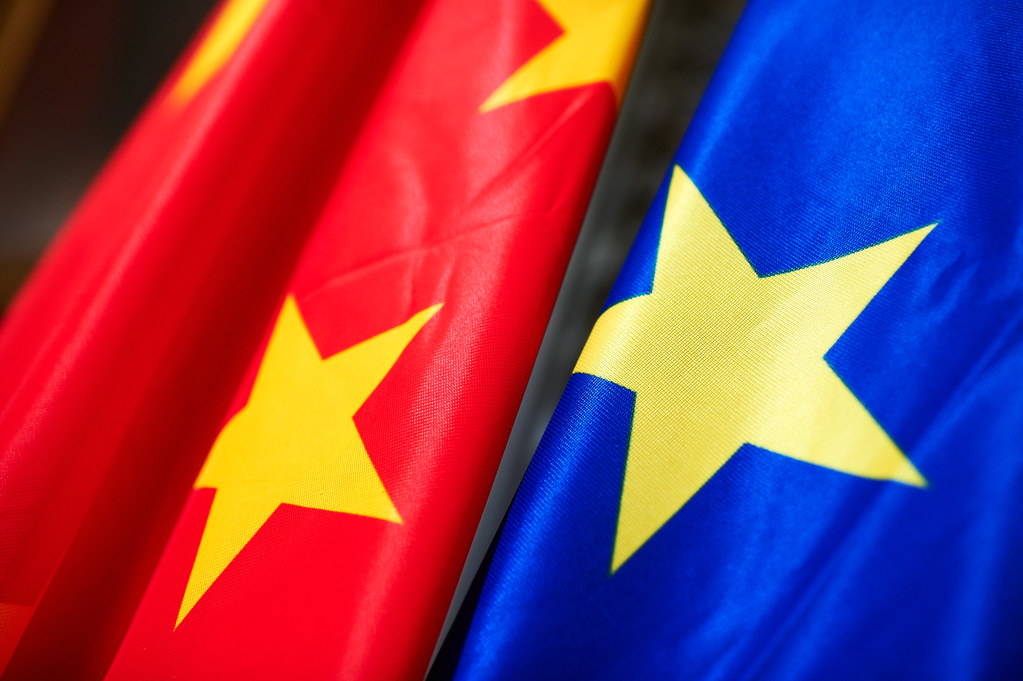
Brussels, 27 April 2026 — China’s Ministry of Commerce formally warned the European Union that it will take “countermeasures” if Chinese companies are harmed by the bloc’s proposed Industrial Accelerator Act, as reported by the Financial Times. The warning, issued through MOFCOM spokesperson channels, marks the most direct retaliatory threat Beijing has made against EU industrial policy in over a decade. The IAA, proposed by the European Commission on 4 March 2026 and now moving through the EU legislative process, is Brussels’ most ambitious attempt yet to push back against cheaper Chinese imports in strategic sectors including batteries, electric vehicles, solar PV and critical raw materials. The Commission’s stated goal: raise manufacturing’s share of EU GDP from 14.3% in 2024 to 20% by 2035. Beijing’s response on Monday signals that getting there will not happen quietly.
The timing of China’s intervention is calibrated. Beijing is currently negotiating an extension to its uneasy trade-war truce with Washington, which has incentivised China to keep European communication channels open as an alternative export market. That makes Monday’s “countermeasures” warning a deliberate diplomatic shot — strong enough to register, vague enough to leave space for talks.
What the IAA Actually Does
Join The European Business Briefing
New subscribers this quarter are entered into a draw to win a Rolex Submariner. Join 40,000+ founders, investors and executives who read EBM every day.
SubscribeThe Industrial Accelerator Act introduces three structural mechanisms that together represent the most significant shift in EU industrial policy since the single market itself.
First, restrictive foreign direct investment rules. Acquisitions of EU companies and greenfield investments in strategic emerging sectors require prior approval from member state Investment Authorities where the deal exceeds €100 million and the investor comes from a country accounting for more than 40% of global manufacturing capacity in that sector. The threshold is country-neutral on paper but, in practice, applies almost exclusively to Chinese investors in batteries, EVs, solar PV and critical raw materials.
Second, “Made in EU” public procurement requirements. Member states will be required to prioritise EU-origin and low-carbon products in public tenders for energy-intensive industries, electric vehicles, and net-zero technologies. EU public procurement represents roughly 15% of EU GDP — a market that, if directed toward European manufacturers, becomes a structural demand anchor for European industry.
Third, joint venture and technology transfer conditions for Chinese investors who do build EU manufacturing capacity. The conditions deliberately mirror the requirements Western companies were forced to accept when entering the Chinese market in the 1990s and 2000s: shared ownership with EU partners, IP and know-how transfer, R&D investment, and EU workforce employment quotas.
The architecture is, in effect, strategic reciprocity — applying to Chinese investors in Europe the same terms that Chinese authorities applied to Western investors entering China for thirty years.
Why China Is Escalating Now
Beijing’s framing in Monday’s MOFCOM statement was deliberately legal and diplomatic. The Act, China argued, “runs counter to basic market economy principles such as commercial voluntariness and fair competition,” and risks violating most-favoured-nation and national treatment principles under WTO rules. The substantive Chinese position is that the EU is “building walls and barriers” under the cover of green transition and industrial competitiveness.
The harder geopolitical context is what makes Monday’s warning consequential. China’s manufacturing overcapacity in EVs, solar and batteries — driven by years of state subsidies running at roughly 4-4.5% of Chinese GDP — needs export markets. Trump-era US tariffs have substantially closed the American market to those products. Europe is the obvious destination. The IAA is designed precisely to prevent that redirection becoming a one-way flow.
For European industrial executives, the stakes go beyond procurement rules. If the IAA passes substantially intact, European battery, EV and solar manufacturers gain meaningful market protection at exactly the moment they need it to scale. If China’s countermeasures threats successfully water it down, European industrial policy loses its most credible competitive instrument in a decade — and the manufacturing-share target of 20% by 2035 becomes effectively unreachable.
The European Read
Three implications matter for European business leaders reading this on Monday morning.
First, European industrial corporates with material China exposure — Volkswagen, BMW, Siemens, BASF, ASML — are now caught in the middle of an escalating bilateral fight. Beijing’s “countermeasures” threats historically translate into selective access restrictions, investigation announcements, and procurement preference reversals against named European companies. Boards should be war-gaming exposure scenarios this quarter.
Second, European battery and clean-tech companies — Northvolt successors, ACC, Verkor, Enel Green Power — are the direct beneficiaries of IAA passage. The Act creates the structural demand visibility that made the original investment case work. Equity markets have not yet fully priced this asymmetry.
Third, the IAA is now the single most important piece of European legislation moving through Brussels in 2026, ahead of the AI Act amendments and ahead of the Capital Markets Union proposals. The trajectory of this bill over the next 12 months will shape European industrial competitiveness for the next decade.
China’s Monday warning was not the end of the conversation. It was the start of the negotiation.
Related Analysis