
































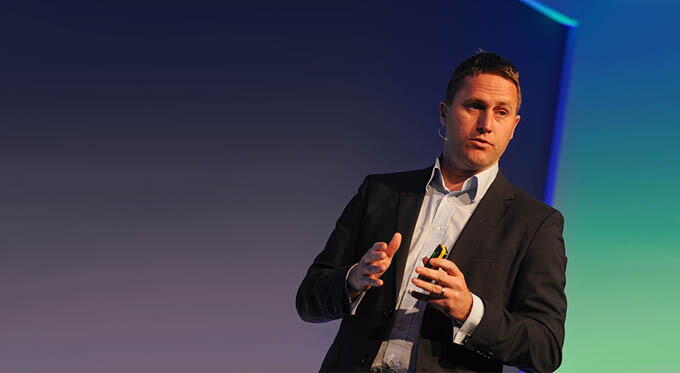
 Professor Damian Hughes is an internationally renowned organisational psychologist and best-selling author who has dedicated his career to studying high performance. He is the co-host of the popular High Performance Podcast, where he interviews world-class athletes, business leaders and cultural icons to uncover the habits and mindsets that drive sustained success.
With a background working alongside elite sports teams and global businesses, Damian is recognised as a leading authority on applying psychological principles to unlock potential and drive meaningful change.
As an expert on enhancing work habits and increasing productivity, Damian brings a rare ability to translate complex research into practical strategies that leaders and teams can use every day. His engaging style has made him a sought-after keynote speaker for organisations around the world, and he is proudly represented by The High Performance Speakers Agency.
Join The European Business Briefing
New subscribers this quarter are entered into a draw to win a Rolex Submariner. Join 40,000+ founders, investors and executives who read EBM every day.
SubscribeIn the following interview, Damian shares his insights on relationships, workplace culture, engagement, and the importance of diversity and inclusion in driving lasting success.
Q: What have you learned since founding Liquidthinker?
Damian Hughes: “I founded my business in 2006 and one of the big things that has dawned on me has been the importance of relationships. People buy people.
There is an old saying that people do not care what you know until they know how much you care, and I think that is very much the case. It is about authenticity, integrity, and decency at the heart of all successful businesses.”
Q: How can businesses create profitable working environments?
Damian Hughes: “My top tip for creating these kinds of environments has been a three-word summary, which is: contain, then explain. If I can clarify where that came from: many years ago, I was doing some research on a book I was writing about high-performing cultures.
I went to a boxing gym in Detroit that was regarded as a greenhouse of talent – a place that produced about thirty world champions in a 25-year period. Forget the sport or even the industry of sport. It was unprecedented in pretty much any environment.
When I met the head coach in that culture, he had this phrase: “contain and explain”. His point was that everybody feels insecure, uncertain, doesn’t want to look silly, or feel out of their depth.
He said that until you can get people to perform their very best, you need to convince them – I will contain them – that they’re safe, that they’re valued, that we care about them.
And when you have got them in that place of being convinced that they are in a safe, caring environment, then you can start to explain how they can deliver their best. But he said what too many businesses do is they try to explain and then contain, and it does not work in that order. So, my summary would be those three words: contain, then explain.”
Q: What is your tip for business leaders looking to improve engagement?
Damian Hughes: “The top tip would be to see the world through the eyes of somebody else’s perspective, do not see it from your own.
The ability to empathise is key. I use a really simple exercise with leaders to do this, where I say: “Draw me a picture of a coffee mug.” People will draw a picture that is a two-dimensional shape, and my suggestion is: you also have the capacity to draw it from a three-dimensional shape, from the top down. But very rarely do people do it. The reason I show that is that we often get stuck in a certain perspective, we see the world through our own eyes.
I think employee engagement is about our ability to see it through the eyes of our staff and to understand it from their perspective. There is a great phrase that is often used: “You would make the same decision if I was you.”
It is the idea that if you understood the world from my angle, you would probably make the same decisions that I would. From a management point of view, if you can understand the world through the eyes of your staff, that allows you to respond accordingly – rather than how you think it should be.”
Q: Why are diversity and inclusion important within organisations?
Damian Hughes: “Diversity and inclusion is key. If you take it from the opposite way around, the inclusion bit is about making people feel that they’re part of something bigger than themselves. Part of our psychology is that we’re tribal by our very nature – we want to feel part of something bigger.
Feeling isolated or cut off from a group is one of the most powerful indicators of mental disorders such as depression. When we feel removed from a group, those factors can increase exponentially. Inclusivity becomes really important in that regard.
Then, diversity isn’t just about gender, race, sexuality, or any of those other aspects. This is often about mental diversity or cognitive diversity, our ability to have different points of view shared with us.
That way, we get a fuller picture of the world around us. There are lots of powerful drivers about why that is so critical, but even more so in our modern world. In terms of social media and electronic mediums, it has been proven – there is a psychologist called Jonathan Haidt, who did a fascinating study – that what that world tends to do for us is: it divides.
We tend to divide everything up on social media into black and white camps: good versus bad, right versus wrong. We mistake feelings for facts. It allows us to believe that because I feel offended, that is a fact. And then what doesn’t kill us makes us weaker. If you are not hearing conflicting views, when you are confronted with them in real life, you are not as robust or resilient in being able to cope.
From a tangible point of view, diversity and inclusion challenges allow us to see the world through all spectrums, rather than just one of two camps. It gives us a sense of hearing different opinions that we might not agree with, but it allows us to process those opinions. And finally, that last point: it makes us more resilient and robust in the face of difficult times.”
This exclusive interview with Professor Damian Hughes was conducted by Louisa Mason-Hayes, Director of Corporate Social Responsibility at The High Performance Speakers Agency.