































EBM WEEKEND READ: By Nick Staunton, Editor-in-Chief
Updated July 2026
There is a moment in every major transfer window when the same name surfaces, quietly, in the background of every significant deal. Not a club chairman. Not a sporting director. Not a manager. Jorge Mendes — a 60-year-old Portuguese agent from Lisbon who once ran a nightclub, never played professional football and answers, in any meaningful sense, to nobody.
Join The European Business Briefing
New subscribers this quarter are entered into a draw to win a Rolex Submariner. Join 40,000+ founders, investors and executives who read EBM every day.
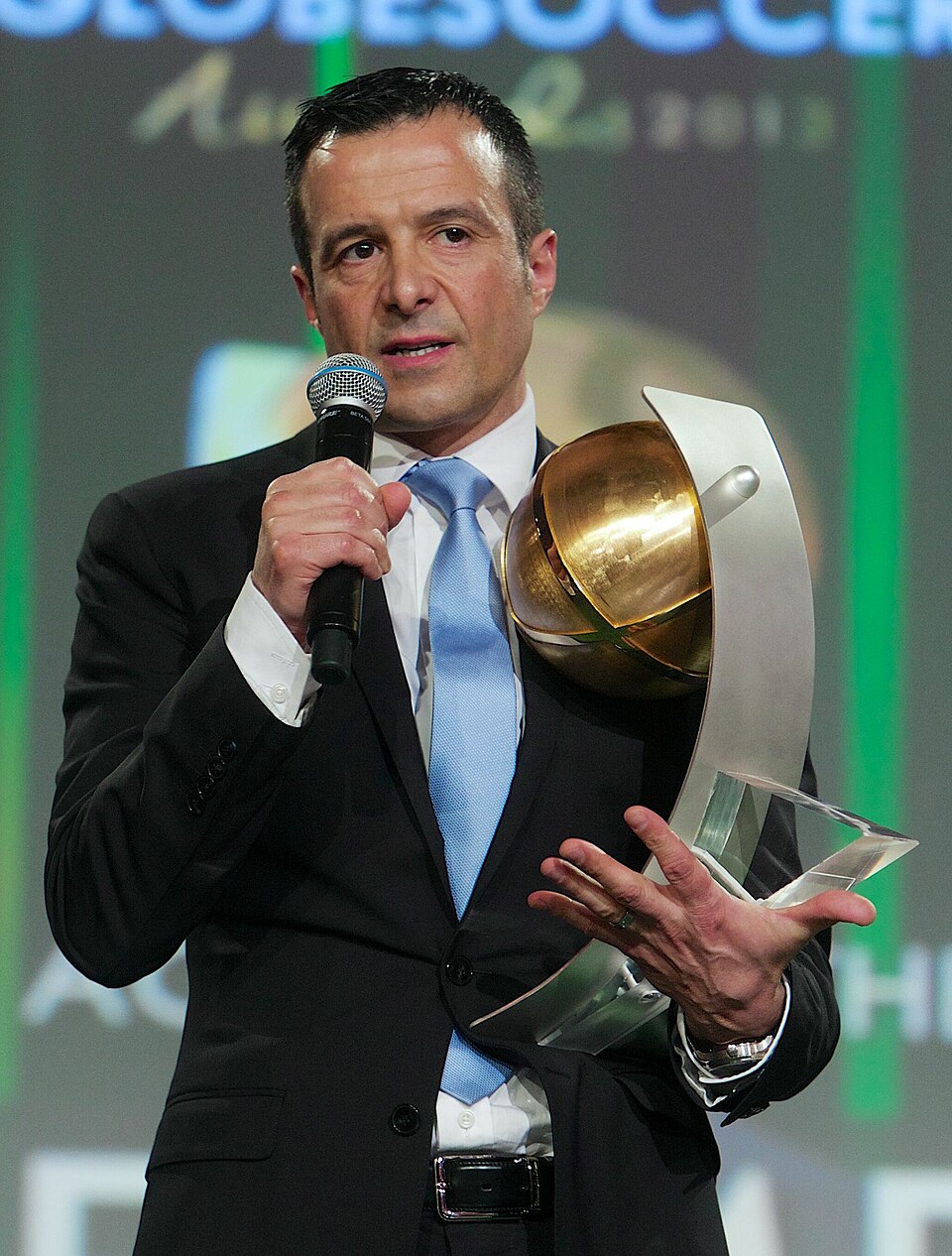
SubscribeAt 60, Mendes commands over €1.6 billion in player value through Gestifute, his agency. In 2024 alone, he was the architect behind five blockbuster transfers — Leny Yoro to Manchester United for €52 million, João Neves to PSG for €60 million, Pedro Neto to Chelsea for €63 million, Manuel Ugarte to Manchester United for €50 million, and João Félix’s return to Chelsea for €52 million — generating over €300 million in transfer fees from a single summer’s work. In December 2025, he was awarded the Globe Soccer Best Agent Award for the 13th time.
This is not an agent. This is a financial institution with a client list. And understanding how Mendes built it tells you more about the economics of modern football than any club balance sheet.
From DJ Booth to Deal Table
Jorge Mendes was born on 7 January 1966 in Lisbon. He started his career as a footballer, abandoned his hopes of a professional career after being rejected by several clubs in his early twenties, then worked as a DJ before opening his own bar and nightclub. It is, on paper, an unlikely origin story for the most powerful intermediary in global sport. In practice, it makes perfect sense. Running a nightclub in Lisbon in the 1990s required exactly the skills that would define his later career: reading rooms, building networks, knowing who needed what and being the person who could provide it.
In 1996, Mendes formally established Gestifute, closing his first deal by brokering Nuno Espírito Santo’s move from Vitória de Guimarães to Deportivo de La Coruña. The fee was modest. The relationship was not. Nuno would become one of the most important clients in Gestifute’s history — a manager whose subsequent career at Porto, Valencia, Wolves and Tottenham opened doors for Mendes at club level that a purely player-focused agency could never have accessed.
The pivot from boutique Portuguese agency to global powerhouse came in 2003, when Mendes brokered what remains the defining transaction of his career. He facilitated Cristiano Ronaldo’s move to Manchester United from Sporting Lisbon, then managed Ronaldo’s career through his moves to Real Madrid in 2009, Juventus in 2018, his return to Manchester United in 2021 and his move to Al-Nassr in Saudi Arabia. Every one of those transfers generated significant commission. Every one of them expanded Gestifute’s reach into a new market. Ronaldo did not just make Mendes wealthy. He made him structurally indispensable to the transfer ecosystem.
As we explored in our examination of how Ronaldo, LeBron and Mbappé have built investment empires that outlast their playing careers, the relationship between elite athlete and elite agent is no longer transactional. It is symbiotic, long-term and worth far more than any single contract.
The Wolves Model: Owning the Club and the Players
The Gestifute business model is more sophisticated — and more controversial — than simple commission collection. Mendes understood early that controlling the supply of players to a club was valuable. Controlling the club itself was transformative.
In 2016, Mendes leveraged his English connections to facilitate Wolverhampton Wanderers’ acquisition by Chinese conglomerate Fosun, who also hold shares in Gestifute. Since then, Mendes constructed Wolves’ squad personally, simultaneously acting as agent for the club, coach and players. In 2022 alone, Wolves invested €124 million predominantly on Mendes clients. A September 2022 match against Fulham illustrated his influence in its starkest form: 12 of Wolves’ 14 players were Mendes signings, worth nearly €300 million in transfer fees.
Wolves owners Fosun have been reported to hold a stake in Mendes’ Gestifute firm via a subsidiary — an arrangement that raises obvious questions under rules designed to prevent conflicts of interest between club ownership and player representation. FIFA and the FA have investigated and cleared the arrangement on technical grounds. Whether the clearance reflects the rules working as intended or the rules not yet having caught up with the reality of modern agent power is a question the sport has not fully resolved.
It mirrors, at a different scale, the broader tension we identified in our analysis of how pickleball’s rapid growth from backyard game to $225 million Wall Street proposition exposed how quickly commercial structures outpace regulatory frameworks in sport.
The Commission Machine
The economics of the Gestifute model are worth examining closely. Standard commission runs at 5-10% of gross salary, or up to 6% of transfer fee under FIFA’s 2023 rules, with image rights income channelled through special purpose vehicles. On a €63 million transfer, that means between €3.78 million and €6.3 million in fees from a single deal. Multiply that across the volume of transactions Gestifute handles annually and the revenue picture becomes clear.
Mendes’ personal fortune has been reported at around $1.8 billion in 2025, with annual income estimated in the tens of millions of euros from commissions alone. His agency currently manages approximately 155 active clients, around 72 of whom are in top-tier leagues, with a total client market value of approximately €1.7 billion.
The breadth extends well beyond football. Outside the game, Mendes represents Formula One star Charles Leclerc, triple jump champion Patricia Mamona, surfer Frederico Morais and cyclist João Almeida — a diversification strategy that positions Gestifute as a multi-sport talent business rather than a football agency with a famous client list. It is the same logic, executed at the agent level, that drove Michael Jordan to build a $3.8 billion corporation on the back of a playing career that generated, by comparison, very little. FootballTransfers
The Regulatory Problem
The men who run football’s governing bodies have spent the better part of a decade trying to contain what Mendes represents. They have not succeeded.
In 2025, FIFA adopted new regulations — the RRFA — designed to professionalise the agent function, improve transparency on commissions and contracts, strengthen controls and protect players against conflicts of interest. The new rules introduce licensing standards, prohibit certain forms of multiple representation and impose a ceiling on agent fees. Mendes publicly opposed earlier versions of these regulations and, alongside the late Mino Raiola and Jonathan Barnett, vowed to fight FIFA’s plans through the courts.

The regulatory push reflects a genuine problem. FIFA revealed that $500.8 million was spent on agent fees in international transfers alone in 2021, with 95.8% of that money paid by European clubs — compared with only around $60 million spent on compensation for training players globally. The imbalance is not simply financial. It is structural. Agents extract value from a system they did not build and are not accountable for sustaining.
Whether the 2025 regulations change that calculus meaningfully remains to be seen. Mendes has survived every previous attempt at constraint by being more structurally embedded in the system than any rulebook can easily untangle. As we noted in our examination of why the NBA’s European expansion has become a serious billion-dollar proposition, the most powerful commercial actors in sport have an extraordinary capacity to shape the rules that are supposed to govern them.
The Next Generation Problem
What Mendes has also done, with less attention than his headline deals attract, is identify and lock in young talent before it becomes expensive. Between 2001 and 2010, Mendes conducted 68% of all player transactions at Sporting Lisbon, Benfica and Porto — achieved by being present in football schools and youth academies in Portugal, building his network and client base through consistent early access. The same model that brought him Ronaldo at 17 is still operating today across Iberia, South America and increasingly Africa.
This matters commercially because the value of an agent is not simply what they extract from a deal today. It is the depth of the pipeline they control for the next decade. Gestifute’s grip on Portuguese football’s production line means that any club serious about accessing Iberian talent — and given Portugal’s extraordinary recent record of developing elite players, that means most of Europe’s major clubs — must at some level negotiate with Mendes. The leverage is not incidental. It is the entire business model.
For European club executives watching Hyrox build a €200 million machine from a standing start by controlling both the product and the distribution channel, the parallel is instructive. Mendes did not invent football. He simply positioned himself as the unavoidable intermediary between its best raw material and its wealthiest buyers.
The Verdict
Jorge Mendes is, by any serious commercial measure, one of the most successful business builders in European sport. He started with nothing, in a market nobody took seriously, using skills he developed in a nightclub. He identified the most valuable asset in the global entertainment economy — elite football talent — and built the most efficient mechanism for controlling access to it.
The governing bodies have not stopped him. The clubs have not stopped him. The players, most of whom are made significantly richer by his involvement, have no interest in stopping him. And the new generation of agents watching from below understand that the Gestifute model — deep youth access, dual representation, club-level relationships, multi-sport diversification — is the blueprint.
The men behind the players have always been powerful. Mendes made them sovereign. The question for football’s next decade, as FIFA tightens its regulatory grip and private equity begins to scrutinise agent economics the way it scrutinises everything else, is whether that sovereignty has a shelf life. The smart money, for now, says no.
As anyone who has read our profile of the athlete-as-hedge-fund economy that Ronaldo, LeBron and Mbappé are building will recognise — in the modern sports economy, the people who own the relationships own everything else too.
RELATED READS:
- WEEKEND READ: The Athlete-as-Hedge-Fund: How Ronaldo, LeBron and Mbappé Are Building Empires That Will Outlast Their Careers — The new athlete economy is reshaping how wealth is created at the top of professional sport. The playing career is merely the marketing budget.
- WEEKEND READ: Michael Jordan Didn’t Retire. He Built a $3.8 Billion Corporation — Jordan earned $93.7 million across 15 NBA seasons. That figure represents barely 2.5% of what he is worth today.
- WEEKEND READ: Why the NBA’s European Expansion Has Become a Serious Billion-Dollar Proposition — The league played two regular season games in Paris. Both sold out in under an hour. The commercial logic of what comes next is impossible to ignore.